Soil calculator app: cubic metres and tonnes for beds, lawns and digs
Published · Updated · By Sai Nath
Soil in MeisterCalc gives the cubic metres and tonnes of soil to fill a bed, top a lawn or clear from a dig, plus 10% to order. Density starts at 1200 kg/m³. A 2400 × 1200 mm raised bed filled 400 mm deep is Volume 1.152 m³, Weight 1.382 t and Order (+10%) 1.521 t. Soil comes with Pro.
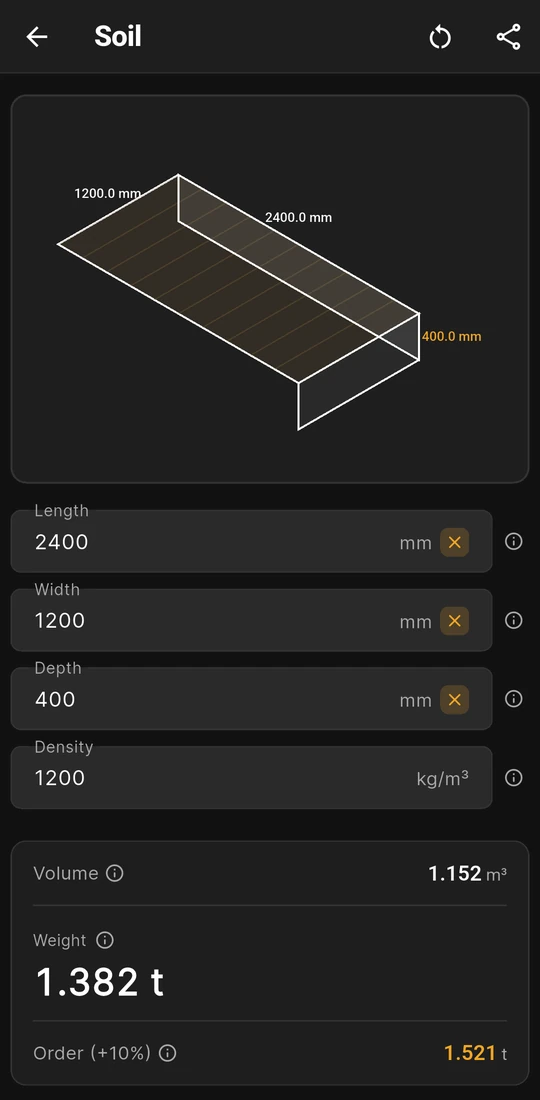
A raised bed filled 400 mm deep: 1.152 m³
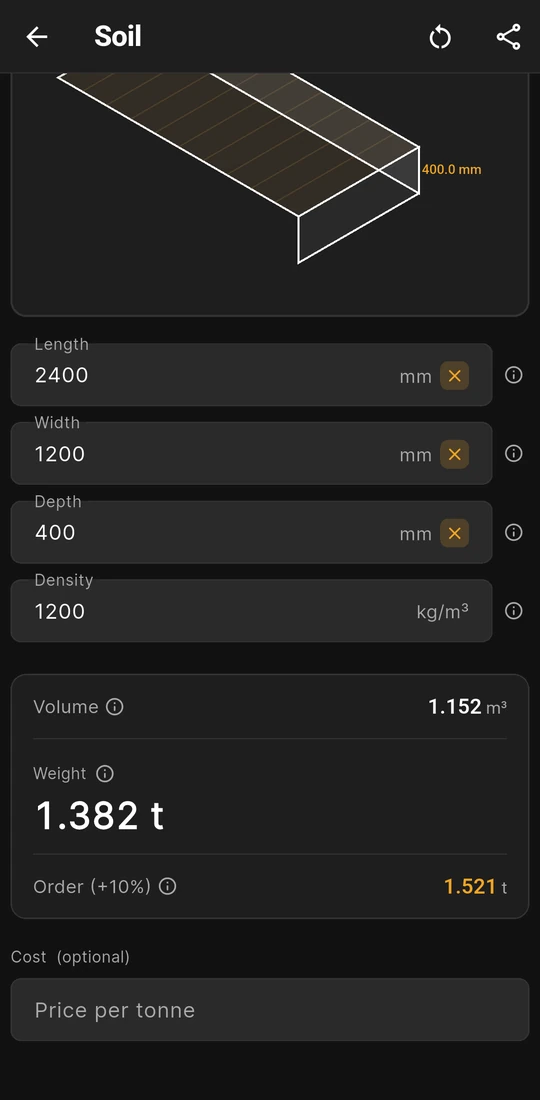
Under the results: Price per tonne


What the Soil calculator works out
Soil turns a rectangle and a depth into the amount of soil that fills it: a raised bed or garden bed, a lawn to top-dress, a hole to backfill, or the spoil that comes out when you dig for a slab or a path. Open Home ▸ Soil.
| Field | Input or result | For soil |
|---|---|---|
| Length | Input | The long side of the bed, lawn or dig. |
| Width | Input | The short side. Split a curved bed into rectangles. |
| Depth | Input | How deep you fill, or how deep you dig. |
| Density | Input | Starts at 1200 kg/m³, which the ⓘ note calls a medium loam. |
| Volume | Result | Cubic metres, to three decimal places. Often the unit a landscape yard sells in. |
| Weight | Result | Volume × Density ÷ 1000, in tonnes. The large figure on the card. |
| Order (+10%) | Result | Weight × 1.10, in tonnes, for settling and spill. |
Soil shares one screen design with Gravel and Asphalt but keeps its own last sizes and its own density, so a figure you set for your garden mix stays on Soil and doesn't change the other two.
Worked example: filling a 2400 × 1200 mm bed to 400 mm
This is the bed from how much soil or topsoil do I need?, and the two screens above show it in the app. The sides are 450 mm high and the soil stops at 400 mm, a little under the rim, at the starting density.
- Volume: 2.4 m × 1.2 m × 0.4 m = 1.152 m³, which the app shows as Volume 1.152 m³.
- Weight: 1.152 × 1200 ÷ 1000 = 1.3824 t, shown as Weight 1.382 t.
- Order: 1.3824 × 1.10 = 1.52064 t, shown as Order (+10%) 1.521 t.
If the yard sells by volume, the Order row is the wrong one to read, because it is in tonnes. Put the margin on the Volume instead: 1.152 × 1.10 is about 1.27 m³.
Buying soil: by the cubic metre, the bag or the tonne
- By volume. Many suppliers sell topsoil by the cubic metre or in bulk bags, so Volume may be all you need. Australian jobs work soil in cubic metres, as the Australia guide notes.
- By weight. When the docket is in tonnes, type the supplier's density first. Soil is not one product: dry, damp, loose and settled soil weigh differently, and so do sandy and clay-rich blends, so 1200 is only somewhere to start.
- By the trailer. A trailer runs out of payload before it runs out of room. At 1200 kg/m³, a 6x4 rated for 500 kg carries 0.417 m³, and one rated for 369 kg carries 0.308 m³, so count the trips from the Weight row. The sums are in how many cubic metres does a trailer or box trailer hold?
The cost line is priced per tonne: Total Cost is the Weight × Price per tonne, and the Wastage slider (0 to 30%, starting at 10%) gives Cost + 10% Waste. If your yard quotes per cubic metre, multiply the Volume by that price instead.
Soil that comes out of a dig
Soil works the other way round too. Enter the plan size of the hole and the depth you dig, and Volume is the soil as it sits in the ground, with Weight at your density. Calculators for concreters works a shed-slab dig like this: 3.6 × 3.0 × 0.15 = 1.620 m³ over the slab area, or 1.944 t at 1200 kg/m³. Dug soil takes up more room loose than it did in the ground, and the app has no bulking setting, so ask the skip or truck hire how they measure a load before you book by volume. A trench is the same sum; trench volume and backfill covers it.
What you see on the screen
- A drawing that shows the depth. The bed is drawn as a 3D box with a soil-brown top, so a 400 mm bed reads as a deep box and a thin top dressing as a flat sheet. The length and width sit on the edges and the depth is in amber.
- The ⓘ notes say to use the compacted depth, not the loose one, and that density changes with moisture and particle size.
- Feet and inches for the sizes, with Settings ▸ Units ▸ Default units ▸ Imperial (ft/in). Density stays in kg/m³ and the results stay in cubic metres and metric tonnes.
- Share results as text or PDF, with the sizes, the density, the three results and any cost.
Is the Soil calculator free?
No. Soil comes with Pro. You can open it without Pro, type the bed and see it drawn, but the results stay blurred until you unlock. Concrete, Stairs and Check Square are the three free ones. Pro is a subscription or a one-time lifetime unlock that opens the other 13; Google Play shows the plans and prices in your currency.
Soil by country
| Country | What the site's guides say | Guide |
|---|---|---|
| United Kingdom | The RHS says 30 cm suits salad leaves, strawberries and dwarf bulbs, and most plants, fruit bushes and shrubs especially, need 45 cm or more. It suggests 7 parts topsoil, 3 organic matter and 2 sharp sand, filled to about 5 cm below the rim. A trailer's maximum authorised mass is on its plate. | soil, trailers |
| Australia | Soil in cubic metres; gravel and road base in tonnes. Trailer limits come from your state road authority. | Australia, trailers |
| New Zealand | A tonne is 1000 kg, as on the app's card. Trailer limits come from Waka Kotahi (NZTA). | tonne or ton, trailers |
| United States | American pages quote tons, a different unit from the app's metric tonnes. | tonne or ton |
Where soil is fill under a slab, a path or a building, the depth and compaction come from the engineer, and the local council, building consent authority, building control or certifier decides what is acceptable.
Rules in more detail: building codes by country, from Australia's NCC to New Zealand's Building Code, England's Approved Documents and the US IRC.
Questions about Soil
Can it split topsoil, compost and sand for a raised bed?
No, it works one material at a time. Run the bed once for the total Volume and split it by hand; the soil guide works the RHS 7 : 3 : 2 mix. If you buy each part by weight, run Soil again for each part with that product's density.
Is 10% enough for settling?
Order (+10%) is the app's fixed rule of thumb, and a deep bed of compost-rich mix can drop more once it is watered and firmed. The RHS advice is to firm the soil, wait a couple of weeks and top up, so plan a small second load rather than one large guess.
How do I work out a lawn top dressing?
Enter the lawn's length and width and the thin Depth from the product label or your supplier. At a few millimetres the depth decides almost everything, so measure the area carefully and read the Volume row if the dressing is sold by volume.
What density should I use for wet clay or dug spoil?
The figure from your supplier or carrier. The app's 1200 kg/m³ is a starting value, and wet or clay-rich soil weighs more. Density takes 100 to 5000 kg/m³; outside that range no result shows, and an empty field is worked at 1200.
Can I use Soil for mulch, compost or sand?
Yes. Type that product's density and the Weight follows; the Volume doesn't depend on the density at all. Any of the three bulk calculators works, but Soil keeps its own density, so use it for the material you buy most.
Guides that go deeper
- How much soil or topsoil do I need?
- How do I convert cubic metres to tonnes for gravel, soil and sand?
- How many cubic metres does a trailer or box trailer hold?
- How do you calculate the volume of a trench and the gravel or backfill for it?
- How do you convert square metres to cubic metres?
Get MeisterCalc
MeisterCalc runs on Android 7.0 or later and works every sum out on the phone, so Soil works with no signal in the garden or the paddock. Soil comes with Pro.