What is the 2R + G stair formula, and how do I use it?
Published · Updated · By Sai Nath
2R + G means twice the riser plus the going. For a comfortable step the total comes to about 600 mm, so a 240 mm going suits a 180 mm riser. It is a comfort rule: the NCC and Approved Document K each give a 550 to 700 mm band.
What do R, G and T stand for?
R is the riser, the height of one step. G is the going, the depth of one tread measured nosing to nosing. Some sources write the rule as 2R + T, with T for tread. On most stairs T and G are the same number. If treads overlap, the going is the nosing-to-nosing distance, so use that one.
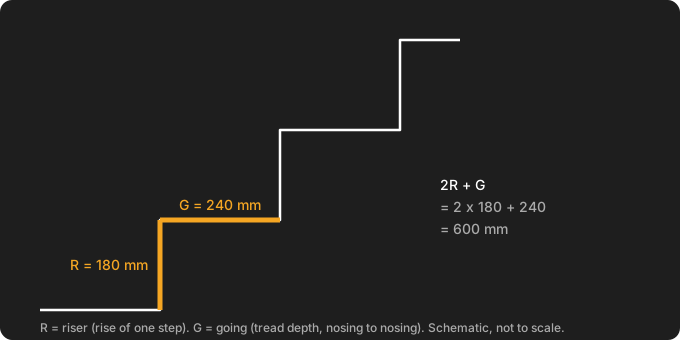
How do I use the formula?
You can work in either direction. Millimetres first, with inches in brackets.
| You know | Work out | Formula |
|---|---|---|
| The going G | The riser R | R = (600 − G) ÷ 2 |
| The riser R | The going G | G = 600 − 2R |
| Both | The check | 2R + G, aiming for about 600 mm |
Two quick sums. From a 250 mm going: R = (600 − 250) ÷ 2 = 175 mm. From a 175 mm riser: G = 600 − 2 × 175 = 250 mm. Check: 2 × 175 + 250 = 600 mm.
As treads get deeper, risers get shorter. That is the point of the rule: a stair with a high riser needs a short going to feel natural, and a long going needs a low riser. A 600 mm total is about 23.6 in (600 ÷ 25.4), but see the imperial section below before using inch rules of thumb.
How do I turn it into a riser count for a real floor height?
The formula gives a target riser. A real floor height will not divide into it exactly, so you round the count and then share the height equally. The steps:
- Measure floor to floor, finished surface to finished surface.
- Pick a going.
- Target riser = (600 − going) ÷ 2.
- Risers = height ÷ target riser, rounded to the nearest whole number.
- Actual riser = height ÷ risers. Treads = risers − 1.
The full method for a 2.4, 2.7 and 3 m floor height is in how many steps for a floor height.
Worked example: three goings on a 2700 mm rise
| Going | Target riser | 2700 ÷ target | Risers | Actual riser | 2R + G |
|---|---|---|---|---|---|
| 240 mm | 180 mm | 15.00 | 15 | 180.0 mm | 600.0 mm |
| 260 mm | 170 mm | 15.88 | 16 | 168.75 mm | 597.5 mm |
| 300 mm | 150 mm | 18.00 | 18 | 150.0 mm | 600.0 mm |
The 260 mm row shows why the total is "about" 600. Rounding 15.88 up to 16 lowers the riser to 168.75 mm, so 2R + G lands at 597.5 mm, still close. The 300 mm row needs 18 risers, which is the most the NCC allows in one flight (see below), so a deeper going on this rise leaves no spare.
Is 2R + G a legal requirement or a comfort rule?
The 600 mm target is a comfort guide. The NCC lists 550 to 700 mm as a limit, and Approved Document K gives it as the normal relationship, and each text sets riser and going limits as well. Checked on 28 October 2026. Your council or certifier decides what applies to your job.
- Australia (NCC 2022 Housing Provisions, clause 11.2.2). Table 11.2.2a lists, for stairs other than spiral, a riser of 115 to 190 mm, a going of 240 to 355 mm and a slope relationship 2R + G of 550 to 700 mm. A flight has 2 to 18 risers. Source: NCC 2022 Housing Provisions, Part 11.2.
- England (Approved Document K, 2013 edition for use in England, Table 1.1). A private stair has a rise of 150 to 220 mm and a going of 220 to 300 mm. A note says the normal relationship is twice the rise plus the going equal to between 550 and 700 mm. Source: Approved Document K (PDF) via GOV.UK.
So a 600 mm target sits in the middle of a 550 to 700 mm band in both, but each also limits riser and going on their own. Check all three numbers, not only the total. For the full Australian set see stair rules in Australia, and for England see stair regulations in the UK. New Zealand is not covered here: read the NZ Building Code clause D1 and its Acceptable Solution at the official source.
Pages online give other bands, such as 600 to 640 mm or 63 to 65 cm. Those are different rules of thumb, not the NCC or Approved Document K figure. Always name the source before quoting a band.
Does it work in feet and inches?
Yes, as arithmetic: 600 mm is about 23.6 in. Imperial rules of thumb use their own totals, and this page does not verify any of them, so do not swap a 24 in figure in for 600 mm without checking where it comes from. MeisterCalc's Stairs calculator uses 600 mm for this rule whichever units you display.
Where does 600 mm come from?
The rule counts the rise twice and the going once, so a step that is steep needs a shallow tread and the reverse. This page has not traced where the 600 mm figure first came from to a source, so it does not name an inventor or a date. What it does say is that 600 mm sits in the middle of the 550 to 700 mm band both texts above state.
How does MeisterCalc use 2R + G?
The Stairs calculator uses 600 as a comfort target, not as a code check. Open Home ▸ Stairs.
- Rise Only: enter Total Rise and Going (the Desired Riser Height field under Advanced is not used for the count unless Riser Limited is ticked). The target riser is (600 − Going) ÷ 2, the riser count is the total rise divided by it and rounded to the nearest whole number (the Advanced option Riser Limited rounds up instead), and the actual riser is the total rise divided by that count. Rise 2700 and going 240 gives 15 risers at 180.0 mm.
- Run Only: from the total run and going it counts the treads, then estimates the riser as (600 − going) ÷ 2 and the total rise from it. Run 3360 and going 240 gives 14 treads, 15 risers and a rise of about 2700 mm.
- Rise + Run: you enter the Desired Riser Height, so the 600 formula is not used.
The calculator is free, with Concrete and Check Square. It is on Google Play for Android only. See also the metric stair calculator guide.
What this doesn't do
- It doesn't decide what is allowed. The NCC, the NZ Building Code or Approved Document K, and your council or certifier do.
- It doesn't design landings, winders or spiral stairs.
- It doesn't measure your floor height. The result is only as good as that measurement.
- It runs on Android only, works offline, and has no iPhone version yet.