How do you convert square metres to cubic metres?
Published · Updated · By Sai Nath
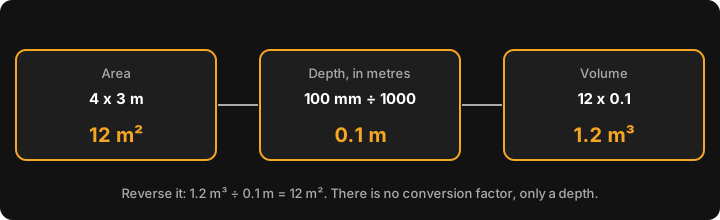
You can't convert them, because square metres measure area and cubic metres measure volume. Multiply the area in m² by the depth in metres to get m³. A 12 m² slab 100 mm deep is 12 × 0.1 = 1.2 m³. To go the other way, divide the volume by the depth.
Why is there no conversion factor?
A square metre is a unit of area and a cubic metre is a unit of volume, so they measure different things (NIST Guide to the SI, chapter 4; checked on 28 October 2026). An area tells you how far a surface spreads. A volume also needs a third measurement: how deep, thick or high it is. Any page that shows one fixed factor for "m² to m³" is hiding a depth it has quietly assumed.
That third measurement is all you need. Volume (m³) = area (m²) × depth (m). If you already have an area, you are one multiplication away. If you only have the length and width, multiply them first: see how to calculate cubic metres.
How do I work out cubic metres from square metres?
- Get the area in m². For a rectangle it is length × width in metres. A 4 m × 3 m slab is 12 m².
- Get the depth in metres. Divide millimetres by 1000. 100 mm is 0.1 m, 75 mm is 0.075 m and 50 mm is 0.05 m. Writing 0.01 for 100 mm is a tenfold mistake, so check this step twice.
- Multiply. 12 × 0.1 = 1.2 m³. That is 1,200 litres.
The same sum for a 9 m² area at 100 mm deep is 9 × 0.1 = 0.9 m³. At 150 mm it is 9 × 0.15 = 1.35 m³. Same area, different depth, different volume: that is why no single factor exists.
How many cubic metres per square metre at common depths?
Each square metre at a given depth holds that depth in metres as cubic metres. The right-hand column is the reverse: how much area one cubic metre covers.
| Depth | m³ in 1 m² | m² covered by 1 m³ |
|---|---|---|
| 50 mm | 0.05 | 20 |
| 75 mm | 0.075 | 13.33 |
| 100 mm | 0.10 | 10 |
| 125 mm | 0.125 | 8 |
| 150 mm | 0.15 | 6.67 |
| 200 mm | 0.20 | 5 |
| 300 mm | 0.30 | 3.33 |
Worked by hand: the middle column is depth ÷ 1000, the right column is 1 ÷ that. For 75 mm, 75 ÷ 1000 = 0.075 m³, and 1 ÷ 0.075 = 13.33 m². These depths are examples for the arithmetic. They are not recommendations for any job: take the depth from your plans, the engineer or your supplier.
How do I convert cubic metres to square metres?
Divide the volume by the depth in metres: area (m²) = volume (m³) ÷ depth (m). The answer only means something for a stated depth. One cubic metre covers 10 m² at 100 mm, but 20 m² at 50 mm and 6.67 m² at 150 mm.
So "how many square metres does a cubic metre cover?" has no single answer either. Pick the depth, then read the table. For 2.4 m³ of material laid 75 mm deep: 2.4 ÷ 0.075 = 32 m².
Three worked jobs
A concrete slab
A 4 m × 3 m slab is 12 m². At 100 mm, 12 × 0.1 = 1.2 m³. Add 10% for low spots and spillage and order 1.32 m³. The full walk-through, with sizes for paths and driveways, is in how much concrete do I need.
A gravel path
A path 10 m long and 3 m wide is 30 m². At 75 mm deep that is 30 × 0.075 = 2.25 m³. Gravel is sold by weight, so volume is not the end of the sum. At 1,500 kg/m³, 2.25 m³ weighs 2.25 × 1,500 ÷ 1,000 = 3.375 tonnes. The density changes with the material and how wet it is, so use your supplier's figure: see converting cubic metres to tonnes.
A topsoil bed
A garden area of 40 m² covered 50 mm deep is 40 × 0.05 = 2.0 m³. At 1,200 kg/m³ that is 2.4 tonnes. Both the depth and the density here are example numbers for the arithmetic, not advice for your garden.
What mistakes go wrong most often?
- Forgetting millimetres to metres. 100 mm is 0.1 m, not 100 and not 0.01.
- Using area as volume. Ordering "12 cubic metres" for a 12 m² slab is ten times too much at 100 mm.
- Ordering the exact figure. A base is rarely a perfect box. Allow extra and ask your supplier how much.
- Mixing up m³ and tonnes. Cubic metres are space. Gravel and soil are sold by weight, so you need a density as well.
- One depth reading on uneven ground. Measure the depth at several points and use the average.
Doing it in MeisterCalc
The Concrete, Gravel and Soil calculators take length, width and depth, not a ready-made area. They work in millimetres by default and add a fixed 10% in the Order (+10%) row.
- Open Concrete on the home screen (Home ▸ Concrete ▸ Slab). For gravel or soil, open Gravel or Soil.
- Enter Length, Width and Depth in millimetres. For the slab above: 4000, 3000 and 100.
- Read the result: Volume 1.200 m³, Volume 1200.0 L and Order (+10%) 1.320 m³. Gravel shows Volume, Weight in tonnes and Order (+10%) in tonnes.
If all you have is a finished area, type the area in square metres as the length (12 m² is 12000 mm) and 1000 mm as the width: the sum is the same. Check the result against your hand sum.
What the calculators don't do
- There is no square-metres-to-cubic-metres converter and no cubic-metres-to-square-metres mode. The app multiplies the three numbers you enter.
- There is no depth table in the app. The table above is worked by hand.
- The 10% allowance is fixed. Depth, thickness and reinforcement are not set by the app: they come from your plans, the engineer and the National Construction Code or your local rules.
Concrete, Stairs and Check Square are the free calculators. Gravel and Soil are among the others, which unlock with a weekly subscription (3-day free trial) or a one-time lifetime unlock, priced by Google Play. Calculations work offline, on Android 7.0 or later. There is no iPhone version yet.
Sources
- NIST Guide to the SI, chapter 4: the square metre as the SI unit of area and the cubic metre as the SI unit of volume. Checked on 28 October 2026.