How many 20 kg bags of concrete make a cubic metre?
Published · Updated · By Sai Nath
It depends on the product. Boral's sheet says 108 bags of its 20 kg Concrete Mix make one cubic metre, and Cement Australia says about 110 bags of its 20 kg PROStrength Extra Strength Concrete Mix. Cement Australia's standard 20 kg Concrete Mix works out at about 119 from its stated coverage. Read the yield on your bag.
How many 20 kg bags make 1 m³?
The formula is bags = 1,000 ÷ litres per bag, rounded up, because a cubic metre is 1,000 litres. Where a maker prints bags per cubic metre, use that figure as it stands. This page is about premixed bags (cement, sand and aggregate already blended), not bags of cement alone. Here is what each maker's own sheet says, checked on 28 October 2026:
| Product and bag (maker's sheet) | What the sheet says | Bags per m³ | Litres a bag |
|---|---|---|---|
| Boral Concrete Mix, 20 kg (Australia) | “108 x 20kg bags equates to one cubic metre of mixed concrete” | 108 | about 9.3 |
| Cement Australia PROStrength Extra Strength Concrete Mix, 20 kg (Australia) | “Approximately 110 x 20kg bags are required per cubic metre” | about 110 | about 9.1 |
| Cement Australia Concrete Mix, 20 kg (Australia) | “2 x 20kg bags cover a 450x500mm slab approximately (75mm thickness)” | about 119 (worked out below) | about 8.4 |
| Dricon HandiCrete, 25 kg (New Zealand) | 0.010 m³, “approximate yield per bag” | 100 | 10 |
| Dricon HandiCrete, 40 kg (New Zealand) | 0.016 m³, “approximate yield per bag” | 62.5 | 16 |
| Heidelberg Materials 40N Concrete, MaxiPack20 (UK) | Yield 0.008 m³ per pack | 125 | 8 |
Litres a bag is 1,000 ÷ bags per m³, or the stated yield in m³ × 1,000. Every figure is the maker's approximation for its own product mixed as its instructions say; another brand, or the same brand's rapid-set or high-strength mix, can differ. The concrete calculator in m³ counts bags for the five products that print a yield.
How do I count bags when the sheet only gives coverage?
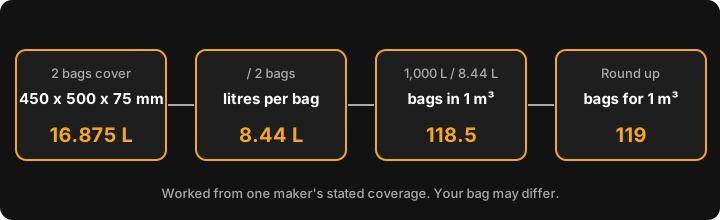
Work the litres out from the coverage. Cement Australia's Concrete Mix 20 kg product sheet says "2 x 20kg bags cover a 450x500mm slab approximately (75mm thickness)". That is 0.45 × 0.5 × 0.075 = 0.016875 m³ for two bags, or 8.44 litres a bag. Then 1,000 ÷ 8.44 = 118.5, so 119 bags of Cement Australia Concrete Mix 20 kg for a cubic metre. The maker states the coverage as approximate and doesn't print a litres-per-bag figure, so treat 119 as an estimate.
Why is there no single number?
Each product has its own yield, so "100 bags" or "120 bags" is right only for the bag it was worked from. A cubic metre takes 108 bags of Boral Concrete Mix 20 kg, about 110 of Cement Australia PROStrength 20 kg or about 119 of Cement Australia Concrete Mix 20 kg. The gap between the first and the last is 11 bags, a tenth more to carry and mix. Bag size moves the count further: a cubic metre is 62.5 bags of Dricon HandiCrete 40 kg. How wet you mix it changes the figure again. If your bag prints a yield, use it. If it only gives coverage, work out the litres as above.
How do I work out the number of bags?
- Find the volume you need in cubic metres. For a slab it is length × width × depth in metres. See how much concrete you need for the volume step.
- Find the yield on the bag or the maker's data sheet: bags per m³, litres or m³ per bag, or coverage. If you only have coverage, divide the volume it covers by the number of bags.
- Divide. Volume in litres ÷ litres per bag, or cubic metres × bags per m³.
- Add 10 percent for spillage, an uneven base and over-dig.
- Round up to whole bags.
How many bags for 0.1, 0.25, 0.5 and 1 m³?
For the three Australian 20 kg bags above, rounded up, with the count after a 10 percent allowance in brackets. As a sum, 0.25 m³ of Boral Concrete Mix is 0.25 × 108 = 27 bags, and with 10 percent 0.275 × 108 = 29.7, which rounds up to 30:
| Volume | Boral Concrete Mix 20 kg (108 per m³) | Cement Australia PROStrength 20 kg (about 110 per m³) | Cement Australia Concrete Mix 20 kg (about 119 per m³) |
|---|---|---|---|
| 0.1 m³ | 11 (12) | 11 (13) | 12 (14) |
| 0.25 m³ | 27 (30) | 28 (31) | 30 (33) |
| 0.5 m³ | 54 (60) | 55 (61) | 60 (66) |
| 1 m³ | 108 (119) | 110 (121) | 119 (131) |
In New Zealand, 1 m³ is 100 bags of Dricon HandiCrete 25 kg (110 with the allowance) or 63 bags of the 40 kg size (69). In the UK it is 125 packs of Heidelberg Materials 40N Concrete MaxiPack20 (138). Each maker's sheet is linked in the first table.
How many cubic metres is one 20 kg bag?
Divide 1 by the bags per m³: 1 ÷ 108 = 0.0093 m³ for Boral, and 1 ÷ 119 = 0.0084 m³ for Cement Australia Concrete Mix. For the three Australian 20 kg bags above that gives 0.0084 to 0.0093 m³. By the makers' figures, a bag of Boral Concrete Mix 20 kg makes about 9.3 litres, Cement Australia PROStrength 20 kg about 9.1 litres and Cement Australia Concrete Mix 20 kg about 8.4 litres. Divide the litres by 1,000 to turn them into cubic metres. Each figure is for that product only.
Worked job: a slab and post holes
A slab 4.0 m × 3.0 m × 100 mm is 4 × 3 × 0.1 = 1.20 m³. With 10 percent it is 1.32 m³, or 1,320 litres. In Boral Concrete Mix 20 kg (108 bags per m³) that is 1.32 × 108 = 142.6, so 143 bags. In Cement Australia Concrete Mix 20 kg (8.44 litres a bag) it is 1,320 ÷ 8.44 = 156.4, so 157 bags. Either way it is close to 3 tonnes of bagged mix to lift and mix: 143 × 20 kg = 2,860 kg.
The app stops at the volume. Multiply its Order (+10%) figure by your bag's bags per m³, or divide its litres by the litres a bag makes, as above.
Six post holes, 300 mm across and 800 mm deep, come to 0.3393 m³, or 0.3732 m³ with 10 percent. That is 0.3732 × 108 = 40.3, so 41 bags of Boral Concrete Mix 20 kg, or 0.3732 × 100 = 37.3, so 38 bags of Dricon HandiCrete 25 kg. For holes in particular, see concrete for post holes. Footings are worked the same way: strip footing concrete.
Do 25 kg and 40 kg bags change the answer?
Yes. A heavier bag makes proportionally more concrete, so you need fewer bags, while the total weight of dry mix stays about the same. Dricon's sheet gives 0.010 m³ for a 25 kg bag of HandiCrete and 0.016 m³ for a 40 kg bag: 1 ÷ 0.010 = 100 bags or 1 ÷ 0.016 = 62.5 bags per m³, which is 100 × 25 = 62.5 × 40 = 2,500 kg either way. This page doesn't give a yield for a 30 kg bag. Use the same method with the figure printed on that bag.
When do bags stop making sense?
108 bags of Boral Concrete Mix 20 kg is 2,160 kg, over 2 tonnes, to carry, tear open and mix for one cubic metre, and each batch can differ a little in water. For a cubic metre or more, a slab that must be poured in one go, or a site where you can't get a mixer, price a ready-mix delivery as well. There is no cut-off figure here, because it depends on access, helpers and what your supplier charges; ask for both quotes. For weights of other materials see cubic metres to tonnes.
What about bags of cement per m³?
That is a different calculation. Cement-only bags depend on the mix ratio of cement, sand and aggregate, and MeisterCalc has no mix-ratio mode. Work from the ratio your engineer or the bag specifies.
Doing it in MeisterCalc
- Open Concrete on the home screen. It is one of the free calculators.
- Choose Slab or Holes.
- Enter Length, Width and Depth in millimetres (or Diameter, Depth and Number of Holes).
- Read Order (+10%) in m³. Slab also shows the volume in litres; Holes shows Per Hole and Total.
- Divide the litres by your bag's yield, or multiply the cubic metres by its bags per m³.
The 4000 × 3000 × 100 mm slab gives Volume 1.200 m³, Volume 1200.0 L and Order (+10%) 1.320 m³. The app doesn't count bags: it gives the volume and you apply the yield of your bag. Calculations work offline, on Android 7.0 or later. The concrete calculator in m³ page covers the same volumes and counts bags for the products in the first table that print a yield.
Sources
- Boral, Concrete Mix product data sheet (PDF): 108 x 20 kg bags to one cubic metre. Checked on 28 October 2026.
- Cement Australia, PROStrength Extra Strength Concrete Mix sheet (PDF): approximately 110 x 20 kg bags per cubic metre. Checked on 28 October 2026.
- Cement Australia, Concrete Mix 20 kg product sheet (PDF): coverage of two bags. Checked on 28 October 2026.
- Cement Australia, Concrete Mix product page: 20 kg size. Checked on 28 October 2026.
- Dricon, HandiCrete technical data sheet (PDF): approximate yield 0.010 m³ per 25 kg bag and 0.016 m³ per 40 kg bag. Checked on 28 October 2026.
- Heidelberg Materials, 40N Concrete technical data sheet (PDF): yield 0.008 m³ per MaxiPack20. Checked on 28 October 2026.
Yields vary by product. Read your own bag, and follow your local council and the NCC or building code for structural concrete.