How do I calculate roof pitch in degrees?
Published · Updated · By Sai Nath
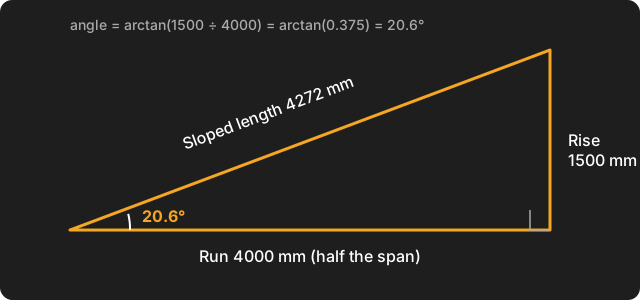
Divide the rise by the run, then take the arctan of the answer on a calculator. The run is the horizontal distance, not the sloped length. A rise of 1500 mm over a run of 4000 mm gives 1500 ÷ 4000 = 0.375, and arctan 0.375 is 20.6°.
How to calculate roof pitch in degrees
The steps are the same for a gable, a hip or a skillion. Only the run changes (see the next section). The example is a gable roof on a building 8000 mm wide, with the ridge 1500 mm above the top of the wall plate.
- Find the rise. This is the vertical height from the top of the wall plate to the underside of the ridge or the high point: 1500 mm.
- Find the run. This is the horizontal distance the roof covers over that rise. On a gable it is half the span: 8000 ÷ 2 = 4000 mm.
- Divide rise by run. 1500 ÷ 4000 = 0.375. This is the slope as a ratio.
- Take the arctan. On a phone or scientific calculator set to degrees, press tan⁻¹ (or atan) of 0.375. The answer is 20.56°, or 20.6°.
- Check it back. tan 20.56° × 4000 mm = 1500 mm. If that gives your rise, the angle is right.
Which run do I use: half the span or the full width?
Use the horizontal distance from the outside of the wall to the point directly under the high point of that roof slope. On a gable or hip roof that is half the building width, because the ridge sits in the middle. On a skillion (single-slope) roof it is the full width, because the roof rises across the whole building. Mixing these up is the most common reason two people get different angles for the same roof. The skillion roof pitch guide covers the single-slope case in more detail.
Some sources use "pitch" for rise ÷ full span and "slope" for rise ÷ run, which is why a 1-in-6 pitch is the same roof as a 1-in-3 slope. Wikipedia sets out the pitch and slope definitions. This page uses rise ÷ run throughout, because that is the number that gives the angle.
Why must the run be horizontal?
Angle = arctan(rise ÷ run) only works when the run is measured level. If you divide the rise by the length along the rafter instead, you have the sine of the angle, not the tangent, and the answer comes out too small. For the same roof, 1500 ÷ 4272 = 0.351 and arctan of that is 19.3°, a full degree and a bit under the true 20.6°. If you do know the sloped length, use arcsin(rise ÷ sloped length) and you get 20.6° again.
How do I calculate roof pitch with rise and run in metres?
Convert everything to the same unit first, then divide. Rise 1.5 m and run 4 m give the same 0.375 as 1500 and 4000 mm. The units cancel, so metres, millimetres and feet all work as long as rise and run match. A skillion example: run 3000 mm, rise 450 mm.
- 450 ÷ 3000 = 0.15.
- arctan 0.15 = 8.53°.
- As a percentage, 0.15 × 100 = 15%. As X/12, 0.15 × 12 = 1.8 in 12.
How do I measure roof pitch when I can't reach the ridge?
Measure the slope with a level and tape, then convert. You don't need the full rise and run.
- From inside the roof space (or on the roof), hold a 1 m level against the underside of a rafter, with one end touching the rafter.
- Level it with the bubble. The level is now your horizontal run: 1000 mm.
- Measure straight down (or up) from the far end of the level to the rafter. Say it reads 375 mm.
- That reading is the rise per 1000 mm of run, so the slope is 375 ÷ 1000 = 0.375, the same as the example above, and the angle is arctan 0.375 = 20.6°.
Measuring over a longer level, say 2000 mm, is fine too: divide the rise by the length of level you used. The longer the level, the smaller the effect of a reading that's a few millimetres out. For the same checks from the other direction, see converting roof pitch to degrees.
How do I convert degrees to X/12, per cent and mm per metre?
All of them are the same slope written differently. Rise per metre of run = tan(angle) × 1000 mm. Per cent = tan(angle) × 100. X/12 = tan(angle) × 12. Going the other way, take the arctan of the ratio. Some common angles:
| Angle | Rise per 1000 mm run | Per cent | X/12 |
|---|---|---|---|
| 15° | 268 mm | 26.8% | 3.2 |
| 22.5° | 414 mm | 41.4% | 5.0 |
| 25° | 466 mm | 46.6% | 5.6 |
| 30° | 577 mm | 57.7% | 6.9 |
| 35° | 700 mm | 70.0% | 8.4 |
| 40° | 839 mm | 83.9% | 10.1 |
| 45° | 1000 mm | 100% | 12.0 |
A few from the pitch side: 4/12 is 18.4°, 6/12 is 26.6° and 12/12 is 45°. A rise of 1 in 3 is also 18.4° and 1 in 2 is 26.6°. A pitch in feet and inches (like 4/12) converts the same way: divide 4 by 12 to get 0.333, then arctan. The roof pitch to degrees page has the full conversions in both directions.
Worked both ways for 30°: tan 30° = 0.5774, so the rise per 1000 mm of run is 0.5774 × 1000 = 577 mm, the grade is 0.5774 × 100 = 57.7% and the X/12 pitch is 0.5774 × 12 = 6.93 in 12. Back again for 4/12: 4 ÷ 12 = 0.3333, and arctan 0.3333 = 18.43°.
Can I find the rafter length from the pitch?
The sloped length of the triangle is √(rise² + run²). For the 1500 × 4000 mm example, that is √(1500² + 4000²) = 4272 mm. That is the line from the eave to the ridge along the roof surface, not a cut length: it does not include the overhang, the ridge thickness or any birdsmouth. Rafter length from pitch goes through how to get to a usable length.
Doing it in MeisterCalc
The Pitch calculator solves the rest from any two of Rise, Run, Pitch (X/12), Angle and % Grade. You choose which two you know from a row of modes (Rise + Run, Run + Angle, Angle + Pitch and so on), then type them in.
- Open MeisterCalc and tap Pitch on the home screen, then pick the Rise + Run mode.
- Enter Rise 1500 and Run 4000 (millimetres by default).
- Read the results: Pitch 4-1/2" (that is 4.5 in 12), Angle 20.56°, % Grade 37.50%, Slope Ratio 0.3750 and Hypotenuse 4272.0 mm. A live triangle diagram redraws as you type.
- To work backwards, pick the Run + Angle mode and enter Angle 30 and Run 1000 instead. The Rise comes out at 577.4 mm and the Pitch at 6-15/16" (about 6.9 in 12).
In the modes that pair two ratio-style values (Angle + Pitch, Angle + % Grade, Pitch + % Grade), the app uses a 1000 mm run as a reference so the diagram still draws, and the Hypotenuse is only meaningful when you've entered a Rise or Run. The Angle must be above 0° and below 90°, and Rise, Run and % Grade must be above zero. For feet and inches, go to Settings ▸ Units ▸ Default units ▸ Imperial (ft/in); Rise, Run and the Hypotenuse then show in feet, inches and fractions of an inch.
Pitch is one of the calculators that unlocks with a subscription or lifetime unlock; Concrete, Stairs and Check Square are the free ones. It works offline. A comparison with other roof pitch apps is in roof pitch calculator app. If you're setting out the frame under the roof as well, how to check if a frame is square covers the diagonals.
What MeisterCalc's Pitch calculator doesn't do
- It doesn't measure the roof. You still take the rise and run (or an angle) on site, and the answer is only as good as those readings.
- It gives the sloped length of the triangle only. It has no rafter, hip, valley or birdsmouth cuts, and no roof area.
- It doesn't say what pitch a roof must have. Minimum pitches for a roofing material come from the manufacturer's installation instructions, and building rules come from the National Construction Code (NCC) in Australia, the NZ Building Code in New Zealand or the Approved Documents in the UK, together with your local council. Check the NCC on the ABCB website or ask your certifier before you order materials.
- It is Android only, with an English interface.
Try it
MeisterCalc works offline, on site with no signal, on Android 7.0 or later. Check Square, Stairs and Concrete are free to use; the other 12 calculators, including Pitch, unlock with a weekly subscription that starts with a 3-day free trial, or a one-time lifetime unlock. Google Play shows the prices in your currency. There's no iPhone version yet; you can join the iOS waitlist.