How many steps do I need for a 2.7 m or 3 m floor height?
Published · Updated · By Sai Nath
A 2.7 m floor-to-floor height takes 15 risers of 180 mm, which means 14 treads. A 3.0 m height takes 17 risers of about 176.5 mm (16 treads), or 16 risers of 187.5 mm if you want fewer steps. Divide the height by 175 mm, round to a whole number, then divide the height by that number.
How many steps for 2.4 m, 2.7 m, 3 m and 10 ft?
These counts use a 250 mm going and a target riser of 175 mm, the comfort rule explained below. The riser is the measured height divided by the number of risers, so every riser is the same.
| Floor to floor | Risers | Each riser | Treads |
|---|---|---|---|
| 2400 mm (94.5 in) | 14 | 171.4 mm | 13 |
| 2700 mm (106.3 in) | 15 | 180.0 mm | 14 |
| 3000 mm (118.1 in) | 17 | 176.5 mm | 16 |
| 3048 mm (10 ft) | 17 | 179.3 mm | 16 |
Check two rows by hand. 2400 mm: 2400 ÷ 175 = 13.71, so 14 risers; 2400 ÷ 14 = 171.4 mm; treads 14 − 1 = 13. 3048 mm: 3048 ÷ 175 = 17.42, so 17 risers; 3048 ÷ 17 = 179.3 mm; treads 17 − 1 = 16.
Many people say "steps" or "stairs" for risers, and some count treads. The count that matters for the build is risers, so ask which one a number means. Four metres is a different problem, covered under the limits below.
How do I calculate the number of risers?
- Measure floor to floor. Take the height from the top of the lower finished floor to the top of the upper finished floor. That includes the joists, the subfloor and the floor finish. It is not the ceiling height and not the wall height.
- Pick a going. The going is the depth of one tread, measured nosing to nosing (what the going is). 250 mm is a common choice.
- Work out the target riser. (600 − going) ÷ 2. For a 250 mm going that is 175 mm.
- Divide and round. Height ÷ target riser, rounded to the nearest whole number. That is the number of risers.
- Divide again. Height ÷ number of risers is the actual riser. Check that rise × number of risers gives the height back.
- Count the treads. There is one fewer tread than risers.
Worked example: a 2.7 m floor height
- Going 250 mm, so the target riser is (600 − 250) ÷ 2 = 175 mm.
- 2700 ÷ 175 = 15.43, which rounds to 15 risers.
- 2700 ÷ 15 = 180.0 mm per riser. Check: 15 × 180 = 2700.
- Treads: 15 − 1 = 14.
A bonus check: twice the riser plus the going is 2 × 180 + 250 = 610 mm, inside the 550 to 700 mm band both the NCC and Approved Document K use for the relationship between riser and going (sources below).
Worked example: a 3 m floor height, and why it is 16 or 17
3000 ÷ 175 = 17.14, which rounds to 17 risers of 3000 ÷ 17 = 176.5 mm, with 16 treads. That is the comfortable answer.
If you divide by a maximum riser instead, you round up. With a 190 mm limit, 3000 ÷ 190 = 15.79, so 16 risers of 187.5 mm. That is under the 190 mm NCC riser maximum but close to it, and a steeper stair. Choose it only when the space is tight.
The rounding trap: 10 ft is 3048 mm, and 3048 ÷ 190 = 16.04. That rounds up to 17, so 48 mm of extra height adds a whole step. When the division lands just over a whole number, check it twice and decide on purpose.
Why is there one more riser than treads?
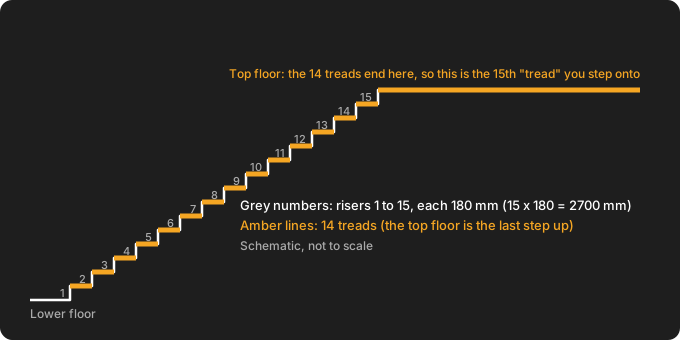
Each riser is a vertical step up and each tread is the flat part you stand on. The top floor is the last surface you step onto, and it already exists, so you do not build a tread for it. Fifteen risers need only 14 treads between the two floors.
What do the rules limit?
Checked on 28 October 2026. Rules differ by country, and the council or building certifier decides what applies to your job. Always name the jurisdiction before quoting a figure.
- Australia (NCC 2022 Housing Provisions, clause 11.2.2). For a stair that is not spiral, Table 11.2.2a gives a riser of 115 to 190 mm, a going of 240 to 355 mm and 2R + G of 550 to 700 mm. A flight has 2 to 18 risers. Adjacent risers or goings may differ by no more than 5 mm, and the largest and smallest in a flight by no more than 10 mm. Source: NCC 2022 Housing Provisions, Part 11.2.
- England (Approved Document K, 2013 edition for use in England, Table 1.1). A private stair has a rise of 150 to 220 mm, a going of 220 to 300 mm and a maximum pitch of 42 degrees. Twice the rise plus the going is normally 550 to 700 mm. Source: Approved Document K (PDF) via GOV.UK.
New Zealand rules are not covered here. For NZ work, read the current NZ Building Code clause D1 and its Approved Document at the official source.
These limits shape the count. At 190 mm maximum, 2.7 m needs at least 15 risers (2700 ÷ 190 = 14.2) and 3.0 m needs at least 16. In England, 220 mm is the cap, so the count can be lower, but a taller riser needs a shorter going to stay comfortable.
What if I need more than 18 risers?
An NCC flight has at most 18 risers, so a 4 m floor height (4000 ÷ 175 = 22.9, so 23 risers) needs a landing that splits it into two flights. Landings and winders are outside what the MeisterCalc Stairs calculator designs, so lay those out by hand and check them against your rules. The sums above then apply to each flight, using the height of that flight.
How do I do it in MeisterCalc?
- Open MeisterCalc and tap Stairs on the home screen.
- Choose Rise Only, the default mode.
- Enter the Total Rise, for example 2700, and the Going, for example 250.
- Read Number of Risers (15), Actual Riser Height (180.0 mm) and Number of Treads (14). A live diagram updates as you type.
- To always round the riser count up from a maximum riser, expand Advanced, set the Desired Riser Height and tick Riser Limited. With 190 mm, 3000 gives 16 risers of 187.5 mm.
The same screen shows the stairwell opening (see stairwell opening size), from the floor or joist thickness and the headroom you enter. For feet, inches and sixteenths go to Settings ▸ Units ▸ Default units ▸ Imperial (ft/in). More on the method is in the 2R + G formula guide.
What this doesn't do
- It doesn't measure the floor height. The answer is only as good as your floor-to-floor measurement.
- It doesn't design landings, winders or spiral stairs.
- It doesn't decide what is allowed. The NCC, the NZ Building Code or Approved Document K, and your local council or certifier do.
- It is Android only, on Android 7.0 or later, and works offline. There is no iPhone version yet.
Try it
Stairs is one of three MeisterCalc calculators that are free to use, along with Concrete and Check Square. The other 12 unlock with a weekly subscription that starts with a 3-day free trial, or with a one-time lifetime unlock; Google Play shows the prices in your currency. You can join the iOS waitlist.