What is a roof pitch in degrees? (X/12 and 1:X conversion chart)
Published · Updated · By Sai Nath
A roof pitch in degrees is the angle whose tangent is rise ÷ run: angle = arctan(rise ÷ run). A 4/12 pitch is 18.43°, a 6/12 pitch is 26.57° and a 12/12 pitch is 45°. The run is the horizontal distance, not the length of the rafter.
Roof pitch to degrees chart: X/12 to degrees, per cent and mm per metre
Each row is one pitch written four ways. The last column is the rise over 1000 mm of horizontal run, which is the number to mark on a level or a rafter template. Degrees are rounded to two decimals.
| Pitch (X/12) | Degrees | Per cent grade | Rise per 1000 mm run |
|---|---|---|---|
| 1/12 | 4.76° | 8.3% | 83 mm |
| 2/12 | 9.46° | 16.7% | 167 mm |
| 3/12 | 14.04° | 25.0% | 250 mm |
| 4/12 | 18.43° | 33.3% | 333 mm |
| 5/12 | 22.62° | 41.7% | 417 mm |
| 6/12 | 26.57° | 50.0% | 500 mm |
| 7/12 | 30.26° | 58.3% | 583 mm |
| 8/12 | 33.69° | 66.7% | 667 mm |
| 9/12 | 36.87° | 75.0% | 750 mm |
| 10/12 | 39.81° | 83.3% | 833 mm |
| 11/12 | 42.51° | 91.7% | 917 mm |
| 12/12 | 45.00° | 100.0% | 1000 mm |
What is a 4/12 pitch in degrees?
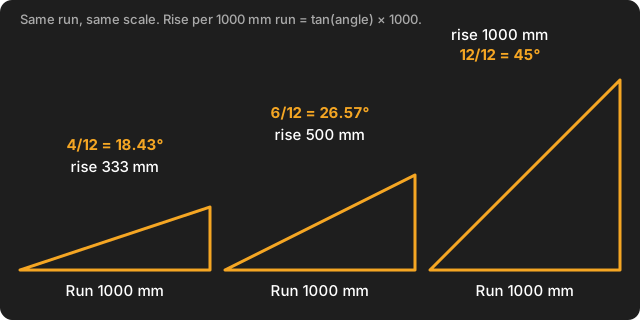
A 4/12 pitch is 18.43°. It rises 4 units for every 12 units of horizontal run, so rise ÷ run = 0.3333 and arctan(0.3333) = 18.43°. That is also a grade of 33.3%, a rise of 333 mm per metre of run, and a ratio of 1:3 (1 in 3).
What is a 6/12 pitch in degrees?
A 6/12 pitch is 26.57°. Rise ÷ run = 0.5, which is a grade of 50%, 500 mm of rise per metre of run and a ratio of 1:2. A 12/12 pitch is 45°, the point where rise equals run (1:1).
What is the formula to convert pitch to degrees?
Work out the slope, which is rise ÷ run, then take the inverse tangent of it. Use the same unit for rise and run.
- From rise and run: angle = arctan(rise ÷ run).
- From X/12: angle = arctan(X ÷ 12).
- From 1:X: angle = arctan(1 ÷ X).
- From per cent grade: angle = arctan(grade ÷ 100). The slope percentage to degrees page has that chart on its own.
A worked example: a gable 8000 mm wide has its ridge 1500 mm above the wall plate. The run is half the width, 4000 mm. Rise ÷ run = 1500 ÷ 4000 = 0.375, and arctan(0.375) = 20.56°. As an X/12 pitch that is 0.375 × 12 = 4.5/12, and as a grade it is 37.5%. The same sum for a skillion roof that rises 450 mm over a 3000 mm run gives 0.15, or 8.53°.
How do I convert degrees back to a roof pitch ratio?
Go the other way with the tangent: rise per 1000 mm of run = tan(angle) × 1000, and X/12 = tan(angle) × 12. For 30°, tan(30°) = 0.5774, so the roof rises 577 mm per metre of run, which is 6.93/12 (call it 7/12) and a grade of 57.7%. For a 1:X ratio, X = 1 ÷ tan(angle), so 30° is about 1:1.73.
| Degrees | X/12 | Per cent grade | Rise per 1000 mm run |
|---|---|---|---|
| 5° | 1.05/12 | 8.7% | 87 mm |
| 10° | 2.12/12 | 17.6% | 176 mm |
| 15° | 3.22/12 | 26.8% | 268 mm |
| 17.5° | 3.78/12 | 31.5% | 315 mm |
| 20° | 4.37/12 | 36.4% | 364 mm |
| 22.5° | 4.97/12 | 41.4% | 414 mm |
| 25° | 5.60/12 | 46.6% | 466 mm |
| 30° | 6.93/12 | 57.7% | 577 mm |
| 35° | 8.40/12 | 70.0% | 700 mm |
| 40° | 10.07/12 | 83.9% | 839 mm |
| 45° | 12.00/12 | 100.0% | 1000 mm |
What do 1:X and "1 in X" ratios convert to?
A ratio of 1:X means 1 unit of rise for every X units of run, so the slope is 1 ÷ X. You will see it written 1:3, 1 in 3 or 1/3. The first number is always the rise. Worked for 1:8: 1 ÷ 8 = 0.125, arctan(0.125) = 7.13°, the grade is 0.125 × 100 = 12.5%, the X/12 pitch is 0.125 × 12 = 1.5/12, and the rise is 0.125 × 1000 = 125 mm per metre of run.
| Ratio (1:X) | Degrees | Per cent grade | X/12 equivalent |
|---|---|---|---|
| 1:1 | 45.00° | 100.0% | 12.00/12 |
| 1:1.5 | 33.69° | 66.7% | 8.00/12 |
| 1:2 | 26.57° | 50.0% | 6.00/12 |
| 1:3 | 18.43° | 33.3% | 4.00/12 |
| 1:4 | 14.04° | 25.0% | 3.00/12 |
| 1:5 | 11.31° | 20.0% | 2.40/12 |
| 1:6 | 9.46° | 16.7% | 2.00/12 |
| 1:8 | 7.13° | 12.5% | 1.50/12 |
| 1:10 | 5.71° | 10.0% | 1.20/12 |
| 1:12 | 4.76° | 8.3% | 1.00/12 |
| 1:20 | 2.86° | 5.0% | 0.60/12 |
| 1:40 | 1.43° | 2.5% | 0.30/12 |
The gentle ratios at the bottom (1:20, 1:40) are drainage and paving falls, not roof pitches. The how to calculate roof pitch page shows how to measure a pitch you already have on site; this page is for converting one you already know.
Pitch, slope and run: why two people get different angles
The usual mistake is the run. On a gable or hip roof the ridge sits in the middle, so the run is half the building width. On a skillion (single-slope) roof it is the full width. Use the whole width on a gable and the slope comes out half as steep.
There is also a naming trap. In metric usage the "pitch" can mean rise ÷ span (the full width), while "slope" means rise ÷ run. A pitch of 1/6 is therefore a slope of 2/6 = 1/3, which is 4/12 or 18.43°. Wikipedia sets out the difference, including the rule that an imperial pitch × 24 gives X in 12 and a metric pitch × 2 gives the rise over a 1 m run: Roof pitch on Wikipedia. Checked on 28 October 2026.
When someone quotes a pitch, ask what it is measured against. Degrees and X/12 both mean rise ÷ run, so those two never need translating.
How is roof pitch usually written?
You will see roof pitch written as degrees, as X/12 (rise in inches over 12 inches of run), as a ratio such as 1:3, and as a per cent grade. They are the same measurement. The chart above is the translator, and every row gives all four.
The conversion does not tell you what pitch a roof is allowed to have. Minimum pitches depend on the roofing material and its manufacturer, and on the NCC, the NZ Building Code or the building rules where you are. Check with the manufacturer's installation guide and your local council before you set the pitch.
Doing it in MeisterCalc
The Pitch calculator solves the triangle from two known values. It has ten two-value modes (Rise + Run, Rise + Angle, Rise + Grade, Rise + Pitch, Run + Angle, Run + Grade, Run + Pitch, Angle + Grade, Angle + Pitch, Grade + Pitch), and you pick the pair you know.
- Open MeisterCalc and tap Pitch on the home screen.
- Pick a mode. For a 4/12 check, choose Rise + Run and enter 4 and 12 in the same unit, or choose Run + Pitch, enter Pitch (X/12) = 4 and any run.
- Read the result card: Pitch, Angle, % Grade, Slope Ratio and Hypotenuse. For 4/12 it shows 18.43° and 33.33%.
- To convert the other way, choose Angle + Pitch (or Angle + Grade) and enter Angle = 30. It shows 57.74% and a Pitch of 6-15/16", which is 6.93/12 to the nearest sixteenth.
The Pitch row on the result card is written in inches and sixteenths (4/12 shows as 4"), so read the Angle and % Grade rows for decimals. The Slope Ratio is rise ÷ run as a decimal (0.3333 for 1:3). There is no 1:X input field, so for a ratio enter its per cent grade (1:3 is 33.33%). Hypotenuse is the sloped length and only means something when you entered a real rise or run. A live diagram of the triangle goes with it.
Quick answers
- What degree is a 12/12 pitch? 45°. Rise equals run.
- What roof pitch is 30 degrees? tan 30° × 12 = 0.5774 × 12 = 6.93/12, so 7/12 to the nearest whole number (7/12 is 30.26°).
- What is the roof pitch multiplier? The sloped length per unit of run: √((rise ÷ run)² + 1). For 4/12, √(0.3333² + 1) = √1.1111 = 1.054, so a 4000 mm run is about 4000 × 1.054 = 4216 mm along the slope. It is the same Pythagoras sum as in Pythagoras in construction.
What the Pitch calculator doesn't do
- It converts and solves pitch. It does not cut rafters, hips, valleys or birdsmouths, and it does not work out roof area.
- It does not tell you the minimum pitch for a roofing material or what your local rules allow.
- It does not measure the roof. You supply the rise and run, or one of the other values.
- The angle must be above 0° and below 90°.
For the roofing sheets, tiles and rafter length that follow once you know the angle, see rafter length from pitch, and roof pitch calculator app for how phone apps compare.
Try it
Pitch is one of the calculators that unlocks with a weekly subscription (it starts with a 3-day free trial) or a one-time lifetime unlock; Google Play shows the prices in your currency. Concrete, Stairs and Check Square are free. It works offline, on Android 7.0 or later. There's no iPhone version yet; you can join the iOS waitlist.