How do you calculate the volume of a trench and the gravel or backfill for it?
Published · Updated · By Sai Nath
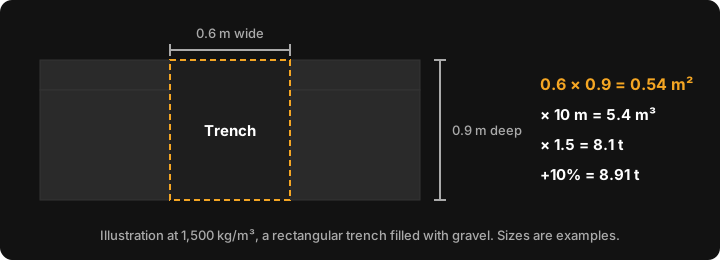
Multiply length × width × depth, all in metres, to get the trench volume in cubic metres. A 10 m trench that is 0.6 m wide and 0.9 m deep is 5.4 m³. Filled with gravel at 1,500 kg/m³ that is 8.1 tonnes, or 8.91 tonnes with 10 percent added. This works for a straight-sided, rectangular trench.
How to calculate trench volume
- Measure the length, width and depth. Use the digging width, which is the bucket or the spade, not the pipe. On uneven ground, measure the depth at several points and average them: depths of 0.85, 0.90 and 0.95 m average (0.85 + 0.90 + 0.95) ÷ 3 = 0.90 m.
- Convert millimetres to metres. Divide by 1,000: 600 mm is 0.6 m, 900 mm is 0.9 m. There is more on this in how to calculate cubic metres.
- Multiply the three. 10 × 0.6 × 0.9 = 5.4 m³. That is the size of the hole, and the volume of anything that fills it completely.
- Take off what stays in the hole. A pipe, or a bed of gravel under it, takes up room that backfill does not need.
- Turn it into tonnes. Cubic metres × density (kg/m³) ÷ 1,000. One tonne is 1,000 kg (NIST SP 811, Appendix B.8; checked on 28 October 2026).
- Add an allowance. About 10 percent is a rule of thumb for spillage and uneven digging. It is not a standard.
Worked through for gravel: the volume is 10 × 0.6 × 0.9 = 5.4 m³. The weight at 1,500 kg/m³ is 5.4 × 1,500 ÷ 1,000 = 8.1 t. With 10 percent on top, 8.1 × 1.10 = 8.91 t.
How many cubic metres per metre of trench?
The cross-section is width × depth, so every metre of trench holds that many cubic metres. Multiply by the length for the total. Here is the arithmetic for some common sizes:
| Width | 450 mm deep | 600 mm deep | 900 mm deep | 1,200 mm deep |
|---|---|---|---|---|
| 300 mm | 0.135 m³ | 0.180 m³ | 0.270 m³ | 0.360 m³ |
| 450 mm | 0.203 m³ | 0.270 m³ | 0.405 m³ | 0.540 m³ |
| 600 mm | 0.270 m³ | 0.360 m³ | 0.540 m³ | 0.720 m³ |
| 900 mm | 0.405 m³ | 0.540 m³ | 0.810 m³ | 1.080 m³ |
For example, a trench 450 mm wide and 900 mm deep: 0.45 × 0.9 = 0.405 m³ per metre, so 4.05 m³ over 10 m. These are volumes per metre of length, not advice on how wide or deep a trench should be.
How do I calculate trench backfill?
Backfill is the trench volume minus whatever stays in the trench. Take the 5.4 m³ trench. Say it has a 100 mm gravel bed under the pipe, and a 100 mm pipe laid on it (the bed and pipe are examples only):
- Bed: 10 × 0.6 × 0.1 = 0.6 m³, so 0.9 t at 1,500 kg/m³.
- Pipe: π × 0.05² × 10 = 0.0785 m³, for the outside of the pipe. It is about 1.5 percent of the trench, so many people ignore it.
- Left to backfill: 5.4 − 0.6 − 0.0785 = 4.7215 m³, about 4.72 m³.
- As soil at 1,200 kg/m³: 4.7215 × 1,200 ÷ 1,000 = 5.67 t. As gravel at 1,500: 4.7215 × 1,500 ÷ 1,000 = 7.08 t.
Two things change the real figure. Soil dug out takes up more room than it did in the ground, so the spoil heap is bigger than the hole. And backfill that is compacted in layers takes more material per cubic metre of trench than loose material would. This page gives no percentage for either. Ask your supplier or engineer, and see how much soil you need for the soil side.
How do I calculate excavation volume?
The same way: length × width × depth, in metres. The result is the volume of the hole in the ground, which is what you are digging out. The truck or skip needs more room than that, because loosened soil is bulkier than undisturbed soil. Plan for a bigger pile than 5.4 m³ for the example trench, and check the figure with whoever is taking the spoil away.
How much gravel for a french drain?
Work out the trench volume, take off the pipe, and convert to tonnes. For the 10 m × 0.6 m × 0.9 m trench with a 100 mm pipe fully surrounded by gravel: 5.4 − 0.0785 = 5.32 m³, which is 7.98 t at 1,500 kg/m³, and about 8.8 t with 10 percent added. Take the drain gravel size, and how wide and deep a french drain should be, from your designer, supplier or council: this page gives none. Gravel density varies by product; the method for tonnes is set out in how much gravel you need.
How do I calculate the volume of a ditch?
If the sides slope, the section is a trapezoid, not a rectangle. Area = (top width + bottom width) ÷ 2 × depth, then volume = area × length. A ditch 1.2 m wide at the top, 0.6 m at the bottom and 0.9 m deep: (1.2 + 0.6) ÷ 2 × 0.9 = 0.81 m², so 8.1 m³ over 10 m. For a V-shaped ditch, the bottom width is zero. The app has no sloped-side mode (see below), so use this formula by hand, or enter the average width, (1.2 + 0.6) ÷ 2 = 0.9 m, as the Width.
How do I turn trench volume into tonnes?
Cubic metres × density ÷ 1,000. The 5.4 m³ trench holds 8.1 t of gravel at 1,500 kg/m³, or 5.4 × 1,200 ÷ 1,000 = 6.48 t of soil at 1,200 kg/m³. These two densities are the app's starting values, not standards. Published ranges are wide: Wikipedia gives gravel as 1,460 to 1,920 kg/m³ (Gravel; checked on 28 October 2026), so ask your supplier for the figure for your product. Cubic metres to tonnes has the conversion both ways.
Doing it in MeisterCalc
There is no trench calculator. Gravel and Soil work the same way, and both treat the trench as a rectangular box.
- Open MeisterCalc and tap Gravel (Home ▸ Gravel) or Soil (Home ▸ Soil).
- Enter Length as the trench length, Width as its width and Depth as its depth. Millimetres are the default; feet and inches are under Settings ▸ Units ▸ Default units.
- Change Density (kg/m³) to your supplier's figure. It starts at 1,500 for Gravel and 1,200 for Soil.
- Read Volume (m³), Weight (t) and Order (+10%) (t).
For 10,000 × 600 × 900 mm at 1,500 kg/m³ the formula gives 5.400 m³, 8.100 t and 8.910 t. To subtract a bed or a pipe, work out its volume yourself and take it off the Volume figure. Share results as text or PDF from the share icon.
What the calculator doesn't do
- Rectangular sections only: no sloped sides, no V or trapezoid ditch.
- No swell, bulking or compaction setting, and no pipe or bedding deduction.
- Density must be between 100 and 5,000 kg/m³.
- It does not tell you how deep you can dig safely, where services are buried, or what your council requires.
Before you dig
Deep trenches can collapse and buried services can be hit. The UK Health and Safety Executive says temporary support should be planned before digging, and that work should not start until the risks from buried services are identified: see its excavations guidance (checked on 28 October 2026). In Australia and New Zealand, check your own work health and safety regulator and the local before-you-dig service. No Australian or New Zealand depth limits are given here. MeisterCalc does not make work compliant.
Try it
Concrete, Stairs and Check Square are the free calculators. Gravel and Soil are among the other twelve, which unlock with a weekly subscription that starts with a 3-day free trial, or with a one-time lifetime unlock; Google Play shows the prices in your currency. Calculations work offline, on Android 7.0 or later. There's no iPhone version yet; you can join the iOS waitlist.
Sources
- NIST Guide to the SI, Appendix B.8: tonne = 1,000 kg. Checked on 28 October 2026.
- Wikipedia: Gravel: bulk density range. Checked on 28 October 2026.
- HSE: Excavations. Checked on 28 October 2026.