How much sand do I need for paving?
Published · Updated · By Sai Nath
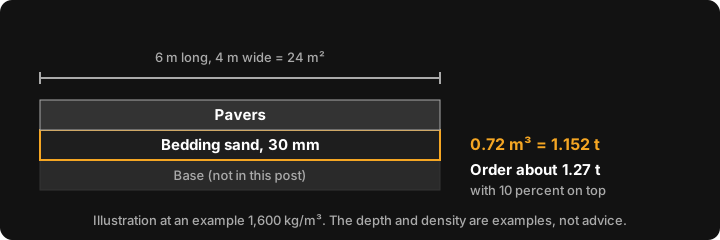
Multiply length × width × the depth of the sand layer, all in metres, to get cubic metres. Multiply by the sand's density in kg/m³ and divide by 1,000 for tonnes. A 6 m × 4 m patio with a 30 mm layer is 0.72 m³, or 1.152 tonnes at an example 1,600 kg/m³. Order 10 percent more.
How do I work out how much sand I need for paving?
- Measure the area. Length × width in metres. For an L-shape or a curve, split it into rectangles and add them.
- Get the bedding depth. This is the thickness of the screeded sand layer the pavers or slabs sit on. Start from the paver or slab maker's laying instructions; 30 mm is the figure in the specification quoted below. Write it in metres: 30 mm is 0.030 m.
- Find the volume. Area × depth = cubic metres. If that step is new, see how to calculate cubic metres.
- Convert to tonnes. Cubic metres × density (kg/m³) ÷ 1,000. One tonne is 1,000 kg (NIST SP 811, Appendix B.8; checked on 28 October 2026).
- Add an allowance. Ten percent is a common rule of thumb for screeding loss, uneven ground and settling. It is not a standard.
Which sand does this cover: bedding, joint or base?
Only the bedding sand, the layer directly under the pavers or slabs. Joint sand, which is swept between the units, is a much smaller quantity and is usually sold in bags. The base underneath is a different material, normally crushed rock, worked out the same way: see how much road base you need. Mixing the three layers into one depth is the usual way people over- or under-order.
A worked example: a 6 m × 4 m patio
The 30 mm depth is the figure in the specification quoted below. The 1,600 kg/m³ density is an example to show the arithmetic and is not sourced. Replace it with the density your supplier quotes, and the depth with your paver maker's figure if it differs.
- Area: 6 × 4 = 24 m².
- Volume: 24 × 0.030 = 0.72 m³.
- Weight at 1,600 kg/m³: 0.72 × 1,600 ÷ 1,000 = 1.152 t.
- With 10 percent on top: 1.152 × 1.10 = 1.2672 t, which MeisterCalc shows as 1.267 t. Ask the supplier for "about 1.3 tonnes".
How much sand per square metre, and how many square metres does a tonne cover?
Per square metre the tonnes depend only on depth and density: tonnes per m² = depth in metres × density ÷ 1,000. At an example 1,600 kg/m³:
| Example depth | Tonnes per m² | m² covered by 1 tonne | 24 m² needs |
|---|---|---|---|
| 20 mm | 0.032 t | 31.3 m² | 0.768 t |
| 30 mm | 0.048 t | 20.8 m² | 1.152 t |
| 40 mm | 0.064 t | 15.6 m² | 1.536 t |
| 50 mm | 0.080 t | 12.5 m² | 1.920 t |
Worked sums for the 40 mm row: 0.04 × 1,600 ÷ 1,000 = 0.064 t per m²; 1 ÷ 0.064 = 15.6 m² per tonne; 24 × 0.064 = 1.536 t. These depths are for the arithmetic only. If your supplier's density is 1,500, scale the tonnes by 1,500 ÷ 1,600: 1.152 × 1,500 ÷ 1,600 = 1.08 t for the patio. Both figures are made up to show the effect.
How much sand for paving slabs, pavers or stones?
The method is the same for all of them. What changes is the bedding depth, which depends on the unit and how it is laid. The one official figure quoted here is from Main Roads Western Australia, Specification 505 Segmental Paving: "Bedding sand 30 mm thick shall be screeded slightly ahead of the laying of pavers and maintained in a loose condition and protected from compaction" (clause 505.28; issued 25 March 2026; checked on 28 October 2026). It is a road authority's specification for segmental paving, not a rule for a home patio, and it says nothing about large slabs or stone. For your job, follow the laying instructions that come with your pavers or slabs, or ask the supplier, and put that depth into step 2.
How many tonnes of sand do I need, and what density do I use?
Sand does not have one density. It changes with moisture, how loose or compacted it is, and the product. A damp load off the truck weighs more per cubic metre than the same sand dry. The Main Roads WA specification above keeps stockpiled bedding sand at 4 to 8 percent moisture by mass (clause 505.07), which is a reminder that the wet weight you pay for includes water. That is why no sand density table appears here. Ask your supplier for the tonnes per cubic metre of the exact product, and whether the figure is for loose or damp sand. The general conversion is in cubic metres to tonnes, and the same method for stone is in how much gravel do I need.
Why order more than the calculated figure?
The bed is screeded, the pavers are bedded down and some sand ends up in the joints, so you tip out more than the bare layer, and the base is never perfectly flat. About 10 percent covers the usual shortfall. MeisterCalc builds in the same 10 percent as Order (+10%). It is a rule of thumb, so go higher on an uneven base. A patio also needs a slight fall for drainage; see how much fall on a patio.
Doing it in MeisterCalc
There is no sand preset, so use the Gravel calculator and type in the sand's density.
- Open MeisterCalc and tap Gravel on the home screen (Home ▸ Gravel).
- Enter Length, Width and Depth, with the depth being the sand layer. Millimetres are the default; feet and inches are under Settings ▸ Units ▸ Default units.
- Change Density (kg/m³) from 1,500 to your supplier's figure.
- Read Volume (m³), Weight (t) and Order (+10%) (t).
- Optional: enter a Price per tonne. A wastage slider then appears, from 0 to 30 percent, starting at 10, with Total Cost and Cost + N% Waste rows. Use Share results for text or PDF.
For the example above, with Density set to 1,600, the card reads Volume 0.720 m³, Weight 1.152 t and Order (+10%) 1.267 t.
What the calculator doesn't do
- It does not count slabs or pavers, and it does not work out joint sand or a sand-cement mix.
- No preset depths or densities for sand, no compaction or moisture setting, and no base layer by use. Enter the right density and run each layer on its own.
- Density must be between 100 and 5,000 kg/m³.
- It does not tell you what your site needs. Your paver supplier and local council do.
Try it
Concrete, Stairs and Check Square are the free calculators. Gravel is among the other twelve, which unlock with a weekly subscription that starts with a 3-day free trial, or with a one-time lifetime unlock; Google Play shows the prices in your currency. Calculations work offline, on Android 7.0 or later. There's no iPhone version yet; you can join the iOS waitlist.
Sources
- NIST Guide to the SI, Appendix B.8: tonne = 1,000 kg. Checked on 28 October 2026.
- Main Roads Western Australia, Specification 505 Segmental Paving: bedding sand 30 mm thick (clause 505.28) and stockpile moisture 4 to 8 percent (clause 505.07). Checked on 28 October 2026.