How do I convert a slope percentage to degrees (or a 1 in X ratio)?
Published · Updated · By Sai Nath
To convert a slope percentage to degrees, divide the percentage by 100 and take the arctangent: 10% is arctan(0.10) = 5.71 degrees. To go back, take the tangent of the angle and multiply by 100. For a ratio, 1 in N is 100 ÷ N per cent, so 1 in 12 is 8.33%, which is 4.76 degrees.
What does a slope percentage actually measure?
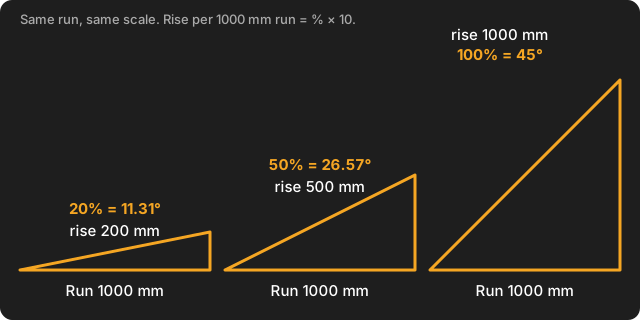
A slope percentage is the vertical rise over the horizontal run, times 100. A 10% slope rises 100 mm for every 1000 mm of run. The same slope can be written three ways: as a percentage (10%), as a ratio (1 in 10) or as an angle (5.71 degrees). They are one slope in three units.
The formulas are the standard ones for grade, set out on Wikipedia's Grade (slope) page and, for terrain slope, in Esri's ArcGIS Pro documentation:
- Percentage = rise ÷ run × 100 = tan(angle) × 100
- Angle = arctan(percentage ÷ 100)
- Ratio: 1 in N, where N = 100 ÷ percentage
- Millimetres per metre of run = percentage × 10
Use the horizontal run, not the length along the slope. A 1 in 12 ramp that is 12 m long measured along its surface does not have 12 m of run. If you only have the sloped length, the run is the sloped length ÷ √(1 + (percentage ÷ 100)²).
Keep the units the same top and bottom. If the rise is in millimetres and the run is in metres, convert one of them first. 85 mm over 1.2 m is 85 ÷ 1200 = 7.08%, not 85 ÷ 1.2.
Worked examples
Degrees are rounded to two decimal places and percentages to two decimals throughout.
- 10% to degrees. 10 ÷ 100 = 0.10. arctan(0.10) = 5.71 degrees. On a 1000 mm run that is a rise of 0.10 × 1000 = 100 mm.
- 1 in 12 to percentage and degrees. 100 ÷ 12 = 8.33%. arctan(0.0833) = 4.76 degrees. The fall is 83.3 mm per metre of run.
- 25 degrees to percentage. tan 25° = 0.4663, so the slope is 46.63%. As a ratio, 100 ÷ 46.63 = 2.14, so about 1 in 2.14.
On a calculator, make sure it is in degree mode before you press the arctan (tan⁻¹) key. In a spreadsheet or in code, the arctangent returns radians: multiply by 180 ÷ π, or use the degrees function, or the answer is out by a factor of about 57.
Slope percentage to degrees chart
Read across from the percentage. Degrees are rounded to two decimals; the 1 in N column is rounded to the nearest 0.1 (1 in 1.25 is shown in full). The 173.2% row is 60 degrees to the nearest tenth of a per cent.
| Slope (%) | Degrees | 1 in N | mm per metre of run |
|---|---|---|---|
| 1% | 0.57° | 1 in 100 | 10 |
| 2% | 1.15° | 1 in 50 | 20 |
| 3% | 1.72° | 1 in 33.3 | 30 |
| 4% | 2.29° | 1 in 25 | 40 |
| 5% | 2.86° | 1 in 20 | 50 |
| 6% | 3.43° | 1 in 16.7 | 60 |
| 8% | 4.57° | 1 in 12.5 | 80 |
| 10% | 5.71° | 1 in 10 | 100 |
| 12% | 6.84° | 1 in 8.3 | 120 |
| 15% | 8.53° | 1 in 6.7 | 150 |
| 20% | 11.31° | 1 in 5 | 200 |
| 25% | 14.04° | 1 in 4 | 250 |
| 30% | 16.70° | 1 in 3.3 | 300 |
| 40% | 21.80° | 1 in 2.5 | 400 |
| 50% | 26.57° | 1 in 2 | 500 |
| 60% | 30.96° | 1 in 1.7 | 600 |
| 70% | 34.99° | 1 in 1.4 | 700 |
| 80% | 38.66° | 1 in 1.25 | 800 |
| 100% | 45.00° | 1 in 1 | 1,000 |
| 150% | 56.31° | steeper than 1 in 1 | 1,500 |
| 173.2% | 60.00° | steeper than 1 in 1 | 1,732 |
| 200% | 63.43° | steeper than 1 in 1 | 2,000 |
How do I convert a slope ratio (1 in 12, 1 in 20, 1 in 100)?
A 1 in 12 slope is 4.76 degrees, or 8.33%. For any 1 in N, the percentage is 100 ÷ N, the angle is arctan(1 ÷ N) and the fall is 1000 ÷ N millimetres per metre of run. A 1 in 20 slope is 5%, or 2.86 degrees.
If "1 in 12" is a roof, check that it is not an X/12 pitch. The arithmetic is the same (12 inches of run, 1 inch of rise gives 4.76 degrees), but roofers usually say 4/12 or 6/12. That convention is covered in roof pitch to degrees and how to calculate roof pitch.
| Ratio | Slope (%) | Degrees | mm per metre of run |
|---|---|---|---|
| 1 in 200 | 0.5 | 0.29° | 5 |
| 1 in 100 | 1 | 0.57° | 10 |
| 1 in 80 | 1.25 | 0.72° | 12.5 |
| 1 in 60 | 1.67 | 0.95° | 16.7 |
| 1 in 50 | 2 | 1.15° | 20 |
| 1 in 40 | 2.5 | 1.43° | 25 |
| 1 in 30 | 3.33 | 1.91° | 33.3 |
| 1 in 20 | 5 | 2.86° | 50 |
| 1 in 14 | 7.14 | 4.09° | 71.4 |
| 1 in 12 | 8.33 | 4.76° | 83.3 |
| 1 in 10 | 10 | 5.71° | 100 |
| 1 in 8 | 12.5 | 7.13° | 125 |
| 1 in 6 | 16.67 | 9.46° | 166.7 |
| 1 in 5 | 20 | 11.31° | 200 |
| 1 in 4 | 25 | 14.04° | 250 |
| 1 in 3 | 33.33 | 18.43° | 333.3 |
| 1 in 2 | 50 | 26.57° | 500 |
| 1 in 1 | 100 | 45.00° | 1,000 |
For drainage falls such as 1 in 60 or 1 in 100 in millimetres, see how much fall is 1 in 100 in millimetres, or the fall ratio calculator page. For ramp lengths from a gradient, see how long a 1 in 14 ramp needs to be. Which gradient a job needs is set by the building code, the standard or the council, not by this page.
How do I convert degrees to a slope percentage?
Take the tangent of the angle and multiply by 100. 15 degrees is tan 15° × 100 = 26.79%. 30 degrees is 57.74%. The reverse of the chart above is below.
| Degrees | Slope (%) | 1 in N |
|---|---|---|
| 1° | 1.75 | 1 in 57.3 |
| 2° | 3.49 | 1 in 28.6 |
| 3° | 5.24 | 1 in 19.1 |
| 5° | 8.75 | 1 in 11.4 |
| 10° | 17.63 | 1 in 5.7 |
| 15° | 26.79 | 1 in 3.7 |
| 20° | 36.4 | 1 in 2.7 |
| 22.5° | 41.42 | 1 in 2.4 |
| 25° | 46.63 | 1 in 2.1 |
| 30° | 57.74 | 1 in 1.7 |
| 35° | 70.02 | 1 in 1.4 |
| 40° | 83.91 | 1 in 1.2 |
| 45° | 100 | 1 in 1 |
| 60° | 173.21 | steeper than 1 in 1 |
| 75° | 373.21 | steeper than 1 in 1 |
| 89° | 5,729 | steeper than 1 in 1 |
Why is a 100% slope 45 degrees, not vertical?
At 45 degrees the rise equals the run, so rise ÷ run = 1, which is 100%. Vertical would need a run of zero, and dividing by zero has no answer. So the percentage grows without limit as the angle nears 90 degrees: 60 degrees is 173.2%, 75 degrees is 373.2% and 89 degrees is about 5,729%.
This is also why percentage suits gentle slopes and degrees suit steep ones. Between about 0% and 20% the two scales move together. Above 100% a small change in angle makes a big change in percentage.
Mistakes and shortcuts
- The small-angle shortcut. Under about 10%, degrees are roughly the percentage × 0.573. So 5% is about 2.87 degrees (the exact value is 2.86). It drifts as the slope steepens: at 20% the shortcut gives 11.46 degrees and the exact figure is 11.31. Never read 5% as 5 degrees.
- Sloped length instead of run. Measure level, or work the run out from the sloped length as above.
- Mixed units. Convert millimetres and metres before dividing.
- Radians. Code and spreadsheets return radians from arctangent. Convert to degrees.
- Rounding. Round the angle to two decimals and the percentage to two decimals. For setting out on site, work from millimetres per metre.
How do I do it in MeisterCalc?
The Pitch calculator converts between angle and % grade. Any two of rise, run, pitch (X/12), angle and % grade solve the rest.
- Open MeisterCalc and tap Pitch on the home screen.
- Choose a mode that pairs what you know, such as Rise + Run, Run + Grade or Angle + Grade.
- Enter the values, for example a run of 1000 mm and a % grade of 10, the same as worked example 1.
- Read Pitch (1-3/16"), Angle (5.71°), % Grade (10.00%), Slope Ratio (a decimal, 0.1000) and Hypotenuse (1005.0 mm), the sloped length. Tap Pitch, Angle or % Grade to use that value as an input.
The app takes an angle above 0 and below or at 90 degrees, and a % grade above zero, so it does not take negative slopes. It has no 1 in N or millimetres-per-metre output: use the table above, or divide 100 by the percentage. It does not check any gradient against a code.
Pitch is one of the 12 calculators that need the weekly subscription (3-day free trial) or the one-time lifetime unlock. The free ones are Stairs, Concrete and Check Square; Google Play shows prices in your currency. It is Android only, on Android 7.0 or later, and works offline.
Frequently asked questions
Is a 100% slope vertical?
No. A 100% slope is 45 degrees, where the rise equals the run. A vertical face has no horizontal run, so its percentage has no finite value. The percentage keeps growing as the angle nears 90 degrees: 89 degrees is about 5,729%.
What is a 10% slope in degrees?
A 10% slope is 5.71 degrees, from arctan(0.10). It is the same as 1 in 10, and it rises 100 mm for every 1000 mm of horizontal run. Degrees are only a little over half the percentage at this size, not equal to it.
How steep is a 1 in 4 slope?
A 1 in 4 slope is 25%, which is 14.04 degrees, and it rises 250 mm per metre of run. Divide 100 by 4 for the percentage, then take arctan(0.25) for the angle.
How do I convert degrees to a percentage?
Take the tangent of the angle and multiply by 100. For 15 degrees, tan 15° = 0.2679, so the slope is 26.79%. For a ratio, divide 100 by the percentage: 100 ÷ 26.79 gives about 1 in 3.73.
What is 1 in 20 as a percentage?
1 in 20 is 5%, because 100 ÷ 20 = 5. As an angle it is 2.86 degrees, and it falls 50 mm for every metre of run.
How many mm per metre is 1%?
A 1% slope is 10 mm per metre of horizontal run. Multiply the percentage by 10 to get millimetres per metre. So 2.5% is 25 mm per metre, and 1 in 40 is the same thing.
Can a slope be more than 100%?
Yes. Anything steeper than 45 degrees is over 100%. A 60 degree slope is about 173.2%, and 63.43 degrees is 200%. The percentage has no upper limit, which is why steep slopes are usually quoted in degrees.
Sources
Checked on 28 October 2026. The conversions are plain trigonometry, worked and cross-checked against the rows on these pages:
- Wikipedia: Grade (slope), for the percent, ratio and angle relationships.
- Esri ArcGIS Pro: How Slope works, for percent rise and its growth towards 90 degrees.
- Omni Calculator: slope percentage, used to check 173.2% = 60 degrees and 5% under 3 degrees.