What is the going of a stair, and how is it different from the tread?
Published · Updated · By Sai Nath
The going is the horizontal distance from the front edge (nosing) of one tread to the nosing of the next. The tread is the board you stand on. Approved Document K defines the going as the tread's depth front to back, less any overlap with the tread above, so the two match only when treads do not overlap.
What is the going of a stair?
The going is the depth of one step as you walk it: nosing to nosing, measured level. It is the number you set out along the stair, and it is what the calculator asks for in its Going field. "Going of a staircase" and "going of a step" mean the same thing, and every step in a flight should have the same one.
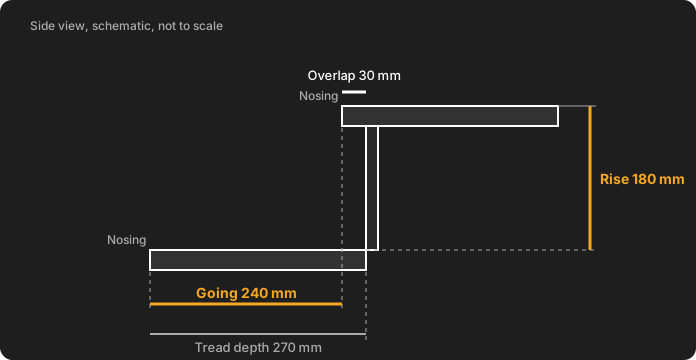
What is the difference between the tread and the going?
The tread is the board. Its depth is measured from its front edge to its back edge. The going is how far that step moves you forward, so it is the tread depth less whatever the tread overlaps the one below. Approved Document K (England) puts it this way: the going is "the depth from front to back of a tread, less any overlap with the next tread above". It also says to measure the going from nosing to nosing (Diagram 1.1).
A worked example: a 270 mm deep tread with a 30 mm nosing overhang has a going of 270 − 30 = 240 mm. The 30 mm is a round number for the sum. Approved Document K says nosings on buildings other than dwellings should protrude no more than 25 mm, so check the limit that applies to you. Make the tread a plain 240 mm board with no overhang and the tread depth and the going are both 240 mm. People use the two words as if they were one because on many stairs they are close. They are not the same measurement when there is a nosing, and the going is the one the rules and the maths use.
Going, run, rise, riser: what do the other words mean?
Every country has its own words, so here is how they line up on this page. Check the definition in any source you are working from.
| Term | Meaning | Example (2700 mm rise, 15 risers) |
|---|---|---|
| Going | Nosing to nosing, one step, horizontal | 240 mm |
| Tread | The board you stand on; its depth can be more than the going | 270 mm deep with a 30 mm overhang |
| Total run | All the goings added up, along the floor | 14 × 240 = 3360 mm |
| Rise (riser height) | Vertical distance from one tread top to the next | 2700 ÷ 15 = 180 mm |
| Riser | The vertical board, or loosely the step's height; also counts the steps | 15 risers |
| Total rise | Finished floor to finished floor | 2700 mm |
American sources often say "run" or "tread depth" for the per-step distance. Read how each source measures it before you swap its number for a going.
Why is there one fewer going than risers?
The top riser lifts you onto the upper floor, and a floor is not a tread. So a stair with 15 risers has 14 treads and 14 goings. Using the example above: 2700 ÷ 15 = 180 mm for each riser, 14 goings of 240 mm make a total run of 3360 mm, and 2 × 180 + 240 = 600 mm for the 2R + G comfort check. Counting 15 goings is the commonest slip when setting out a stair by hand. How the riser count comes from a floor height is in how many steps for a floor height.
What is the minimum going on a staircase?
It depends on the country and the type of stair. Checked on 28 October 2026 at the official sources below. Your council or certifier decides what applies to your job.
- Australia (NCC 2022 Housing Provisions, Table 11.2.2a). For stairs other than spiral, the going is 240 mm minimum and 355 mm maximum, with a riser of 115 to 190 mm and 2R + G of 550 to 700 mm. Clause 11.2.2(5) says to measure them as in Figure 11.2.2f, so read that figure for the method. Source: NCC 2022 Housing Provisions, Part 11.2.
- England (Approved Document K, 2013 edition for use in England, Table 1.1). A private stair has a going of 220 to 300 mm and a rise of 150 to 220 mm. A note says that for dwellings, external tapered steps and stairs that are part of the building, the going of each step should be at least 280 mm. Source: Approved Document K (PDF) via GOV.UK.
- New Zealand. This page does not give a figure. Read clause D1 of the New Zealand Building Code and its Acceptable Solution at building.govt.nz.
The full sets are in stair rules in Australia and stair regulations in the UK, so they are not repeated here. Check all three numbers, the riser, the going and the 2R + G total.
How does the going set the rest of the stair?
Pick the going and the comfort rule gives the riser: (600 − going) ÷ 2. A 240 mm going points to a 180 mm riser, and a deeper going points to a lower one. The reasoning and a table of goings are in the 2R + G stair formula, and the whole sequence from floor height to stringer is in how to calculate stairs. If space is the limit, stairs in a tight space covers what a shorter going costs you.
How do I measure the going on a built stair?
- Hold a tape level from the front edge of one tread to the front edge of the next.
- Measure at the centre of a straight stair, not at the wall end.
- Repeat for every step. The goings should be consistent through the flight.
- Count the treads and the risers separately. Risers should be one more than treads.
Measuring the board's depth and adding nothing is the common error: if there is a nosing overhang, take it off, or measure nosing to nosing and skip the sum. Approved Document K measures tapered steps differently, at the centre of the tread, so winders are a separate question.
Where does the going go in MeisterCalc?
Open Home ▸ Stairs. The Going field is the going as defined above, and it starts at 250 mm. The calculator has three modes at the top: Rise Only, Rise + Run and Run Only.
- In Rise Only, enter the Total Rise and your preferred Going. With 2700 and 240 you get 15 risers of 180 mm and 14 treads.
- In Run Only, enter the Total Run and the Going. A run of 3360 and a going of 240 gives 14 treads and 15 risers, with a rise of about 2700 mm.
- In Rise + Run, you enter both and the going is worked out from the run, so the Going field is hidden.
One thing to know about Rise Only: its Total Run, Stringer Length and Incline Angle are worked from 15 × 240 = 3600 mm, which is one going more than the 14 treads (14 × 240 = 3360 mm). The risers, riser height, treads and Stairwell Opening are not affected. When you want a run that matches the hand sum, use Run Only or Rise + Run.
A naming note: the result card says Number of Treads and Actual Tread Width. Here "tread" means the going, so Actual Tread Width is the nosing-to-nosing distance, and Number of Treads is also the number of goings.
What the Stairs calculator does not do
- It does not check your stair against the NCC, Approved Document K or the New Zealand Building Code. Those documents and your council set the rules.
- It has no landings, winders or tapered treads, and it does not work out nosing overhang for you.
- It works in millimetres by default. Feet and inches are in Settings ▸ Units.
Try it
Stairs is one of three MeisterCalc calculators that are free, along with Concrete and Check Square. It works offline on Android 7.0 or later. There is no iPhone version yet; you can join the iOS waitlist.