How much concrete do I need for strip footings?
Published · Updated · By Sai Nath
A strip footing is a long, thin slab. Measure the length down the middle of the trench (the centreline), then multiply length × width × depth, all in metres. Add about 10% for uneven digging and spill. For a 36 m run, 600 mm wide and 300 mm deep, that is 6.48 m³, so order about 7.13 m³.
How to calculate the concrete for a strip footing
The width and depth come from your drawings. The steps below turn them into cubic metres.
- Get the width and depth from the drawings. Use the engineer's or designer's sizes, not a rule of thumb. See "Who decides the size?" below.
- Find the centreline length. Add up the length of every strip measured down its middle, corners counted once, plus every T-junction and internal wall strip.
- Check the depth you actually dug. Measure the trench bottom against your pegs or level. The drawing says what was wanted; the hole says what you will fill.
- Multiply: length (m) × width (m) × depth (m) = volume in m³. Work in metres: 600 mm is 0.6 m.
- Add the allowance, about 10%, then round up to the next 0.1 m³ or to what the supplier sells.
How do I measure the length when there are corners and T-junctions?
Measure down the centre of the strip, not along the outside edge. Each corner is then counted once. A rectangle with a 10.0 × 8.0 m centreline is 2 × (10.0 + 8.0) = 36.0 m. Adding the outside length of each side (10.6 × 8.6 m for a 600 mm strip) gives 38.4 m, because each corner is counted twice. Strips that branch off, such as one under an internal wall, are added at their own length, measured to the centreline of the strip they meet.
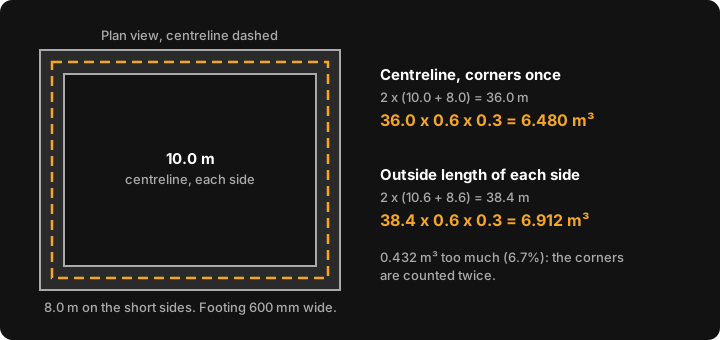
Worked example: a 600 mm wide, 300 mm deep strip
- Centreline: 2 × (10.0 + 8.0) = 36.0 m.
- Section: 0.6 × 0.3 = 0.18 m³ for every metre of run.
- Volume: 36.0 × 0.18 = 6.480 m³, which is 6480 litres.
- With 10%: 6.480 × 1.10 = 7.128 m³, so about 7.13 m³.
- The outside-length mistake: 38.4 × 0.18 = 6.912 m³, which is 0.432 m³ (6.7%) too much.
These are example sizes only. Your footing may be a different size. If the supplier sells in 0.1 m³ steps, 7.128 m³ rounds up to 7.2 m³.
How much concrete per metre of footing?
Multiply width by depth in metres to get cubic metres per metre of run, then multiply by your total length. Examples only:
| Width × depth (example) | m³ per metre | For a 20 m run |
|---|---|---|
| 450 × 300 mm | 0.135 | 2.70 m³ |
| 450 × 450 mm | 0.2025 | 4.05 m³ |
| 600 × 300 mm | 0.180 | 3.60 m³ |
| 600 × 450 mm | 0.270 | 5.40 m³ |
| 600 × 600 mm | 0.360 | 7.20 m³ |
These show how fast the volume grows with depth. They are not sizes to build to.
Who decides how wide and deep a strip footing is?
Not this page, and not any calculator. The size depends on the soil, the load and the local rules, so it comes from the engineer's or designer's drawings and what your council has approved. In Australia, the National Construction Code (NCC) points footings to AS 2870 or to the Housing Provisions. The NCC 2022 Housing Provisions, Part 4.2 says footings and slabs must be founded on sites classified under AS 2870, that its strip footing tables cover Class A, S and M sites only, and that sites classed H, E or P must refer to AS 2870. It also says bearing capacity varies by site and should be determined by a qualified engineer, an experienced engineering geologist or someone with appropriate local knowledge. Checked on 28 October 2026.
In England, foundations are covered by Approved Document A (published 1 September 2013, checked on 28 October 2026). In New Zealand, ask your designer or council which NZS 3604 or specific-design route applies. This page gives no widths or depths from any of these.
How much extra should I order?
About 10% is a common rule of thumb, not a standard. Strips need it because the trench is rarely a perfect box: the bottom varies, edges break away, soft spots get dug out and some concrete is lost in placing. Measure the real dug depth to cut the guesswork, and add more if the ground is soft or the trench was dug by machine. The reasoning is in how much extra concrete to order. A bag maker such as Quikrete says the same about its own calculator: its yields "do not allow for uneven substrate, waste, etc." (checked on 28 October 2026).
What if the footing changes size?
Split it into runs that each have one width and depth, calculate each, and add the results. A deeper section under a step, or a wider strip under a load-bearing wall, is its own run. Squaring up the set-out first saves re-digging; see how to square a building.
Does the reinforcement take up volume?
Steel bars take a very small part of the volume, so the usual approach is to ignore them and let the allowance cover it. Bar size, cover and laps are the engineer's call. No figure for this is given here.
Doing it in MeisterCalc
Concrete is free. Enter each footing run as a slab.
- Open MeisterCalc and tap Concrete on the home screen.
- Choose Slab at the top of the screen.
- Enter Length as the centreline length (36000 mm), Width as the footing width (600 mm) and Depth as the footing depth (300 mm).
- Read Volume in m³ and in litres, and Order (+10%). For this example that is Volume 6.480 m³, Volume 6480.0 L and Order (+10%) 7.128 m³.
- For a footing with different sizes, run each section and add the results yourself.
- To send the numbers, tap the share icon and choose Share as Text or Share as PDF.
Millimetres are the default. For feet and inches, go to Settings ▸ Units ▸ Default units ▸ Imperial (ft/in). For the same sum on a slab, see how much concrete do I need. For footings under posts, see concrete for post holes.
Bags or ready-mix?
A footing of several cubic metres is a lot of bags. Bag counts depend on each product's yield: at the 108 bags per m³ on Boral's data sheet for its 20 kg Concrete Mix, the 7.128 m³ order above is 7.128 × 108 = 769.8, which rounds up to 770 bags. Other makers' figures are in bags of concrete per m³. If you need a weight, see cubic metres to tonnes. There is no ready-mix minimum order here, since it varies by supplier. Ask for a quote for both.
What the Concrete calculator doesn't do
- It doesn't count the centreline or the corners. You measure the length.
- It doesn't size or design footings, and it doesn't make work comply with the NCC, AS 2870 or any council rule.
- It has no multi-run total, no stepped or tapered sections, no reinforcement and no bag count.
- The Order (+10%) line is fixed at 10%. Add more yourself for over-dig or soft ground.
- A raft or slab-on-ground is a different footing type. It is a wide slab, see how much concrete do I need.
Try it
Concrete is one of three MeisterCalc calculators that are free to use, along with Stairs and Check Square. It works offline, on Android 7.0 or later. The other 12 calculators unlock with a weekly subscription that starts with a 3-day free trial, or with a one-time lifetime unlock; Google Play shows the prices in your currency. There's no iPhone version yet; you can join the iOS waitlist.
Sources
- ABCB, NCC 2022 Housing Provisions Part 4.2. Checked on 28 October 2026.
- GOV.UK, Structure: Approved Document A. Checked on 28 October 2026.
- Quikrete, concrete calculator. Checked on 28 October 2026.