How do you calculate cubic metres (and convert mm to m3)?
Published · Updated · By Sai Nath
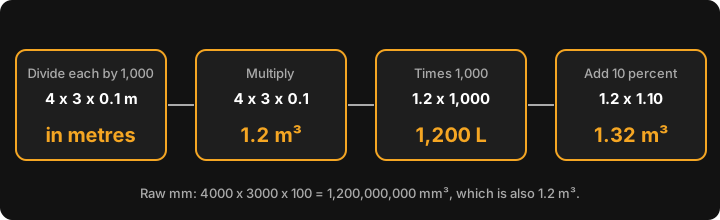
Cubic metres equal length × width × depth, with all three in metres. If your measurements are in millimetres, divide each one by 1,000 first, then multiply. A slab 4000 × 3000 × 100 mm is 4 × 3 × 0.1 = 1.2 m³. Multiply the three millimetre figures straight across and you get mm³, not m³.
How do I calculate cubic metres from mm?
Convert first, multiply second. Each side goes from millimetres to metres by dividing by 1,000, and only then do you multiply.
- Write down the three sizes in millimetres. Say 4000 (length), 3000 (width) and 100 (depth).
- Divide each by 1,000. 4000 ÷ 1,000 = 4 m, 3000 ÷ 1,000 = 3 m, 100 ÷ 1,000 = 0.1 m.
- Multiply. 4 × 3 × 0.1 = 1.2 m³.
Centimetres work the same way with 100 in place of 1,000: 250 × 200 × 10 cm becomes 2.5 × 2 × 0.1 = 0.5 m³.
Why does multiplying raw millimetres go wrong?
Because the answer comes out in cubic millimetres. 4000 × 3000 × 100 = 1,200,000,000 mm³. A cube one metre on each side is 1,000 mm × 1,000 mm × 1,000 mm, so 1 m³ is 1,000,000,000 mm³ (a billion), and you divide by that: 1,200,000,000 ÷ 1,000,000,000 = 1.2 m³. Same answer, but nobody enjoys counting nine zeros on site. Converting each side first is easier to check by eye. In the same way, 1 m³ is 1,000,000 cm³.
The common slip is dividing the result by 1,000 instead of 1,000,000,000, which is out by a factor of a million.
How many litres are in a cubic metre?
1,000. NIST gives the litre as exactly 0.001 m³ (NIST SP 811, Appendix B.8; checked on 28 October 2026), so 1.2 m³ is 1,200 L. To go the other way, divide litres by 1,000: a 200 L drum holds 0.2 m³.
How do I calculate cubic metres of concrete?
A slab, footing, path or driveway is a box, so use the same formula: length × width × depth. The 4000 × 3000 × 100 mm slab above needs 1.2 m³. Concrete is usually ordered with some extra for uneven ground and spillage. MeisterCalc's Concrete calculator adds a fixed 10 percent to its order quantity, which gives 1.2 × 1.10 = 1.32 m³. That is the app's rule of thumb, not a standard; ask your supplier. The full job, with bags and mixes, is in how much concrete do I need and bags of concrete per m³.
How do I calculate cubic metres of a room?
A room is a box too: floor length × floor width × ceiling height. A room 5 m × 4 m with a 2.4 m ceiling is 5 × 4 × 2.4 = 48 m³. If you already have the floor area, see square metres to cubic metres: multiply the area by the depth or height in metres.
How do I calculate cubic metres of a cylinder or post hole?
Use π × radius² × depth, all in metres. The classic mistake is putting the diameter in where the radius goes. Halve it first.
- A hole 300 mm across is 0.3 m in diameter, so the radius is 0.15 m.
- The depth is 800 mm = 0.8 m.
- Per hole: π × 0.15² × 0.8 = 3.1416 × 0.0225 × 0.8 = 0.0565 m³ (about 56.5 L).
- For six holes: 0.0565 × 6 = 0.3393 m³. With 10 percent extra, 0.3732 m³.
Round at the end, not in the middle. Rounding 0.0565 and multiplying by six gives 0.339, close here, but the error grows with the hole count.
What about trenches, L-shapes and sloping floors?
- Trench or footing. A box again: 10 m long × 0.45 m wide × 0.6 m deep = 2.7 m³.
- L-shaped or irregular area. Split it into rectangles, work each one out and add. A 6 m × 4 m part plus a 3 m × 2 m part is 24 + 6 = 30 m², and at 0.1 m deep that is 3.0 m³.
- Sloping base. If the depth changes steadily from one end to the other, use the average depth. 100 mm at one end and 160 mm at the other averages 130 mm, so a 5 m × 4 m area is 5 × 4 × 0.13 = 2.6 m³. Measure the depth at more than two points if the surface is uneven.
Doing it in MeisterCalc
The Concrete calculator does the conversion for you. Concrete is one of the free calculators.
- Open MeisterCalc and tap Concrete on the home screen.
- For a box, choose Slab and enter Length, Width and Depth in millimetres (4000, 3000, 100).
- Read Volume in m³ (1.200), Volume in L (1200.0) and Order (+10%) (1.320 m³).
- For round holes, choose Holes and enter Diameter (300), Depth (800) and Number of Holes (6). The card shows Per Hole, Total (0.3393 m³) and Order (+10%) (0.3732 m³). You enter the diameter, so there is no radius to get wrong.
- Tap the share icon for Share as Text or Share as PDF.
The Gravel and Soil calculators use the same length × width × depth maths and then convert to tonnes with a density you can edit; see cubic metres to tonnes. Switch to feet and inches under Settings ▸ Units ▸ Default units.
What the calculators don't do
- No room-volume or trench mode: use Slab with the trench's length, width and depth.
- No irregular shapes or sloping floors: work out each section, or the average depth, by hand and enter it.
- The 10 percent on the Order (+10%) line is fixed. The optional cost section has its own Wastage slider, which only changes the cost.
- It does not convert mm³ or cubic yards.
- It does not know what your job needs. Quantities and rules come from your plans, supplier and council.
Try it
Concrete, Stairs and Check Square are the free calculators. Gravel and Soil are among the other twelve, which unlock with a weekly subscription that starts with a 3-day free trial, or with a one-time lifetime unlock; Google Play shows the prices in your currency. Calculations work offline, on Android 7.0 or later. There's no iPhone version yet; you can join the iOS waitlist.
Sources
- NIST Guide to the SI, Appendix B.8: 1 litre = 0.001 m³. Checked on 28 October 2026.
- The mm³ and cm³ figures follow from 1 m = 1,000 mm = 100 cm, cubed.