How much concrete do I need for a post hole?
Published · Updated · By Sai Nath
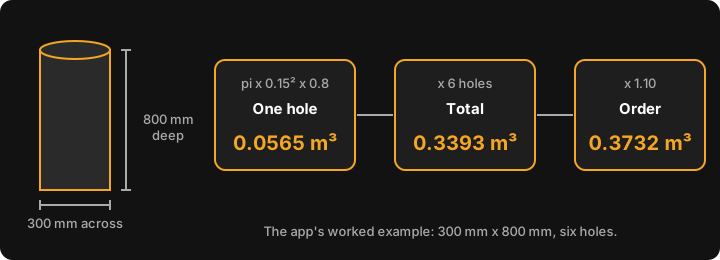
A post hole is a cylinder, so its volume is pi × radius² × depth. A hole 300 mm wide and 800 mm deep is 0.0565 m³, or about 57 litres. Multiply by the number of holes, add 10 percent, and you have the amount to order: for six such holes, 0.3732 m³.
How do I work out the concrete for one post hole?
The formula is volume = pi × (diameter ÷ 2)² × depth, with everything in metres. Work it in four steps:
- Diameter to radius. A 300 mm hole is 0.3 m across, so the radius is 0.15 m.
- Depth in metres. 800 mm is 0.8 m.
- One hole. 3.1416 × 0.15 × 0.15 × 0.8 = 0.0565 m³. One cubic metre is 1,000 litres, so that is 57 litres.
- All the holes. Six holes: 0.0565 × 6 = 0.3393 m³. Add 10 percent for spillage and uneven hole walls: 0.3393 × 1.10 = 0.3732 m³.
How much concrete for common hole sizes?
These are the same sums for sizes people often dig. They are arithmetic, not recommendations: the right hole for your post is covered further down.
| Hole (diameter × depth) | Per hole | Per hole, litres | With +10% |
|---|---|---|---|
| 200 × 600 mm | 0.0188 m³ | 19 L | 0.0207 m³ |
| 300 × 600 mm | 0.0424 m³ | 42 L | 0.0467 m³ |
| 300 × 800 mm | 0.0565 m³ | 57 L | 0.0622 m³ |
| 300 × 900 mm | 0.0636 m³ | 64 L | 0.0700 m³ |
| 450 × 900 mm | 0.1431 m³ | 143 L | 0.1575 m³ |
| 600 × 1,000 mm | 0.2827 m³ | 283 L | 0.3110 m³ |
Width matters more than people expect. Going from 300 mm to 450 mm across, at the same 900 mm depth, more than doubles the concrete (0.0636 m³ to 0.1431 m³), because the diameter is squared.
How deep and how wide should the hole be?
The concrete maths is easy. The hole size is the real question, and it depends on the post, the soil, the load and your local rules. One published rule of thumb comes from the concrete maker Quikrete, a US company: the depth of the hole should be one-half of the above-ground post height, and its examples pair a 4 inch post with a 12 inch hole and a 6 inch post with an 18 inch hole, about three times the post width. Source: Quikrete post-setting calculator; checked on 28 October 2026. The page has no date.
In metric terms, a post standing 1.2 m above ground would go about 1.2 ÷ 2 = 0.6 m, or 600 mm, into the ground by that rule, and a 100 mm post would get a hole of about 3 × 100 = 300 mm. That is a US manufacturer's guidance in inches, not an Australian or New Zealand standard.
For a fence or deck, check with the post or panel maker, and for a deck, a house or anything structural, the plans and your council. Footing sizes for structures are set by the building rules, not by a rule of thumb. MeisterCalc's own help text says only that post holes are typically 600 to 900 mm deep for fences and decks, depending on soil and post height: a guide, not a standard. For post spacing, see how far apart fence posts should be.
Do I subtract the volume of the post?
No. Order for the full hole and let the extra 10 percent cover it. The post does take up room: a 100 × 100 mm post sitting 800 mm deep is 0.1 × 0.1 × 0.8 = 0.0080 m³, which is about 14 percent of the 0.0565 m³ hole. That is not trivial, so do not read "it is negligible" into the 10 percent.
The reason not to subtract is practical. Holes are rarely a clean cylinder, so the real hole is usually bigger than the sum says, and some concrete is lost to spillage. The post's displaced volume is a similar size to the 10 percent allowance, so ordering the full hole volume plus 10 percent leaves you with a small margin. If your holes are neat tube forms or augered clean, you could subtract the post and keep the allowance. Do not subtract the post and also skip the allowance.
How many bags of concrete per post hole?
Divide the volume you need by the volume one bag makes. The yield is printed on the bag or the maker's data sheet, in litres or cubic metres, and it differs between products and bag sizes, so there is no single bags-per-hole figure. Check the label on the bag you buy, because yields differ between brands and mixes.
Here is the method with two makers' figures. Boral's data sheet says 108 bags of its 20 kg Concrete Mix make 1 m³. A 300 × 800 mm hole with 10 percent extra needs 0.0622 m³, and 0.0622 × 108 = 6.7, so buy 7 bags of the Boral mix (6.7 rounds up). Dricon's data sheet gives 0.010 m³ for a 25 kg bag of HandiCrete, so 0.0622 ÷ 0.010 = 6.2: also 7 bags. Six such holes take 41 bags of the Boral mix or 38 of the Dricon. Swap in the figure from your own bag. Other makers' figures are in how many bags of concrete make a cubic metre, and the concrete calculator in m³ counts bags for them. If you need the weight of the concrete, see cubic metres to tonnes.
What about round piers, tube forms and belled holes?
A round pier or a cardboard tube form is the same cylinder: use its inside diameter and the depth of concrete. A belled hole, wider at the bottom, is two cylinders. Work the shaft and the bell separately and add them. For example, a 300 mm shaft 600 mm long is 0.0424 m³, and a 500 mm bell 200 mm high is 0.0393 m³, so 0.0817 m³ in all. Treating that as a plain 500 mm hole would overstate it, and treating it as a 300 mm hole would understate it.
How much concrete for a deck footing or a concrete pier?
The volume is the same cylinder sum. What differs is the size, which for a deck or any structural footing comes from the design and the building rules, not from this page. Use the dimensions on your plans or from your engineer or certifier, and enter them as the diameter and depth. For larger pours, see how much concrete you need for slabs and other shapes.
Doing it in MeisterCalc
- Open Home ▸ Concrete and choose Holes at the top (the other mode is Slab).
- Enter Diameter and Depth in millimetres. Switch to feet and inches under Settings ▸ Units ▸ Default units.
- Enter Number of Holes.
- Read the result card: Per Hole, Total and Order (+10%), all in m³.
- Optionally add a price per m³ to get a cost, or send the result with Share results as text or PDF.
With 300 mm, 800 mm and 6 holes, it shows Per Hole 0.0565 m³, Total 0.3393 m³ and Order (+10%) 0.3732 m³. You enter the diameter, not the radius. Holes of different sizes: work each size as its own group and add the totals. If you want a plain volume tool, see the concrete calculator in cubic metres.
What the Holes calculator doesn't do
- It gives cubic metres only. There is no litres line in Holes mode and no bag count; use the bag method above.
- It treats every hole as a straight cylinder. Belled or tapered holes need splitting into groups.
- It does not subtract the post and does not add a gravel base.
- The Order (+10%) line is fixed at 10 percent. The Wastage setting, if you use the cost option, changes the cost figure only.
- It does not know your soil, your post or your local rules. Hole size is your call, or your engineer's.
Try it
Concrete, Stairs and Check Square are the free calculators. The other twelve unlock with a weekly subscription that starts with a 3-day free trial, or with a one-time lifetime unlock; Google Play shows the prices in your currency. Calculations work offline, on Android 7.0 or later. There's no iPhone version yet; you can join the iOS waitlist.
Sources
- Quikrete post-setting calculator (US manufacturer): hole depth one-half of above-ground post height; hole diameters of 6, 9, 12 and 18 inches for 2, 3, 4 and 6 inch posts. Checked on 28 October 2026.
- Boral, Concrete Mix product data sheet (PDF): 108 x 20 kg bags to one cubic metre. Checked on 28 October 2026.
- Dricon, HandiCrete technical data sheet (PDF): approximate yield 0.010 m³ per 25 kg bag. Checked on 28 October 2026.