How much fall is 1 in 100 (and 1 in 60, 1 in 80) in millimetres?
Published · Updated · By Sai Nath
A fall of 1 in 100 is 10 mm per metre of run: 50 mm over 5 m, 60 mm over 6 m. It equals a 1% slope or 0.573 degrees. A fall of 1 in 80 is 12.5 mm per metre and 1 in 60 is 16.7 mm. The sum is run ÷ N, in millimetres.
How do you calculate fall?
Divide the run by the second number in the ratio. Fall and run must be in the same unit.
- Fall = run ÷ N for a fall of 1 in N.
- Fall = run × percentage ÷ 100 if you are given a percentage.
Three worked examples, all in millimetres:
- 1 in 100 over 6 m. 6000 ÷ 100 = 60 mm.
- 1 in 60 over 3.5 m. 3500 ÷ 60 = 58.33, so 58.3 mm.
- Working backwards: 50 mm over 4 m. N = run ÷ fall = 4000 ÷ 50 = 80, so the fall is 1 in 80.
The usual mistake is multiplying instead of dividing. A 1 in 100 fall over 6 m is 60 mm, not 600 mm. A quick check: a bigger N means a flatter fall, so the number of millimetres should get smaller as N goes up.
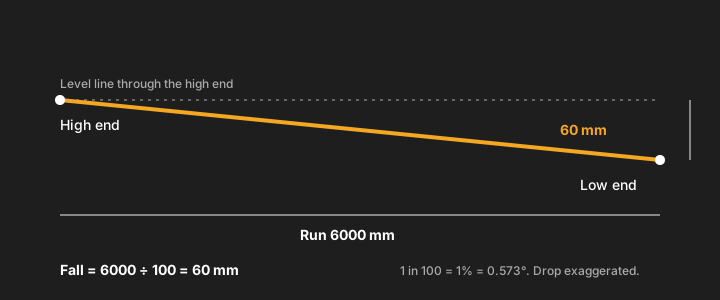
How much fall is 1 in 100 over 1 m, 3 m or 6 m?
Ten millimetres per metre, so 10 mm over 1 m, 30 mm over 3 m and 60 mm over 6 m. The table below gives the fall in millimetres for common ratios over runs of 1 to 10 m. Values are run in millimetres ÷ N, rounded to 0.1 mm. Angles are rounded to three decimals.
| Fall | Slope (%) | Angle (°) | 1 m | 2 m | 3 m | 4 m | 5 m | 6 m | 8 m | 10 m |
|---|---|---|---|---|---|---|---|---|---|---|
| 1 in 40 | 2.5 | 1.432 | 25 | 50 | 75 | 100 | 125 | 150 | 200 | 250 |
| 1 in 50 | 2 | 1.146 | 20 | 40 | 60 | 80 | 100 | 120 | 160 | 200 |
| 1 in 60 | 1.7 | 0.955 | 16.7 | 33.3 | 50 | 66.7 | 83.3 | 100 | 133.3 | 166.7 |
| 1 in 80 | 1.25 | 0.716 | 12.5 | 25 | 37.5 | 50 | 62.5 | 75 | 100 | 125 |
| 1 in 100 | 1 | 0.573 | 10 | 20 | 30 | 40 | 50 | 60 | 80 | 100 |
| 1 in 150 | 0.7 | 0.382 | 6.7 | 13.3 | 20 | 26.7 | 33.3 | 40 | 53.3 | 66.7 |
| 1 in 200 | 0.5 | 0.286 | 5 | 10 | 15 | 20 | 25 | 30 | 40 | 50 |
| 1 in 500 | 0.2 | 0.115 | 2 | 4 | 6 | 8 | 10 | 12 | 16 | 20 |
The 1 in 60 row gives the answer to “1 in 60 fall over 1 m”: 16.7 mm. The 1 in 80 row gives 12.5 mm. For a run that is not in the table, just divide: 1 in 100 over 8.5 m is 8500 ÷ 100 = 85 mm.
What is 1 in 100 as a percentage and in degrees?
1 in 100 is 1% and 0.573 degrees. The same fall written three ways:
- Percentage = 100 ÷ N. 1 in 100 = 1%; 1 in 80 = 1.25%.
- Millimetres per metre = 1000 ÷ N. 1 in 100 = 10 mm per metre.
- Angle = arctan(1 ÷ N). arctan(0.01) = 0.573 degrees.
At falls this flat, percentage and the tangent are almost the same thing, so degrees are rarely used on site. To go the other way from a percentage or a pitch, see slope percentage to degrees and roof pitch to degrees.
How much fall does the job need?
The ratio is set by the rules for that job, the product maker and the person certifying the work, not by a calculator. The figures below come from official documents. Always name the country: they differ.
| Job | Fall | Source |
|---|---|---|
| Eaves gutter (Australia) | Not less than 1:500 (2 mm per metre) | NCC 2022 Housing Provisions, clause 7.4.4 |
| Wet-area floor to a floor waste (Australia) | Minimum 1:80, maximum 1:50, continuous | NCC 2022 Housing Provisions, clause 10.2.12 |
| 75 mm and 100 mm rainwater drains (England) | Not less than 1:100 | Approved Document H (2015 edition), paragraph 3.15 |
| 150 mm and 225 mm rainwater drains (England) | Not less than 1:150 and 1:225 | Same, paragraph 3.15 |
| Paved areas (England) | At least 1 in 60 recommended; across a path not more than 1 in 40 | Same, Part H3 paragraph 2.3 |
Checked on 28 October 2026. Three notes on reading it:
- Gutters. 1:500 is a minimum, so 6 m of eaves gutter needs at least 12 mm of fall (6000 ÷ 500). The NCC page says box gutters are a different matter and points to AS/NZS 3500.3 for their sizes, falls and overflow.
- Shower and wet-area floors. Between 1:80 and 1:50 over a 1.8 m run to the waste is 22.5 mm to 36 mm (1800 ÷ 80 and 1800 ÷ 50). Too little fall leaves water behind; too much makes tiling harder. Your waterproofer and the product maker will have the final say.
- Underground drains in Australia. The fall depends on the pipe size and the plumbing code, AS/NZS 3500, which this page does not quote. Ask your plumber or council. The England figures are there to show how a drain rule reads, not as an Australian rule.
Rules change by edition and by state or council. Building rules are set by the NCC, the NZ Building Code or Approved Documents, and your local council, not by this page or the app. For a ramp, which is a gradient and not a fall, see ramp gradient 1 in 14.
How do you set out a fall on site?
- Work out the total fall: run in millimetres ÷ N. For a 5 m patio edge at 1 in 100, 5000 ÷ 100 = 50 mm.
- Mark the high end at its finished level and keep it fixed.
- Mark the low end 50 mm lower, measured straight down from a level line, not along the slope.
- Pull a string line between the two marks and check the middle against it with a tape. Midway should sit half the total fall below the high end: 50 ÷ 2 = 25 mm here.
- For a long run, put a mark every metre. Each one is 10 mm lower than the last.
With a dumpy level, read the staff at both ends. The difference between the two reduced levels is the fall. For example, if the staff reads 1.320 m at the high end and 1.370 m at the low end, the low end is 1.370 − 1.320 = 0.050 m = 50 mm lower, which is 1 in 100 over 5 m. The sums are in how to calculate reduced level, and the set-up is in how to use a dumpy level. A fall also has a direction: always check which end the water should run to before you pin the high end.
Doing it in MeisterCalc
The app has no “1 in N” field and no calculator called fall. Use the Pitch calculator, where you pick which two values you know (Rise, Run, Angle, % Grade or Pitch) and enter them. A 1 in 100 fall is a 1% grade.
- Open MeisterCalc and tap Pitch on the home screen.
- Tap the Run + Grade mode chip under the diagram.
- Enter the Run: 6000 mm, the same as worked example 1.
- Enter % Grade: 1.
- The Angle row shows 0.57° and % Grade 1.00%. The diagram’s Rise label shows 60.0 mm, which is the fall over that run (6000 × 0.01 = 60).
For a different ratio, enter its percentage (100 ÷ N): 1.25 for 1 in 80, 1.667 for 1 in 60. You can also use the Rise + Run mode with a Rise of 10 and a Run of 1000: the result card then shows % Grade 1.00%. For the fall between two points you have levelled, the Dumpy Level calculator gives the reduced level at a staff reading.
What the app doesn’t do
- It has no “1 in N” input or output and no fall field or result. The Rise on the diagram is the fall.
- It doesn’t know what fall a job needs. It does the sum for the ratio you choose.
- It isn’t a drainage design tool: no pipe sizing or flow.
- It doesn’t make work compliant with the NCC or any other rule.
Try it
Pitch and Dumpy Level are among the MeisterCalc calculators that unlock with a weekly subscription that starts with a 3-day free trial, or with a one-time lifetime unlock; Google Play shows the prices in your currency. Concrete, Stairs and Check Square are free. It works offline, on Android 7.0 or later. There’s no iPhone version yet; you can join the iOS waitlist. For roof slopes rather than falls, see how to calculate roof pitch.