How do I convert millimetres to feet, inches and sixteenths?
Published · Updated · By Sai Nath
Divide the millimetres by 25.4 to get inches, take whole feet out in twelves, multiply the leftover fraction of an inch by 16 and round to the nearest sixteenth. 1000 mm is 39.37 in, which is 3' 3 3/8". If the sixteenths round up to 16, carry one inch.
This page is for metric trades who meet imperial numbers: a drawing in feet and inches, a supplier's sheet, or a tape that reads in sixteenths. It converts one number at a time. For a live version inside the app, see doing it in MeisterCalc.
How do you convert mm to feet, inches and sixteenths, step by step?
Four steps. The same maths is used for every length.
- Inches. Divide the millimetres by 25.4.
- Feet. Divide the inches by 12 and keep the whole number. The inches left over are the remainder.
- Whole inches and the fraction. Keep the whole inches. Multiply the decimal part by 16 and round to a whole number. That is the number of sixteenths.
- Carry and reduce. If the sixteenths come to 16, add 1 inch and drop the fraction. If the inches then reach 12, add 1 foot. Reduce the fraction: 2/16 is 1/8, 8/16 is 1/2.
Worked examples
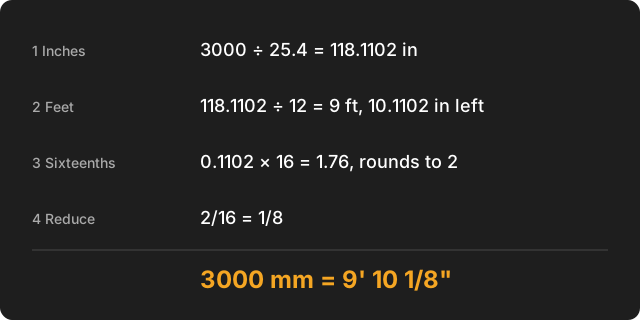
3000 mm. 3000 ÷ 25.4 = 118.1102 in. 118.1102 ÷ 12 is 9 feet with 10.1102 in left. The decimal 0.1102 × 16 = 1.76, which rounds to 2. So 9' 10 2/16", reduced to 9' 10 1/8".
1575 mm. 1575 ÷ 25.4 = 62.0079 in, which is 5 feet and 2.0079 in. 0.0079 × 16 = 0.13, which rounds to 0. The answer is 5' 2".
4800 mm, with a carry. 4800 ÷ 25.4 = 188.9764 in, which is 15 feet and 8.9764 in. 0.9764 × 16 = 15.62, which rounds to 16. Carry: 8 in becomes 9 in and the fraction goes. The answer is 15' 9".
2440 mm, just over 8 feet. 2440 ÷ 25.4 = 96.063 in, which is exactly 8 feet and 0.063 in. 0.063 × 16 = 1.0, so the answer is 8' 0 1/16". A sheet sold as 2440 mm is a hair over 8 feet.
Why is it 25.4, and is it exact?
Yes. The foot is defined as exactly 0.3048 m, and an inch is a twelfth of that, so 1 in = 25.4 mm exactly and 1 ft = 304.8 mm exactly. NIST says that since the 1959 agreement the yard has been defined as exactly 0.9144 m, and so the foot as exactly 0.3048 m (NIST SP 811, Appendix B). Checked on 28 October 2026. The same page notes a separate US survey foot, which differs by two parts in a million and doesn't matter for building work.
The converse is one line: mm = inches × 25.4. A 7 1/2" measurement is 7.5 × 25.4 = 190.5 mm. A sixteenth of an inch is 25.4 ÷ 16 = 1.5875 mm.
Chart: common sizes in feet, inches and sixteenths
Each size is the metric number converted and rounded to the nearest 1/16". It does not say what a product is called in an imperial country, only what the millimetres come to.
| mm | Feet, inches, fraction (nearest 1/16") | Decimal inches |
|---|---|---|
| 3 | 1/8" | 0.1181 |
| 6 | 1/4" | 0.2362 |
| 9 | 3/8" | 0.3543 |
| 12 | 1/2" | 0.4724 |
| 16 | 5/8" | 0.6299 |
| 19 | 3/4" | 0.7480 |
| 25 | 1" | 0.9843 |
| 32 | 1 1/4" | 1.2598 |
| 38 | 1 1/2" | 1.4961 |
| 45 | 1 3/4" | 1.7717 |
| 50 | 1 15/16" | 1.9685 |
| 70 | 2 3/4" | 2.7559 |
| 90 | 3 9/16" | 3.5433 |
| 100 | 3 15/16" | 3.9370 |
| 140 | 5 1/2" | 5.5118 |
| 190 | 7 1/2" | 7.4803 |
| 200 | 7 7/8" | 7.8740 |
| 300 | 11 13/16" | 11.8110 |
| 450 | 1' 5 11/16" | 17.7165 |
| 600 | 1' 11 5/8" | 23.6220 |
| 900 | 2' 11 7/16" | 35.4331 |
| 1000 | 3' 3 3/8" | 39.3701 |
| 1200 | 3' 11 1/4" | 47.2441 |
| 1800 | 5' 10 7/8" | 70.8661 |
| 2400 | 7' 10 1/2" | 94.4882 |
| 2440 | 8' 0 1/16" | 96.0630 |
| 2700 | 8' 10 5/16" | 106.2992 |
| 3000 | 9' 10 1/8" | 118.1102 |
| 3600 | 11' 9 3/4" | 141.7323 |
| 4800 | 15' 9" | 188.9764 |
How accurate is a sixteenth?
Rounding to the nearest step can be out by up to half a step. Nearest 1/16" is out by at most 1/32", which is 0.79 mm. Nearest 1/32" is out by at most 0.40 mm, and nearest 1/8" by at most 1.59 mm.
| Round to | Step | Largest error |
|---|---|---|
| 1/8" | 3.175 mm | 1.59 mm |
| 1/16" | 1.5875 mm | 0.79 mm |
| 1/32" | 0.79375 mm | 0.40 mm |
For framing and setting out, 1/16" is finer than most tape reading. For tight joinery or a fit between two parts, use 1/32" or stay in millimetres. Each conversion carries its own rounding, so converting many lengths and adding the results can drift. Convert the total, not the parts. Take ten lengths of 450 mm. Each is 17.7165 in, which rounds to 17 11/16" (11.46 sixteenths rounds to 11), so ten of them add to 10 × 17 11/16" = 176 7/8". The total, 4500 mm, is 177.1654 in, which rounds to 177 3/16" (2.65 sixteenths rounds to 3). The parts come out 5/16" (about 8 mm) short.
Why is 2400 mm not 8 feet?
8 feet is 8 × 304.8 = 2438.4 mm, and 4 feet is 1219.2 mm. So 2400 mm is 7' 10 1/2", about 38 mm short of 8 feet, and 1200 mm is 3' 11 1/4", about 19 mm short of 4 feet. Metric and imperial sizes sit near each other without matching. If a plan in feet needs a part that fits a 2400 mm length, check the measurement, not the rounded name.
Why do metric trades need this?
Imperial numbers turn up on imported drawings, product sheets, online plans and tools. Reading a set-out in feet and inches is easier once you can turn one dimension at a time into millimetres and back. Dimensions that depend on right angles are a separate job: Pythagoras on site and checking a frame is square work in any unit, as long as you stay in one. For a stair, see the 2R + G stair formula; a rise of 175 mm is 6 7/8", but the limits for riser and going are set by the building rules where you work, not by this page.
Doing it in MeisterCalc
MeisterCalc is metric first. To see feet and inches, open Settings (the gear on Home) ▸ Units ▸ Default units and choose Imperial (ft/in). The support page says all calculators update instantly and you can switch back at any time (Support).
Choosing Imperial adds two settings: Fraction display (the fraction as 7/16 or in raised and lowered figures) and Fraction precision (1/8, 1/16 or 1/32; the default is 1/16). They do not appear in Metric. Inside, the app keeps every value in millimetres and converts at display: divide by 25.4, take out feet, round the fraction, carry at a full inch and at 12 inches, and reduce. Results read like 5' 7 7/16". Under an inch it shows just the fraction. The voice readout on Baluster Spacing and Running Measurements reads imperial values rounded to 1/16.
The calculators are Android only, work offline, and three of them (Concrete, Stairs and Check Square) are free. The rest unlock inside the app. See how many steps for a floor height for one place the units come up.
What this page and the app don't do
- MeisterCalc is not a converter page. You switch the whole app between metric and imperial; you can't paste one number and get a conversion.
- It does not do feet-and-inch arithmetic, such as adding 5' 3 1/2" to 2' 9".
- The rounding is to the nearest step you choose. It can be up to half a step out (0.79 mm at 1/16").
- The CAD scale and drawing-unit settings in a drawing program are separate from this conversion.
Frequently asked questions
How many mm in an inch? 25.4, exactly. How many mm in a foot? 304.8, exactly.
What is 1000 mm in feet and inches? 39.3701 in, which is 3' 3 3/8" to the nearest sixteenth.
How do I round to the nearest 1/16? Multiply the decimal part of the inch by 16, then round to a whole number. 0.1102 × 16 = 1.76, so 2/16, which is 1/8.
How do I convert inches back to mm? Multiply by 25.4. 3 15/16" is 3.9375 × 25.4 = 100.01 mm.
Facts on this page are from the NIST source linked above, checked on 28 October 2026, and from arithmetic shown in the worked examples. App behaviour is from MeisterCalc v1.0.3.