How much extra concrete should I order?
Published · Updated · By Sai Nath
Order about 10% more than the exact volume. Work out length × width × depth in metres, then multiply by 1.10: a 4 m × 3 m slab, 100 mm deep, is 1.20 m³, so order 1.32 m³. Use about 5% for a neat, well-formed job and more for rough ground. Your supplier's advice and minimum load come first.
The sum, at 5%, 10% and 15%
Start with the exact volume. For the example slab that is 4 × 3 × 0.1 = 1.20 m³, or 1200 litres. If you have not measured the job yet, how much concrete do I need for a slab walks through it. Then multiply by one plus the allowance.
| Allowance | Sum | Order (m³) | Extra over exact |
|---|---|---|---|
| None (exact) | 1.20 | 1.20 | 0 |
| 5% | 1.20 × 1.05 | 1.26 | 60 L |
| 10% | 1.20 × 1.10 | 1.32 | 120 L |
| 15% | 1.20 × 1.15 | 1.38 | 180 L |
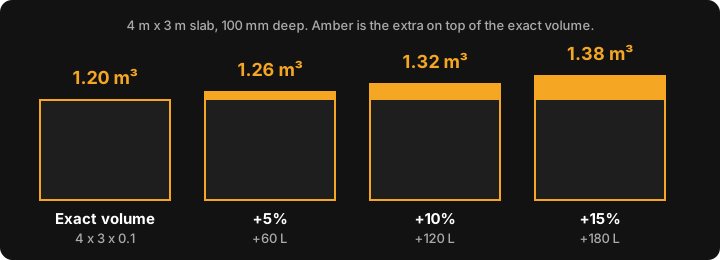
Going from 5% to 15% changes the order by 1.38 − 1.26 = 0.12 m³. That is the gap between "might just make it" and "has a barrow load to spare".
Why order extra at all?
The sum describes a perfect box. A real pour is not one. The extra covers four things:
- Low spots in the base. Every millimetre of extra depth over the whole slab is volume. On the 12 m² example, 10 mm of extra depth is 12 × 0.01 = 0.12 m³, which is the whole 10% on its own.
- Formwork that gives. Boards bow and shift under the weight, and the slab ends up slightly bigger than drawn.
- Spillage and what is left behind. Concrete stays in the chute, the barrow and the pump line.
- Ragged holes and trenches. Dug sides are never as neat as the diameter or width you entered.
Boral, an Australian supplier, says to allow a small buffer for ground variation but gives no percentage (Boral concrete calculator, checked on 28 October 2026). A New Zealand calculator site suggests about 5 to 10 percent for spillage, uneven ground and over-excavation (calculate.co.nz, checked on 28 October 2026). No building code sets a waste percentage, so treat the figures here as a rule of thumb, not a rule.
Which percentage should I use?
Match it to how much can go wrong. These are the author's rules of thumb, not supplier or code figures:
- About 5%: a small, square slab on a trimmed and compacted base, with straight, braced formwork, where you have measured the depth in several places.
- About 10%: the usual starting point for a slab or path.
- 10% to 15% or more: soft or uneven ground, a base you have not levelled yet, long thin pours, or holes and trenches in loose soil.
Measure the depth to the base at several points across the slab and use the average, rather than one reading at the edge. For holes, the sums are on how much concrete for a post hole.
What if I order too little?
Running short mid-pour means a second delivery, and a second delivery means a gap while the first load sets. A joint where fresh concrete meets set concrete is a line to avoid in a slab. A second load may also be a small order that a plant charges for or refuses. Ordering 0.12 m³ too much costs a barrow load of leftover concrete. Ordering 0.12 m³ too little can cost a whole delivery. If you do have a little spare, plan something to put it in, such as a few pavers or a stepping pad, before the truck arrives.
What is the minimum amount of concrete you can order?
It depends on the plant. Boral says minimum order quantities can vary depending on location and plant, and that many agitator trucks carry around 6 to 8 m³ a load (Boral, checked on 28 October 2026). That is why a 1.3 m³ slab can be a small order for a truck built for six times as much.
A short load is a delivery smaller than the plant's minimum or standard load. Suppliers can add a charge for it, and it can differ by plant. Boral and Holcim link regional service fee sheets from their pages, so look up the sheet for your area, or ring the plant and ask three things: what is the smallest load, what does a short load cost, and is there a waiting-time charge (Boral service fees, Holcim service fees, checked on 28 October 2026). This page gives no short-load dollar figure, because none is the same everywhere.
Does the same extra apply to bags?
Yes. Work out the volume, add the allowance, then divide by what one bag makes and round up to whole bags. The yield is printed on the bag and differs by brand: see how many 20 kg bags of concrete make a cubic metre. Round up, because a half bag does not exist and the last bag is the one you will wish you had.
How to do it in MeisterCalc
- Open Home ▸ Concrete ▸ Slab and enter length, width and depth in millimetres: 4000, 3000 and 100.
- Read Volume 1.200 m³, Volume 1200.0 L and Order (+10%) 1.320 m³.
- For another percentage, enter a Price per m³. A Wastage slider (0 to 30%, starting at 10%) then appears in the cost section. With an example price of 200 per m³, Total Cost is 240 and Cost + 10% Waste is 264.
The Holes mode works the same way: six holes, 300 mm across and 800 mm deep, are 0.3393 m³, and Order (+10%) shows 0.3732 m³ (0.3393 × 1.10).
Two limits. The Order (+10%) row is fixed at 10% and does not follow the slider; the slider only changes the cost figure. And the app works out volume only: it does not know your plant's minimum load, short-load charges or how a plant rounds, and it does not give bag counts. Concrete is one of three free MeisterCalc calculators, with Stairs and Check Square. It works offline, on Android 7.0 or later. There is no iPhone version yet.
Questions people ask
How much excess concrete should I order?
About 10% over the exact volume for a typical slab, from 5% for a neat job to 15% or more on rough ground. Confirm with your supplier.
What is a normal concrete wastage percentage?
Sources give a range, not a rule. One NZ site says about 5 to 10 percent, and Boral gives no figure. No building code sets one.
How much concrete is wasted on a job?
There is no reliable published figure, so this page gives none. What you waste depends on your base, formwork and how you order.
Is 10% too much?
On the example slab it is 0.12 m³, or 120 litres. That is usually cheaper than a second delivery.
Limits of this page
The percentages are rules of thumb. Slab thickness, reinforcement and strength come from your plans, the engineer and the local council, under the National Construction Code in Australia, the NZ Building Code in New Zealand or the Building Regulations in the UK. MeisterCalc does not make work compliant. Sources checked on 28 October 2026.