Baluster spacing calculator app: count, gap and a mark for every baluster
Published · Updated · By Sai Nath
Baluster Spacing in MeisterCalc takes the run between two posts, the baluster width and a maximum gap, and gives the number of balusters, the equal gap, the on-centre spacing and a set-out mark for each one. A 3000 mm run of 42 mm balusters at a 125 mm maximum takes 23 balusters with 84.75 mm gaps, 126.75 mm on centres.
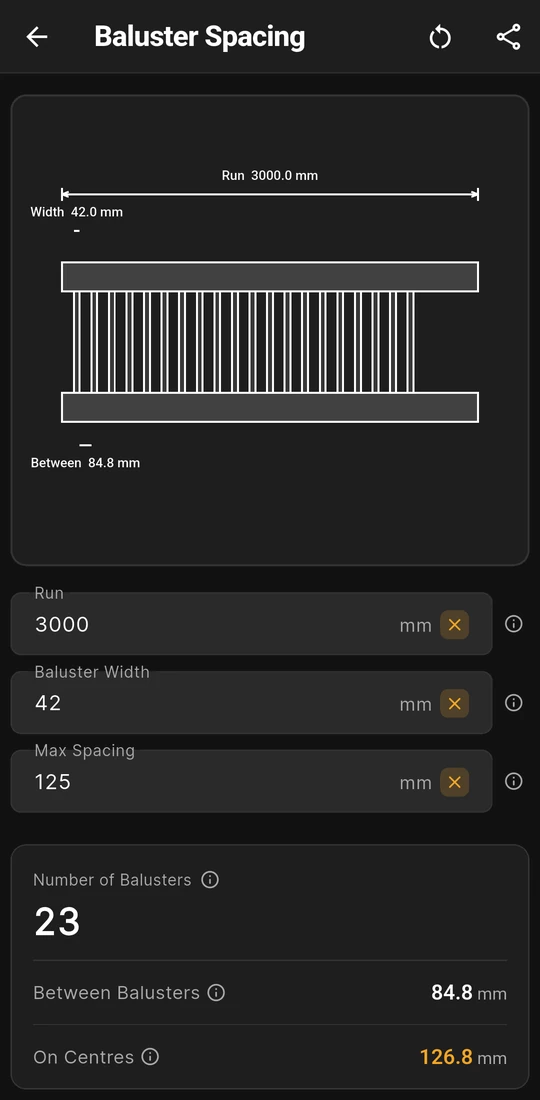
3000 mm run, 42 mm balusters: 23 at 84.8 mm
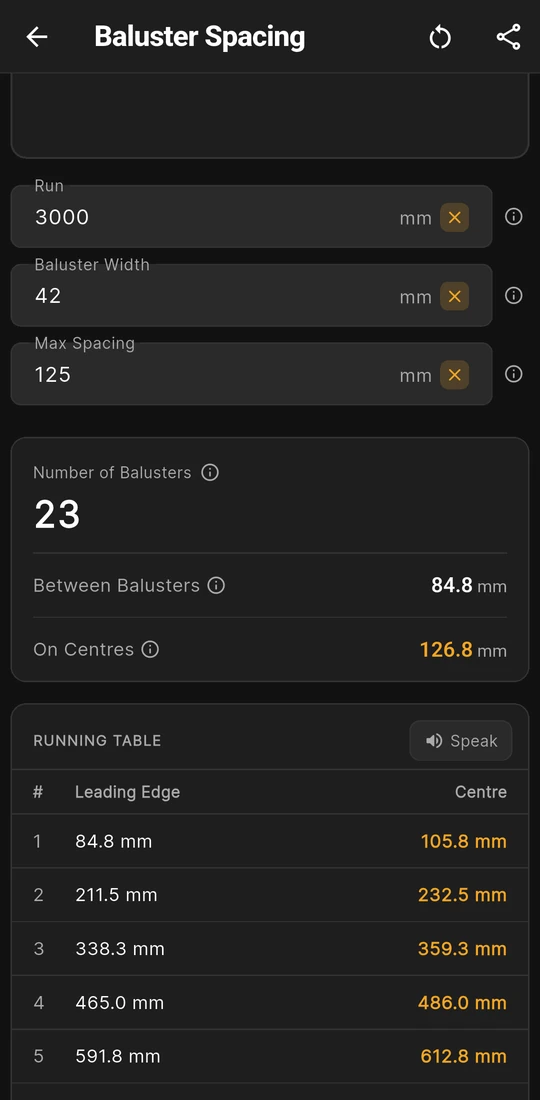
Running table: leading edge and centre, with Speak
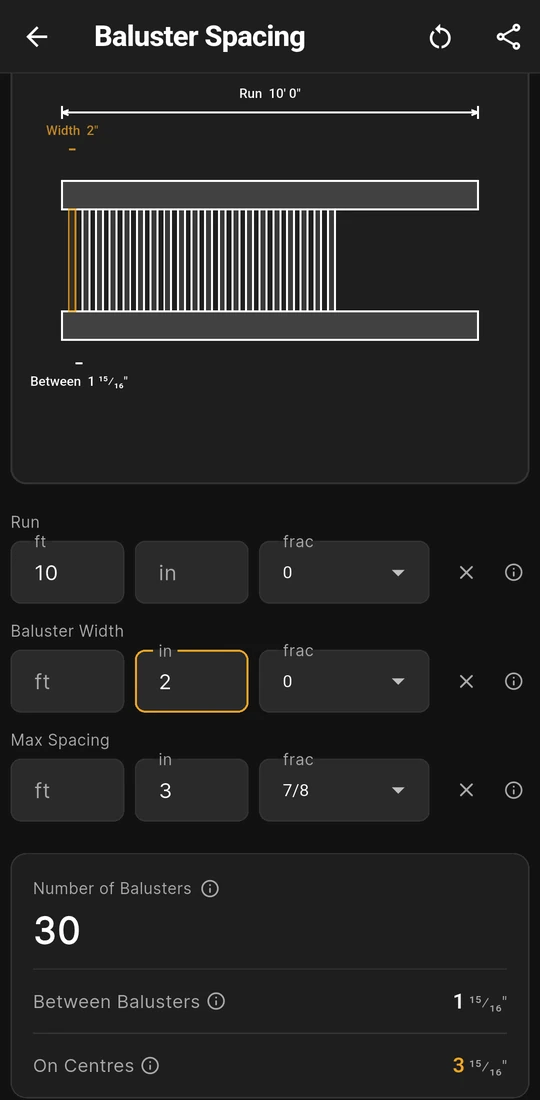
Feet and inches: 10 ft run, 2 in balusters, 30


What does Baluster Spacing work out?
It sets out a row of balusters between two posts so that every gap is the same and none is wider than the limit you give it. Open Home ▸ Baluster Spacing and fill in three fields. The results, the running table and a drawing of the panel update as you type.
| Field | In or out | What it means |
|---|---|---|
| Run | You enter | The clear span between the two posts, not the length of the handrail. Every position in the running table is measured from the start of it. |
| Baluster Width | You enter | The face of one baluster as seen from the front. It has to be less than the Run. |
| Max Spacing | You enter | The widest clear gap allowed between two balusters, face to face. It starts at 125 mm, or 3 7/8 in when the app is in feet and inches, and must be above 0 and under 200 mm. |
| Number of Balusters | Result | How many balusters go between the posts. The posts themselves are not counted. |
| Between Balusters | Result | The clear gap. It is the same everywhere, including from each post to the nearest baluster. |
| On Centres | Result | Baluster Width plus the gap: the step from one baluster's centre to the next. |
| Leading Edge and Centre | Running table | For each baluster by number, where its first face and its centre fall, measured from the start of the Run. |
When a combination can't work, a red note under the field says why, such as "Width must be less than Run", and the results wait until it is fixed. Your last values stay for next time.
Worked example: 3000 mm between posts, 42 mm balusters
From the first two screens above: Run 3000 mm, Baluster Width 42 mm and the pre-filled Max Spacing of 125 mm.
- Number of Balusters: the app divides the run by the maximum, rounds up and takes one off. 3000 ÷ 125 is exactly 24, so 24 − 1 = 23 balusters.
- Between Balusters: the 23 balusters fill 23 × 42 = 966 mm of the run. The other 2034 mm is shared by 24 gaps, one more than the balusters because there is a gap against each post: 2034 ÷ 24 = 84.75 mm.
- On Centres: 42 + 84.75 = 126.75 mm.
- Running table: baluster 1 starts one gap in from the post, at 84.75 mm, and its centre is half a width further on, at 105.75 mm. Each row after that adds 126.75 mm, so baluster 23 starts at 2873.25 mm.
- Check the far end: 2873.25 + 42 = 2915.25 mm, which leaves 3000 − 2915.25 = 84.75 mm to the second post, the same gap again.
The screen shows one decimal place: Number of Balusters 23, Between Balusters 84.8 mm and On Centres 126.8 mm, with the table running from 84.8 mm (centre 105.8 mm) to 2873.3 mm (centre 2894.3 mm).
The gap comes out well under the 125 mm you entered, and that is how the count works. It divides the run by Max Spacing as if the balusters had no width, so the real gap lands roughly one baluster width under the maximum. Every gap stays under the limit, but it is not the fewest balusters the limit allows; the maximum gap between balusters in Australia works the smaller count out by hand. Before you order, read Between Balusters as well as the figure you typed.
What you see on the screen
- A front view of the panel. Top and bottom rails with the balusters between them, labelled Run, Width and Between, and the field you are typing in lights up on the drawing. It draws up to 20 balusters to scale from the left-hand post, so with 23 the right-hand end is empty; the table lists every one.
- The running table, read aloud. Speak, on the RUNNING TABLE header, reads each row through the phone's text-to-speech: "Baluster 1, leading 85 millimetres, centre 106 millimetres". It rounds to the whole millimetre when it speaks, and the button shows Stop while it talks.
- A note on every field. Each ⓘ button opens a short note and a fuller page with a drawing; the Max Spacing note quotes the NCC's 125 mm.
- Feet and inches. With Settings ▸ Units ▸ Default units ▸ Imperial (ft/in), each length takes feet, inches and a fraction, and the results read in feet and inches. The third screen is a 10 ft run of 2 in balusters at 3 7/8 in: 30 balusters, 1 15/16 in apart and 3 15/16 in on centres. Changing units clears the fields.
- Share results. Share as Text or Share as PDF sends the three inputs, the three results and every row of the running table, and the PDF adds the drawing.
Is Baluster Spacing free?
No. Baluster Spacing is one of the 13 Pro calculators; Concrete, Stairs and Check Square are the free ones. Without Pro you can open it, type a run and see the panel drawn, but the results and the running table are blurred until you unlock. Pro is a subscription or a one-time lifetime unlock; Google Play shows the plans and prices in your currency.
Baluster gap rules by country
Each code below tests an opening with a ball, so its limit is a clear gap, the same thing Max Spacing means. The figures for houses:
| Country | No opening may let through | Where it comes from |
|---|---|---|
| Australia | A 125 mm sphere | NCC Housing Provisions 11.3.4(4): balustrade gaps in Australia |
| New Zealand | A 100 mm sphere, in housing | Acceptable Solution F4/AS1, 1.2.1: baluster gaps in New Zealand |
| England | A 100 mm sphere, where children under five may use the building | Approved Document K, 1.39 and 3.3: stair spindle gaps in the UK |
| United States | A 4 in sphere | IRC R312.1.3 (2021 edition; R321.1.3 in 2024): MeisterCalc for US jobs |
The 125 mm the app starts with is the Australian figure, and 3 7/8 in sits under the US 4 in. In New Zealand or England, type a Max Spacing under 100 mm, because a 100 mm ball passes a 100 mm gap. The app doesn't check barrier heights, the gap at a deck edge, the triangle under a stair rail or turned spindles, and it can't make a balustrade compliant. The code and your council, building consent authority or building control decide.
Rules in more detail: US guards and the 4-inch rule (IRC), NZ stairs and barriers, UK stairs and guarding, and the rest of building codes by country, from Australia's NCC to New Zealand's Building Code, England's Approved Documents and the US IRC.
Questions about Baluster Spacing
Does Number of Balusters include the posts?
No. It counts only the balusters between the posts. The Run is the clear span from one post face to the other, and the gap from each post to its nearest baluster equals Between Balusters, so the ends look like the middle.
Is Max Spacing a gap or a centre-to-centre figure?
A gap: the clear opening between the faces of two balusters, the space a test sphere would have to pass. On Centres is a result, the gap plus one width. If your drawings give a centre spacing, take one baluster width off it before you type it in as Max Spacing.
Can I use it for pickets, slats or a battened screen?
Yes. Anything with a fixed width that needs equal gaps under a limit works the same way, and searching "picket" or "fence" on the home screen finds Baluster Spacing. For posts treated as points around a target spacing, Equal Spacings fits better.
Does it work along a stair rake?
It has no rake setting; it works along whatever length you give it. Measure the Run along the rail you will fix to, set the balusters out from that rail, then check the finished openings, including the triangle above each tread, with the sphere your code uses.
Why does Max Spacing start at 3 7/8 in when the app is in feet and inches?
The US rule is a 4 in sphere (IRC R312.1.3 in the 2021 edition), and 125 mm converted is 4 15/16 in, which would fail it. 3 7/8 in keeps every gap under 4 in. A figure you type yourself stays until you tap Clear or switch units, which put the starting value back.
Guides that go deeper
- What is the maximum gap between balusters in Australia?
- What is the maximum gap between balusters in New Zealand?
- What is the maximum gap between stair spindles in the UK?
- How do you space deck posts evenly?
Get MeisterCalc
MeisterCalc runs on Android 7.0 or later and works every calculation out on the phone, so Baluster Spacing works with no signal on the deck. Concrete, Stairs and Check Square are free to try before you unlock Pro.