How much road base (or Type 1) do I need?
Published · Updated · By Sai Nath
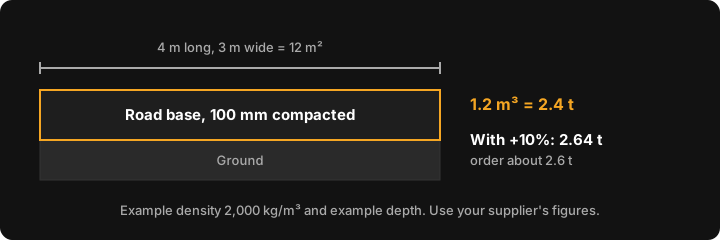
Tonnes = length × width × compacted depth (all in metres) × density ÷ 1,000. Then add about 10 percent. A 4 m × 3 m patio base, 100 mm compacted, is 1.2 m³. At an example density of 2,000 kg/m³ that is 2.4 tonnes, or about 2.6 with the allowance. Use your supplier's density, not mine.
How do I work out how much road base I need?
- Measure the area. Length × width in metres. For an odd shape, split it into rectangles and add them. See square metres to cubic metres if you start from an area.
- Decide the finished, compacted depth. Work in metres: 100 mm is 0.1 m. This is the depth after the plate compactor, not the depth of the loose heap you tip.
- Find the volume. Area × depth = cubic metres. More on the arithmetic in how to calculate cubic metres.
- Convert to tonnes. Cubic metres × density (kg/m³) ÷ 1,000. One tonne is 1,000 kg (NIST SP 811, Appendix B.8; checked on 28 October 2026).
- Add an allowance. About 10 percent is a common rule of thumb for spillage, uneven ground and edges. It is not a standard.
A worked example: a 4 m × 3 m patio base
Say the supplier tells you the compacted density is 2,000 kg/m³. That number is made up for this example. It is not a road base figure from a quarry or a standard.
- Area: 4 × 3 = 12 m².
- Volume at 100 mm compacted: 12 × 0.1 = 1.2 m³.
- Weight: 1.2 × 2,000 ÷ 1,000 = 2.4 t.
- With 10 percent on top: 2.4 × 1.10 = 2.64 t. Ring the supplier with "about 2.6 tonnes" and ask how they load and price it.
How many tonnes of road base per square metre?
Per square metre the answer depends only on depth and density: tonnes per m² = depth in metres × density ÷ 1,000. At the same example 2,000 kg/m³:
| Compacted depth | Tonnes per m² | m² covered by 1 tonne | 10 m² needs |
|---|---|---|---|
| 50 mm | 0.1 t | 10 m² | 1 t |
| 100 mm | 0.2 t | 5 m² | 2 t |
| 150 mm | 0.3 t | 3.3 m² | 3 t |
Worked sums for the 100 mm row: 0.1 × 2,000 ÷ 1,000 = 0.2 t per m²; 1 ÷ 0.2 = 5 m² per tonne; 10 × 0.2 = 2 t for 10 m². These depths show the arithmetic only. They are not recommendations. If your supplier's density is 1,800, scale the figures by 1,800 ÷ 2,000, which is 10 percent fewer tonnes: 2.4 × 0.9 = 2.16 t on the patio base. If it is 2,200, scale up by 10 percent: 2.4 × 1.1 = 2.64 t. Both numbers are made up to show the effect.
Why does loose versus compacted matter?
Road base is spread loose and then compacted, and it ends up thinner and denser than it arrived. So the volume you tip is larger than the finished layer, and the density that matters depends on which state the supplier quotes. Ask two questions: "What is the compacted tonnes per cubic metre?" and "Is that for the product you are quoting me?" Then use the compacted depth in the maths with that density. Densities and compaction factors vary by product, so this page gives neither. For the tonnes and cubic metres conversion in both directions, see cubic metres to tonnes.
Road base, crusher dust or Type 1: is it the same sum?
Yes. Whatever the product, the sum is area × compacted depth × density. What changes is the density, and the depth your job needs. Product names and specifications vary between suppliers and between countries, so ask for the supplier's data sheet and use the density that sheet gives for the exact product. A crusher dust bedding layer and a road base layer under it are two separate lines: work each out with its own depth and its own density, then add them. As an example, a 30 mm crusher dust bedding at 1,600 kg/m³ under the same 12 m² is 12 × 0.03 × 1,600 ÷ 1,000 = 0.576 t, on top of the 2.4 t of road base.
How much road base for a driveway?
Use the same method over the driveway's area, with the compacted depth your supplier, installer or council specifies. This page gives no depth, because the right figure depends on the ground and the traffic. A driveway with two layers is worked through in how much gravel do I need; swap in your road base density. If the drive is a slab rather than a base, see how much concrete do I need.
How much road base under pavers, or sub-base for a patio?
The sum is the worked example above. The depth is the part this page won't guess: paver makers publish laying guides, and councils and installers have their own requirements, so take the sub-base depth from one of them and write it down. Remember the sub-base is only one layer: the bedding layer and the pavers add to the finished height, which matters when the patio meets a door threshold or needs a fall for drainage. For the fall, see how much fall on a patio.
How much Type 1 do I need in the UK?
Type 1 is a common UK name for a crushed stone sub-base material. The sum is identical: area × compacted depth × density ÷ 1,000 for tonnes. UK suppliers often sell it by the tonne or in bulk bags, so ask what a bulk bag weighs and divide your tonnage by that, rounding up. As an example, 2.64 t in 0.8 t bags is 2.64 ÷ 0.8 = 3.3, so 4 bags. As with road base, this page gives no Type 1 density or depth, so use the figures your merchant gives for the exact product.
Why order more than the calculated figure?
Edges are never perfectly level, the ground below soaks some up, and a thick layer is easy to leave a little deep. About 10 percent covers the usual shortfall. MeisterCalc builds in the same 10 percent as Order (+10%). It is a flat allowance, not a compaction factor, so go higher for soft ground or a deep layer. Read the extra-material question in more detail in how much extra concrete to order; the reasoning carries over.
Doing it in MeisterCalc
There is no road base preset. Road base, crusher dust and Type 1 all go through the Gravel calculator once you enter the density.
- Open MeisterCalc and tap Gravel on the home screen (Home ▸ Gravel).
- Enter Length, Width and the compacted Depth. Millimetres are the default; feet and inches are under Settings ▸ Units ▸ Default units.
- Change Density (kg/m³). The app starts at 1,500, which is an app default and not a road base figure. Type in your supplier's compacted figure.
- Read Volume (m³), Weight (t) and Order (+10%) (t).
- Optional: enter a Price per tonne. A wastage slider then appears, from 0 to 30 percent, starting at 10, with Total Cost and Cost + N% Waste rows. Use Share results for text or PDF.
For the patio example, entering 4 m, 3 m, 100 mm and a density of 2,000 should give Volume 1.200 m³, Weight 2.400 t and Order (+10%) 2.640 t.
What the calculator doesn't do
- No compaction or moisture setting. Enter the compacted depth and the compacted density instead.
- No preset density for road base, crusher dust or Type 1, and no depth presets for patios, pavers or driveways.
- The 10 percent is flat. It is a rule of thumb, not a compaction factor.
- Density must be between 100 and 5,000 kg/m³.
- It does not know the depths your site, supplier or council requires.
Try it
Concrete, Stairs and Check Square are the free calculators. Gravel is among the other twelve, which unlock with a weekly subscription that starts with a 3-day free trial, or with a one-time lifetime unlock; Google Play shows the prices in your currency. Calculations work offline, on Android 7.0 or later. There's no iPhone version yet; you can join the iOS waitlist.
Sources
- NIST Guide to the SI, Appendix B.8: tonne = 1,000 kg. Checked on 28 October 2026.