How many cubic metres does a trailer or box trailer hold?
Published · Updated · By Sai Nath
A 6x4 box trailer holds about 0.7 cubic metres when filled level to the top of its sides: inside length × inside width × filled depth. That is volume only. Its weight limit usually stops a gravel load at roughly 0.25 to 0.35 m³. These figures come from two example trailers, so measure yours and read its compliance plate.
How many cubic metres in a 6x4 trailer?
About 0.7 m³ level full, from the two 6x4 trailers whose makers publish an inside size:
| Trailer | Inside L × W × H | Level full |
|---|---|---|
| MacGregor B64 unbraked | 1,950 × 1,250 × 290 mm | 0.707 m³ |
| Towsure 369 | 1,860 × 1,160 × 320 mm | 0.690 m³ |
| Nominal 6 × 4 ft, 300 mm sides assumed | 1,829 × 1,219 × 300 mm | 0.669 m³ |
Sizes from the makers' pages: MacGregor Supplies and Towsure (checked on 28 October 2026). Both are UK trailers; the volume sum is the same anywhere. The last row is worked out from the name alone, with an assumed side height. Treat all three as an example, not a standard.
Why is a 6x4 not 6 feet by 4 feet inside?
The name is a nominal, imperial, outside size. 6 ft is 6 × 0.3048 = 1.83 m and 4 ft is 4 × 0.3048 = 1.22 m (1 ft = 0.3048 m). The frame and sides take up some of that, so the box you load is smaller or simply different: 1.95 × 1.25 m on one trailer, 1.86 × 1.16 m on another. MacGregor's page says its dimensions and weights are guides only. Measuring your own trailer beats any table, including this one.
How do I work out my own trailer?
- Measure the inside length and width of the box floor in millimetres. If there are wheel arches, measure the clear width between them, and treat the arches as lost space.
- Pick the depth you will fill to, also in millimetres: the side height for a level-full load, or less.
- Convert to metres and multiply. 1.95 × 1.25 × 0.29 = 0.707 m³.
If you are new to the sum, how to calculate cubic metres covers it step by step.
Why weight, not volume, is the limit
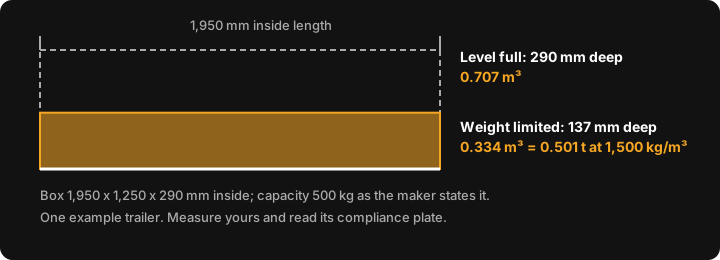
Level full of gravel, a 6x4 is usually overweight. Payload is what the trailer may carry, and it is set by the maker. The Towsure page lists a 369 kg capacity (499 kg maximum gross, 130 kg unladen). The MacGregor page states a 500 kg capacity. Divide the payload by the material's density to get the most volume you can carry:
| Trailer and payload | Density | Most volume | Depth over the floor |
|---|---|---|---|
| MacGregor B64, 500 kg | 1,500 kg/m³ | 0.333 m³ | 137 mm |
| MacGregor B64, 500 kg | 1,200 kg/m³ | 0.417 m³ | 171 mm |
| Towsure 369, 369 kg | 1,500 kg/m³ | 0.246 m³ | 114 mm |
| Towsure 369, 369 kg | 1,200 kg/m³ | 0.308 m³ | 143 mm |
Worked through for the first row: 500 ÷ 1,500 = 0.333 m³, and 0.333 ÷ (1.95 × 1.25) = 0.137 m, which is 137 mm. The densities, 1,500 and 1,200 kg/m³, are MeisterCalc's starting values for gravel and soil, not supplier figures. Your material may differ and wet material is heavier, so ask the supplier for its density. Filling the MacGregor box level full at 1,500 kg/m³ would put 1.95 × 1.25 × 0.29 × 1,500 ÷ 1,000 = 1.06 tonnes on it, more than double the stated capacity. That is why a 6x4 of gravel looks half empty and is still full by weight.
The maker's capacity, and the weight rules for your state or country, are on the trailer's compliance plate or sticker. In the UK, the gov.uk towing guide says the maximum authorised mass is normally shown on a plate or sticker fitted to the trailer (checked on 28 October 2026). This page doesn't quote the Australian or New Zealand limits; check your state road authority or Waka Kotahi (NZTA). To turn volume into tonnes yourself, see cubic metres to tonnes.
How many cubic metres in a 7x5 trailer?
It depends on the trailer's inside size and side height, and the name gives neither. A nominal 7 × 5 ft is 7 × 0.3048 = 2.13 m by 5 × 0.3048 = 1.52 m outside, and inventing a side height to build a volume on would be a guess. Measure the inside length, width and filled depth, then multiply as above. The weight limit works the same way: read the plate, then divide by the density.
How many cubic metres in a box trailer?
"Box trailer" covers every size, so there is no single answer. Volume is inside length × inside width × filled depth, and the cap is the plate payload divided by density. A 6x4 gives about 0.7 m³ level full. Bigger boxes hold more volume but carry no more weight unless the plate says so.
How big is a trailer load when a supplier sells one?
It varies by supplier, so this page quotes no standard figure. Ask what a trailer load means in cubic metres or tonnes, whether the trailer is theirs or yours, and whether they weigh it. Many sell by the tonne, which is safer, because it is the weight that matters to your trailer. A heaped load is not a bigger legal load: weight limits apply however high you pile it.
How much do I order for the job?
Work out the volume of the job first, then divide by your trailer's weight-limited load to find the number of trips. The calculations are in how much gravel do I need and how much soil do I need. As a made-up example, a job of 2.25 m³ at 1,500 kg/m³ is 3.375 t. At 0.5 t a trip, that is seven trips.
Doing it in MeisterCalc
MeisterCalc has no trailer calculator. Use the Gravel or Soil calculator as a box calculator:
- Tap Gravel (or Soil) on the home screen.
- Enter Length 1950 and Width 1250, the inside size of the box, in millimetres. Feet and inches are under Settings ▸ Units ▸ Default units.
- Enter the Depth you will fill to, for example 137.
- Set Density (kg/m³) to your supplier's figure. This example uses 1,500.
- Read Volume and Weight: 0.334 m³ and 0.501 t.
- Compare the weight with your trailer's payload. Change the depth until it fits.
The app shows volume in m³ and weight in tonnes, even in imperial mode, and the density is always in kg/m³.
What the calculator doesn't do
- It doesn't know your trailer's payload, mass limits or plate. You enter the box size and compare the weight yourself.
- It doesn't model wheel arches or a heaped load. Enter a flat depth.
- The help text says depth is the compacted depth. For a trailer, enter the depth of the load as it sits.
- The Order (+10%) line is the weight to order including 10% for waste and compaction, and doesn't apply to a trailer. Ignore it.
- It doesn't make a load legal. Road and weight rules are set by your state, country and the road authority.
Try it
Concrete, Stairs and Check Square are the free calculators. Gravel and Soil are among the other twelve, which unlock with a weekly subscription that starts with a 3-day free trial, or with a one-time lifetime unlock; Google Play shows the prices in your currency. Calculations work offline, on Android 7.0 or later. There's no iPhone version yet; you can join the iOS waitlist.
Sources
- MacGregor Supplies B64 unbraked trailer: inside 1,950 × 1,250 × 290 mm, stated capacity 500 kg. Checked on 28 October 2026.
- Towsure 369 6x4 trailer: inside 186 × 116 × 32 cm, capacity 369 kg. Checked on 28 October 2026.
- gov.uk, Towing with a car: maximum authorised mass normally shown on a plate or sticker. Checked on 28 October 2026.