How big should the gap between decking boards be?
Published · Updated · By Sai Nath
For timber decking in Australia, Forest and Wood Products Australia recommends a gap of 2 to 5 mm at installation, depending on hardwood or softwood, board cover width and how dry the boards are, and calls 3 to 4 mm ideal over the long term. Composite and other products have their own figures, so follow your board maker's installation guide.
Checked on 28 October 2026 against the WoodSolutions Technical Design Guide 21, Domestic Timber Deck Design (Forest and Wood Products Australia, revised October 2020, the edition checked on that date; the guide itself says to check the WoodSolutions site for a newer one). This page gives no figure for composite or for the UK, because no maker's or official guide was verified for them. A forum answer such as "3 mm" with no source is a guess. The arithmetic further down was worked by hand and matches the formula in MeisterCalc's Decking calculator.
What gap do timber decking boards need?
Table 4 of the guide gives the recommended gap at the time you lay the boards. The cover width is the visible width of the board.
| Timber | Cover width | Boards when laid | Gap at installation |
|---|---|---|---|
| Hardwood | 86 to 90 mm | Seasoned | 3 to 4 mm |
| Hardwood | 91 to 140 mm | Seasoned | 4 to 5 mm |
| Hardwood | 86 to 90 mm | Unseasoned | 2 to 3 mm |
| Hardwood | 91 to 140 mm | Unseasoned | 2 to 3 mm |
| Softwood | 70 to 90 mm | Seasoned | 3 to 4 mm |
| Softwood | 91 to 120 mm | Seasoned | 4 to 5 mm |
The same guide says a gap of 3 to 4 mm is ideal over the long term and that the gap must not be wide enough to be a trip hazard. In its section on decks close to the ground it asks for a minimum long-term spacing of 5 to 6 mm, for drainage and ventilation. It also asks for boards to be kept 10 mm clear of the building wall for drainage. These are an industry guide's recommendations. Your board maker's guide, the NCC and your council decide what applies to your deck, and MeisterCalc doesn't check any of it.
The guide has no row for unseasoned softwood, so for treated pine laid wet, ask the supplier or the maker.
Why is there a gap between decking boards?
The gap lets water drain and air move under the deck, and it leaves room for the timber to swell when wet and shrink when dry. Boards laid with no gap trap water and have nowhere to go when they expand. That is why the gap is part of the installation instructions rather than a matter of taste.
Who decides the gap, and where do I find it?
For timber, the table above is the starting point. The maker of your boards has the last word. Look in the installation guide that comes with the product or on the maker's website, and use the figure for your exact board and fixing method. Hidden-fixing clips often set the gap themselves, so the clip you buy decides it. Local rules and your council also apply to the deck as a whole. MeisterCalc doesn't set or check them.
Expect the guide to differ by product. A kiln-dried hardwood board, a treated pine board and a composite board are different materials and do not move the same way. Don't carry a figure from one product to another, and don't use a figure from a US page in inches without checking it against your own product's guide.
Does the gap change with moisture, board width or weather?
Yes. The guide says the gap depends on hardwood or softwood, the cover width and the moisture content of the boards when they are laid, and that unseasoned boards need less gap than seasoned ones. Wet boards shrink as they dry, so their gaps open up. Dry boards swell when they get wet, so their gaps close. That is why the table asks 2 to 3 mm for unseasoned hardwood and 3 to 5 mm for seasoned. Ask your supplier how dry the boards are on delivery.
Does the gap change how many boards I need?
Yes. Each board uses its own width plus one gap, so a bigger gap means fewer boards across. The calculation is the one in how many decking boards you need: boards across = deck width ÷ (board width + gap), rounded up. Lineal metres = boards across × deck length.
Here is one deck, 6 m long and 4 m wide (24 m²), with 90 mm boards. Worked for the 5 mm gap: 4000 ÷ (90 + 5) = 42.1, rounded up to 43 boards across; 43 × 6 = 258 m; 258 × 1.10 = 283.8 m to order.
The same sum at four gaps:
| Gap | 4000 ÷ (90 + gap) | Boards across | Lineal metres | Order (+10%) |
|---|---|---|---|---|
| 0 mm | 44.4 | 45 | 270 m | 297.0 m |
| 3 mm | 43.01 | 44 | 264 m | 290.4 m |
| 5 mm | 42.1 | 43 | 258 m | 283.8 m |
| 8 mm | 40.8 | 41 | 246 m | 270.6 m |
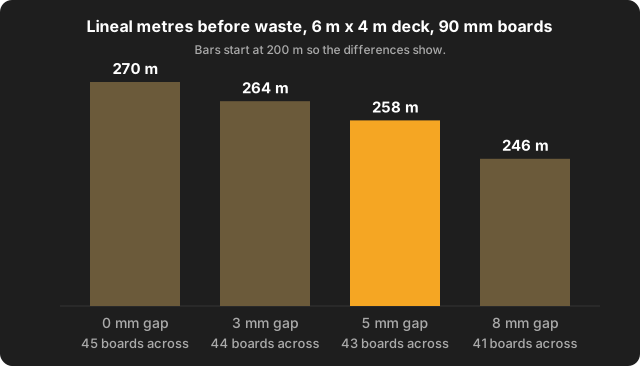
Two things to notice. First, the gap you pick moves the order by tens of metres, which is real money on a big deck. Second, the 3 mm row is a rounding trap: 4000 ÷ 93 is 43.01, so rounding up adds a 44th board for a sliver. The rounding rule is blunt near a whole number. In practice 43 boards at about 3.1 mm fit across 4000 mm, as the next section shows, and 3.1 mm sits inside the 3 to 4 mm the guide gives for seasoned 90 mm hardwood.
How do I make whole boards fit the width?
Work backwards from a whole number of boards. For n boards there are n − 1 gaps, so:
gap = (deck width − n × board width) ÷ (n − 1)
- 43 boards of 90 mm across 4000 mm: (4000 − 3870) ÷ 42 = 3.1 mm.
- 42 boards of 90 mm across 4000 mm: (4000 − 3780) ÷ 41 = 5.4 mm.
So a target gap of 5 mm leaves 15 mm over after 42 boards (42 × 90 + 41 × 5 = 3985 mm), and the 43rd board would be a thin rip. Opening the gap to 5.4 mm fits 42 boards exactly with no ripping, if your board's guide allows a gap that size (5.4 mm is above the 3 to 4 mm range for seasoned hardwood 90 mm wide, so it would not suit that board). If it doesn't, rip the last board or share a small change over the last few rows. This formula is plain arithmetic, not a feature of the app. Check it against your real frame width, measured at both ends.
How do I keep the gap even?
Use a spacer of the right thickness between boards as you fix each one, such as a purpose-made decking spacer or an offcut of known thickness. Check every few rows with a tape across five or six boards, so small errors don't build up. A frame that is out of square makes the last row taper, so square the deck frame before the first board goes down. If the last board is too narrow, there are ways to fix that too.
What if the last board doesn't fit?
Either rip the last board to the width that is left, or change the gap slightly over the last few rows, staying inside the maker's allowed range. Do the sum before the first board is fixed, using the formula above, and you can choose where the extra goes.
How do I use the Decking calculator for this?
MeisterCalc's Decking calculator has a Board Spacing input. It defaults to 5 mm, and 0 is allowed if boards are butted tight. Enter Deck Length, Deck Width, Board Width and your maker's gap. The results show Boards Across, Lineal Metres and Order (+10%), and the diagram updates as you change the spacing. The app's own help text calls the spacing the gap between adjacent boards for drainage and expansion. Try two gaps side by side to see the order change, as in the table above. Our decking calculator app guide covers the options, and square metres to lineal metres explains the conversion.
What the Decking calculator doesn't do
- It doesn't tell you what gap to use. You enter the maker's figure.
- It doesn't work out the gap needed to fit whole boards. Use the formula above.
- It doesn't cover stock lengths, joins, hidden-fixing layouts, borders or diagonal layouts.
- It rounds up to whole boards, so it can count a thin last row as a full board.
Try it
Decking is not one of the three free calculators. Concrete, Stairs and Check Square are free; the other 12, Decking included, unlock with a weekly subscription that starts with a 3-day free trial, or with a one-time lifetime unlock, and Google Play shows the prices in your currency. It works offline on Android 7.0 or later. There's no iPhone version yet; you can join the iOS waitlist.
Sources
- WoodSolutions Technical Design Guide 21, Domestic Timber Deck Design, Forest and Wood Products Australia, revised October 2020. Table 4 and the deck board spacing section. Checked on 28 October 2026.
- MeisterCalc's Decking calculator logic and help text, v1.0.3.