How much soil or topsoil do I need?
Published · Updated · By Sai Nath
Multiply length × width × depth, all in metres, to get cubic metres of soil. For tonnes, multiply by the soil's density in kg/m³ and divide by 1,000. A 2.4 m × 1.2 m raised bed filled 400 mm deep is 1.152 m³. Allow about 10 percent more for settling, so order roughly 1.27 m³.
How do I work out how much soil I need?
- Measure the bed or area. Length × width in metres. Split an odd shape into rectangles, work each one out and add them.
- Choose the depth of soil. Convert it to metres: 300 mm is 0.3 m.
- Find the volume. Length × width × depth = cubic metres. Many suppliers sell topsoil by volume or in bulk bags, so this may be all you need. See how to calculate cubic metres if the steps are unfamiliar.
- Convert to tonnes if you are sold by weight. Cubic metres × density (kg/m³) ÷ 1,000. A tonne is 1,000 kg (NIST SP 811, Appendix B.8; checked on 28 October 2026).
- Add an allowance. Soil settles once it is watered and firmed down. Ten percent is a rule of thumb, not a standard.
A worked example: a raised bed, 2.4 m × 1.2 m
The Royal Horticultural Society says 30 cm is deep enough for dwarf bulbs, salad leaves and strawberries, and most plants, especially fruit bushes, shrubs and small trees, need 45 cm or more. It also says to fill the bed to about 5 cm below the rim (RHS, raised beds; checked on 28 October 2026). So take a bed 450 mm deep, filled to 400 mm.
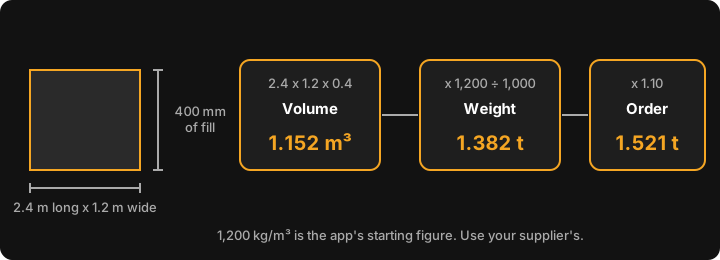
- Volume: 2.4 × 1.2 × 0.4 = 1.152 m³.
- Weight at 1,200 kg/m³: 1.152 × 1,200 ÷ 1,000 = 1.3824 t.
- With 10 percent on top: 1.3824 × 1.10 = 1.5206 t, which MeisterCalc shows as 1.521 t. In volume that is about 1.27 m³.
What should I fill a raised bed with?
Not straight topsoil. The RHS says 7 parts topsoil is enough for most raised beds, mixed with 3 parts organic matter (garden compost, leafmould or well-rotted manure) and 2 parts sharp sand, by volume (RHS, raised beds; checked on 28 October 2026). That is 12 parts in all, so for the 1.152 m³ bed above:
- Topsoil: 1.152 × 7 ÷ 12 = 0.672 m³.
- Compost or manure: 1.152 × 3 ÷ 12 = 0.288 m³.
- Sharp sand: 1.152 × 2 ÷ 12 = 0.192 m³.
Work out the settling allowance on each part: 0.672 × 1.10 = 0.739 m³ of topsoil, 0.288 × 1.10 = 0.317 m³ of compost or manure and 0.192 × 1.10 = 0.211 m³ of sharp sand. Then order each by its own unit. Those three products have different densities, so don't weigh the whole bed at one figure. The 1,200 kg/m³ in the earlier example is only for showing the arithmetic.
How many square metres does one cubic metre of soil cover?
One cubic metre covers 1 ÷ depth in metres square metres. This is plain arithmetic and holds for any loose material:
| Depth | m² covered by 1 m³ | m³ for 10 m² |
|---|---|---|
| 20 mm | 50 m² | 0.2 m³ |
| 50 mm | 20 m² | 0.5 m³ |
| 100 mm | 10 m² | 1 m³ |
| 150 mm | 6.7 m² | 1.5 m³ |
| 300 mm | 3.3 m² | 3 m³ |
Worked sums for the 150 mm row: 1 ÷ 0.15 = 6.7 m² per cubic metre, and 10 × 0.15 = 1.5 m³ for 10 m². If you only know the area, square metres to cubic metres explains the step from one to the other.
How many tonnes of topsoil do I need?
Volume × density ÷ 1,000. The hard part is the density, because soil is not one product. Dry, loose, damp and settled soil all weigh differently, and so do sandy and clay-rich blends. At the app's starting 1,200 kg/m³, 1 m³ is 1.2 t. At a made-up 1,000 kg/m³ it would be 1 t, and the 2.4 × 1.2 × 0.4 bed would need 1.152 t, not 1.382 t. That is why there is no density table here for bought topsoil. Ask your supplier for tonnes per cubic metre of the exact product, and whether the figure is loose or settled. The full conversion is in cubic metres to tonnes.
How much soil do I need to top dress a lawn?
The method is the same, with a very shallow depth. This page gives no depth for top dressing, so check the product's label or your supplier. As arithmetic only, take a lawn 10 m × 8 m and a layer 20 mm deep:
- Area: 10 × 8 = 80 m².
- Volume: 80 × 0.020 = 1.6 m³.
- With 10 percent on top: 1.76 m³.
For a lawn the depth is the number that swings the answer, since a 10 mm change over 80 m² is 80 × 0.010 = 0.8 m³. Measure the area carefully and settle the depth with your supplier before you order.
Why order more than the calculated volume?
Loose soil drops as it is watered and firmed. The RHS advice for raised beds is to firm the soil, leave it for a couple of weeks and top it up if it has dropped. An allowance of about 10 percent covers the usual shortfall. MeisterCalc builds in the same 10 percent as Order (+10%), but that figure is in tonnes, and it is the app's rule of thumb. A deep bed of fluffy compost-rich mix can drop more, so top up rather than assuming one order is enough.
Doing it in MeisterCalc
- Open MeisterCalc and tap Soil on the home screen (Home ▸ Soil).
- Enter Length, Width and Depth. Millimetres are the default; feet and inches are under Settings ▸ Units ▸ Default units.
- Change Density (kg/m³) from 1,200 to your supplier's figure.
- Read Volume (m³), Weight (t) and Order (+10%) (t).
- Optional: enter a Price per tonne. A wastage slider then appears, from 0 to 30 percent, starting at 10, with Total Cost and Cost + N% Waste rows. Use Share results for text or PDF.
For the 2.4 m × 1.2 m × 400 mm bed the card reads Volume 1.152 m³, Weight 1.382 t and Order (+10%) 1.521 t. Soil uses the same screen as Gravel and Asphalt, with a different starting density; compare it with how much gravel you need.
What the calculator doesn't do
- Rectangles only. Split a curved or L-shaped bed into rectangles and add the results.
- No settling or moisture setting beyond the fixed 10 percent. Put your supplier's density in instead.
- No cubic-metres-to-bags mode, no tonnes-to-cubic-metres mode, and no topsoil, compost and sand splitter. Do the 7:3:2 split by hand as above.
- Density must be between 100 and 5,000 kg/m³.
- It does not know your supplier's densities or how deep your lawn or bed should be. Your supplier does. For a pour rather than a fill, see how much concrete you need.
Try it
Concrete, Stairs and Check Square are the free calculators. Soil is among the other twelve, which unlock with a weekly subscription that starts with a 3-day free trial, or with a one-time lifetime unlock; Google Play shows the prices in your currency. Calculations work offline, on Android 7.0 or later. There's no iPhone version yet; you can join the iOS waitlist.
Sources
- Royal Horticultural Society, raised beds: depths of 30 cm and 45 cm, 7:3:2 fill mix, fill to 5 cm below the rim, firm and top up. Checked on 28 October 2026.
- NIST Guide to the SI, Appendix B.8: tonne = 1,000 kg. Checked on 28 October 2026.