How do I use the 3-4-5 rule to set out a right angle?
Published · Updated · By Sai Nath
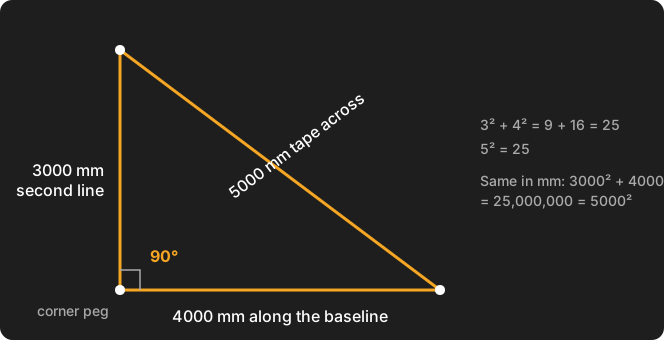
From the corner peg, mark 3 units along one line and 4 along a second line set roughly square to it. Hold a tape between the marks and swing the second line until it reads 5 units. The corner is then 90 degrees. Any multiple works: 600, 800 and 1000 mm, or 3, 4 and 5 m.
Why does 3-4-5 make a right angle?
Because 3² + 4² = 9 + 16 = 25 = 5². The converse of Pythagoras' theorem says that if the squares of two sides add up to the square of the third, the angle between those two sides is a right angle (Pythagorean theorem, Wikipedia). The numbers 3, 4 and 5 are the smallest whole-number set that does it (Pythagorean triple, Wikipedia), which is why a tradie can remember it and carry it in their head. Checked on 28 October 2026.
The ratio is what matters, not the unit. Any multiple of the sides gives the same triangle, only bigger. If you want the full background, Pythagoras in construction covers the theorem on its own.
How do I set out a right angle with the 3-4-5 method?
You need two tapes (or a tape and a string line), pegs or marks, and ideally a helper. This example uses metres for a slab or deck corner.
- Fix the baseline. Stretch a string line along the edge you trust, and put a peg at the corner where the right angle goes.
- Mark 4 m on the baseline. Hook the tape on the corner peg, pull it along the line and mark 4000 mm.
- Run a second line out roughly square. Pull a second string from the corner peg, by eye at about 90 degrees to the first. Mark 3000 mm along it from the corner peg.
- Measure across. With one tape hooked on the 4000 mm mark and the other end held on the 3000 mm mark, read the distance between them.
- Swing the second line. If the reading is over 5000 mm, the angle is too open: bring the 3 m mark in. If it is under, the angle is too tight: move it out. Keep the 3 m mark exactly 3000 mm from the corner peg as you swing.
- Fix it at 5000 mm. Drive a peg or tension the string at that spot. The line from the corner peg through the 3 m mark is square to the baseline. Extend it past the mark to the full length you need.
Measure from the same point on each mark every time, and keep the tape straight and tight. This is the same habit as in how to check if a frame is square.
Which numbers should I use: 3-4-5 or bigger?
Use the biggest multiple the job allows. Any multiple works because the shape is the same, and a bigger triangle makes the same tape error a smaller angle error. Some common choices (these are practical sizes, not rules from a code):
| Sides (mm) | Also written | Handy for |
|---|---|---|
| 600 – 800 – 1000 | (about 2 – 2.6 – 3.3 ft) | A quick check of a wall frame or tile layout corner |
| 900 – 1200 – 1500 | (about 3 – 4 – 5 ft) | Small decks, a sheet-size frame |
| 1500 – 2000 – 2500 | 1.5 – 2 – 2.5 m | Decks, pergolas, a garden path |
| 3000 – 4000 – 5000 | 3 – 4 – 5 m (about 10 – 13 – 16 ft) | A house slab or footing corner |
| 6000 – 8000 – 10 000 | 6 – 8 – 10 m | Large slabs and building set-out |
Each row is the 3-4-5 set multiplied by the same number: 200, 300, 500, 1000 or 2000 mm. Any whole-number multiple is also a Pythagorean triple (Wikipedia, checked on 28 October 2026). Imperial sets are 3-4-5 ft, 6-8-10 ft and so on.
How accurate is the 3-4-5 rule?
As accurate as your tape reading and your marks. The maths is exact, so the error is the measuring. Say you set out 3000 and 4000 mm and the tape across reads 5010 mm instead of 5000. The angle is then about 90.24 degrees, and the far end of the 4 m leg is about 17 mm out sideways.
The working is the cosine rule: cos θ = (3000² + 4000² − 5010²) ÷ (2 × 3000 × 4000) = (25,000,000 − 25,100,100) ÷ 24,000,000 = −0.00417, so θ = 90.24°. The sideways miss at the end of the 4000 mm leg is 4000 × sin(0.24°) = 16.7 mm, about 17 mm.
The same 10 mm reading error on different sizes:
| Triangle | Across reads | Angle you get |
|---|---|---|
| 600 – 800 – 1000 mm | 1010 mm | about 91.2° |
| 3000 – 4000 – 5000 mm | 5010 mm | about 90.24° |
| 6000 – 8000 – 10 000 mm | 10 010 mm | about 90.12° |
Doubling the triangle halves the angle error. The usual sources of a bad reading are a sagging tape, a hook that has slid, marks that wander when you swing the line, and sloping ground (measure level, or use a plumb line from the tape). Which tolerance a job needs comes from the drawings, the specification or the builder, not from this page.
What are the angles of a 3-4-5 triangle?
The right angle is 90 degrees and the other two are 36.87 degrees (opposite the 3 side) and 53.13 degrees (opposite the 4 side). They come from arctan(3 ÷ 4) = arctan(0.75) = 36.87° and arctan(4 ÷ 3) = arctan(1.3333) = 53.13°.
What if my sides aren't 3-4-5?
Use Pythagoras: the long side is √(a² + b²). For a 4800 × 3600 mm rectangle, 4800² + 3600² = 23,040,000 + 12,960,000 = 36,000,000, and the square root is 6000 mm. That is 3-4-5 again, with each unit 1200 mm, which is why 4800 × 3600 gives a round answer. A 3000 × 2400 mm frame gives √(9,000,000 + 5,760,000) = √14,760,000 = 3841.9 mm, not a round number, but the check is just as good.
The square-up diagonal calculator page has a table of target diagonals for common sizes, so you can read the third side without working it out each time.
Is 3-4-5 enough, or should I check the diagonals?
3-4-5 squares one corner. Once the whole rectangle is pegged or framed, measure both diagonals: if opposite sides match and the diagonals are equal, all four corners are square. A single 3-4-5 corner can be right while the far side is out, and the diagonals catch that. The full method is in how to check if a frame is square, and how to square a building uses both on a larger set-out.
Does it work for tiles, decks, slabs and footings?
Yes, for any job where you need one right angle from a baseline: the first tile corner, a deck or pergola, a slab, formwork or footings. Pick the multiple from the table above to suit the size. For a tile layout, 600-800-1000 mm is usually enough; for a house footing, 6-8-10 m is better than 3-4-5 m.
Did the Egyptians use the 3-4-5 rule?
It is often said they did, but it is not proven. Plutarch wrote that Egyptians admired the 3:4:5 triangle, and one historian has argued that rope-stretchers used it, yet another writes that there is no evidence they used it to construct right angles (3-4-5 triangle, Wikipedia, checked on 28 October 2026). It does not change how you use it.
Doing it in MeisterCalc
MeisterCalc doesn't generate a 3-4-5 set-out or check a corner you've built, but two calculators give you the numbers.
- Check Square (free): open Home ▸ Check Square, enter Length and Width, and the Target Diagonal is the third side. 4800 × 3600 mm gives 6000 mm. Switch to Is It Square? and enter two measured diagonals to see the racking gap: 5012 and 5000 mm is a 12 mm gap, so the frame is racked. When it's out, push until both diagonals read the same.
- Triangles: a right-triangle solver. Enter two values, such as Base and Rise, and it returns Hyp and both angles. Base 4000 and Rise 3000 gives Hyp 5000.0 mm, with Angle A 36.870° and Angle B 53.130°.
Both work offline. Check Square is one of the three free calculators (with Stairs and Concrete); Triangles unlocks with a weekly subscription that starts with a 3-day free trial, or a one-time lifetime unlock, with prices shown by Google Play. MeisterCalc is for Android 7.0 or later; there's no iPhone version yet, but you can join the iOS waitlist. The app gives numbers only; you still do the tape work on site.
Limits
- 3-4-5 sets out one corner. It doesn't prove a whole frame is square, or level, or plumb.
- Building rules, including how square work must be, come from the National Construction Code (ncc.abcb.gov.au) in Australia, the New Zealand Building Code in New Zealand, and your local council. This page gives no tolerance and MeisterCalc doesn't make work compliant. Checked on 28 October 2026.
- Metric sizes above are practical choices, not requirements.