How much screed do I need for a floor?
Published · Updated · By Sai Nath
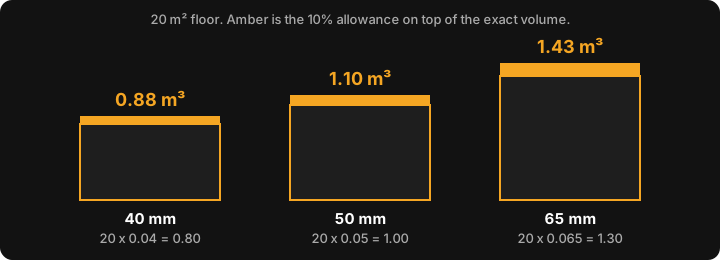
Multiply floor area in square metres by screed depth in metres to get cubic metres, then add 5 to 10% for waste. A 20 m² floor at 65 mm is 20 × 0.065 = 1.30 m³, so order about 1.43 m³. The depth is not a free choice: it comes from the screed type and the maker's data sheet.
The sum in six steps
- Measure the area. Length × width to the walls, in metres. Split an L-shaped room into rectangles and add them.
- Pick the depth from the screed type (next section) and write it in metres: 65 mm is 0.065.
- Volume = area × depth.
- Check the slab. If the base is not level, use the average depth (see the sloping floor section).
- Add the allowance, 5 to 10%.
- Convert to what you buy: tonnes, bags or cubic metres.
| Floor area | 40 mm | 50 mm | 65 mm |
|---|---|---|---|
| 10 m² | 0.40 m³ | 0.50 m³ | 0.65 m³ |
| 20 m² | 0.80 m³ | 1.00 m³ | 1.30 m³ |
| 30 m² | 1.20 m³ | 1.50 m³ | 1.95 m³ |
These are exact volumes, before any allowance. The same sum is used for slabs on how much concrete do I need; the unit work is on how to calculate cubic metres.
Worked sum for the 20 m² row: a room 5 m × 4 m is 5 × 4 = 20 m², and at 65 mm that is 20 × 0.065 = 1.30 m³.
How thick should the screed be?
It depends on the type: bonded to the slab, unbonded on a membrane, or floating on insulation, and sand-cement or calcium sulphate (flowing). The figures below are from the Designing Buildings wiki, which summarises BS 8204 and was last edited on 15 September 2020 (Designing Buildings, Screed, checked on 28 October 2026). It hedges most of them as typical values.
| Screed | Sand-cement | Calcium sulphate (flowing) |
|---|---|---|
| Bonded | generally about 25 to 40 mm | minimum 12 mm |
| Unbonded | usually about 50 mm | minimum 30 mm |
| Floating | over 65 mm, light loads; 75 mm, heavy loads | 35 mm domestic; 40 mm commercial |
One maker's data shows how much products differ. Tarmac's Topflow Screed C lists 50 mm unbonded and, floating over insulation, 35 mm residential and 40 mm commercial (NBS Source product data, checked on 28 October 2026). When the sheet and a table disagree, the sheet for the product you are buying wins, then your designer's specification.
How much screed over underfloor heating?
Here "depth" and "cover" get mixed up. Cover is the screed above the top of the pipe. If the pipes sit on the insulation, total depth = pipe diameter + cover.
- Designing Buildings gives a 65 mm minimum for sand-cement over underfloor heating, ideally 65 to 75 mm, and as little as 20 mm of cover for specialised calcium sulphate screeds (source, checked on 28 October 2026).
- Tarmac's data lists a nominal 30 mm cover to the pipes for Topflow Screed C (source, checked on 28 October 2026).
Worked example, with an assumed 16 mm pipe: 16 + 30 = 46 mm. For 20 m² that is 20 × 0.046 = 0.92 m³. Use your own pipe size and your product's cover figure.
What if the slab is sloping or uneven?
Use the average depth. If a 20 m² slab runs from 55 mm at the high side to 75 mm at the low side, the average is (55 + 75) ÷ 2 = 65 mm, which gives the same 1.30 m³. For a slab that is lumpy rather than evenly sloping, measure the depth to the base at several points and average them. The depth you measure must still meet the minimum at the high point.
How much extra screed should I order?
Add 5 to 10%. The slab is never a perfect box, and some mix stays in the barrow, hose or pump line. On the example, 1.30 × 1.10 = 1.43 m³, or 1.30 × 1.05 = 1.37 m³. These are rules of thumb, not a supplier or code figure. The reasoning is the same as how much extra concrete to order, and your supplier's advice comes first.
How many tonnes or bags of screed do I need?
1 m³ is 1000 litres. For tonnes you need the density of the product. Tarmac lists Topflow Screed C at 2200 kg/m³ wet and 2000 kg/m³ dry (NBS Source, checked on 28 October 2026). A flowing screed at 40 mm over 20 m² is 20 × 0.04 = 0.80 m³; with 10% that is 0.80 × 1.10 = 0.88 m³, and at the wet density 0.88 × 2200 ÷ 1000 = 1.94 t. A sand-cement mix has a different density, so use your supplier's figure. The idea behind it is on cubic metres to tonnes.
For bags, use the yield printed on the bag: bags needed = order volume in litres ÷ litres per bag, rounded up. This page gives no bag yield, because it differs by product. As an assumed example only, a bag that makes 12 litres covers 12 ÷ 65 = 0.18 m² at 65 mm, and the 1.43 m³ order (1,430 litres) needs 1,430 ÷ 12 = 119.2, so 120 bags.
Does liquid screed change the quantity?
The volume sum is the same: area × depth. Flowing screeds can be laid thinner (see the table), which is why the depth, not the maths, changes the total. They are usually ordered by the cubic metre or tonne from the supplier, so ask for a quote. This page gives no prices.
How to do it in MeisterCalc
- Open Home ▸ Concrete ▸ Slab.
- Enter length 5000, width 4000 and depth 65 (millimetres).
- Read Volume 1.300 m³, Volume 1300.0 L and Order (+10%) 1.430 m³.
The Concrete calculator is built for concrete, so its help text and diagram talk about concrete, but the volume sum is the same. Limits: it gives volume only, with no tonnes, bags, mixes or underfloor heating cover, it takes one rectangle at a time, and for a sloping base you work out the average depth first. The Order row is fixed at 10%. Concrete is one of three free MeisterCalc calculators, with Stairs and Check Square. It works offline, on Android 7.0 or later. There is no iPhone version yet.
Questions people ask
How many square metres does a bag of screed cover?
It depends on the product and depth, so read the yield on the bag. Divide the litres per bag by the depth in millimetres to get square metres per bag.
How much screed do I need for 10 m²?
At 50 mm it is 0.50 m³, or about 0.55 m³ with 10% extra. The depth must suit your screed type.
Is 40 mm enough?
Only for some types. Flowing calcium sulphate screeds are listed from 35 mm floating, but sand-cement floating is over 65 mm. Check the data sheet.
Limits of this page
Depths and covers come from the sources linked above, checked on 28 October 2026, and BS 8204 itself was not read for this page. Your screed's data sheet, the designer's specification and the Building Regulations, NCC or local council requirements set what you must do. MeisterCalc does not make work compliant.