Can you trust ChatGPT for construction maths?
Published · By Sai Nath

Trust ChatGPT to explain a method, not to set your numbers. Chatbots can run code for the sums, which makes the arithmetic more reliable, but they can still get the setup wrong: a going counted for every riser, millimetres mixed with feet and inches, a count rounded down. Check any number bound for a cut list or order.
What do chatbots get right for site maths?
Explaining a method, and more and more of the arithmetic. Ask what 2R + G means, or how to get cubic metres from millimetres, and you will usually get the formula laid out step by step. In a 2025 study of six chatbot models on engineering exam questions, theory questions were their strongest type, at 84% correct on average (Oblitas and colleagues, in the research below).
Many chatbots can now write and run a short program for a sum instead of working it in their heads. OpenAI's help page on accuracy lists a code tool for ChatGPT, available depending on the plan, and says it enables accurate calculations. When the code runs, the computer does the multiplication, not the language model.
That matters, because the models on their own were weak at long sums. In a 2023 NeurIPS study, ChatGPT and GPT-4 working without tools got only 55% and 59% of 3-digit by 3-digit multiplications right (Dziri and colleagues). A 2025 study had ChatGPT work out the bearing capacity of piles to the API RP 2A design standard: the Python code it wrote gave reliable results, and its direct calculations were less reliable (Kim, Kim and Youn).
So a plain multiplication slip is less of a worry than it was, as long as the sum actually runs as code. The code still does whatever the model decided the question was.
Where do chatbots still go wrong on site maths?
In the setup: what to count, which units, which way to round and which rule applies. Those are decisions, not arithmetic, and running code doesn't make them for you.
What is being counted
A flight with 15 risers has 14 treads, because the top floor is the last step up (why there is one more riser than treads). A 3.6 m wall with studs at 450 mm centres has 8 spaces and 9 studs (how many studs). When a question says "steps", the answer depends on whether that means risers or treads, and a chatbot has to guess unless you say.
Units: millimetres, metres, feet and inches
Mixed units in one question are where conversions slip. 8 ft 10 in is 8.83 ft, not 8.10 ft, and the difference is 224 mm. A slope of 22.5 could be degrees or percent: 22.5° is a 41.4% grade, and a 22.5% grade is 12.7° (slope percentage to degrees). Roof pitch has the same trap: a 6/12 pitch is 26.57°, not 6° (roof pitch in degrees). For converting millimetres to feet, inches and sixteenths by hand, see mm to feet and inches.
Which way to round
Some numbers must round up, whatever the decimal says. Divide a floor height by a maximum riser and round up, or one riser ends up over the limit. Studs, bags, sheets and loads round up too, and an order rounds up to what the supplier sells. Rounding to the nearest is wrong for all of them.
An example: six post holes 300 mm across and 800 mm deep hold 0.339 m³, and 0.373 m³ with 10% extra (concrete for post holes). At Boral's figure of 108 bags of its 20 kg Concrete Mix per cubic metre (bags per cubic metre), that is 0.373 × 108 = 40.3 bags. Buy 41, not 40. More on margins in how much extra concrete to order.
Different answers to the same question
Two things cause it. First, many site questions have more than one defensible method. A 3 m floor height gives 17 risers of 176.5 mm by the comfort rule, or 16 risers of 187.5 mm if you divide by a 190 mm maximum and round up. A question that doesn't name the rule gets whichever one is assumed. Second, chatbots generate text with some randomness. The authors of the December 2025 exam study (Oblitas and colleagues) note that answers to the same prompt can change from one session to the next, and call their own scores indicative. If you get two different answers, treat both as unchecked.
Photos of plans and sketches
In the same study, the chatbots averaged 87% on text questions and 42% on questions that came with a figure, graph or diagram. Type the dimensions in rather than relying on a photo of a plan.
Sounding sure
OpenAI's help page warns that ChatGPT can sound confident even when it is wrong. The tone of an answer tells you nothing about the number.
What does the research say?
Newer chatbots score better on engineering exam questions, but calculation-heavy topics such as statics stay the weakest, and the authors describe the tools as a supplement or a tutor for students.
| Study | What was tested | Result |
|---|---|---|
| Genç, Journal of Asian Architecture and Building Engineering, October 2025 | The paid ChatGPT-4, on 100 sample questions from the US Fundamentals of Engineering (FE) Civil exam, with no worked example in the prompt | 49% correct overall, 14% in Statics and 100% in Ethics and Professional Practice. Adding one worked example to the prompt fixed 30 of the 51 wrong answers. |
| Oblitas, Adeeb and Cruz-Noguez, Discover Artificial Intelligence, December 2025 | Six chatbot models, including ChatGPT o3, ChatGPT-4o and Gemini 2.5 Pro, on the 100-question official FE Civil Practice Exam, with the whole solution marked | Four models above 70% and two above 60%. Text questions 87% on average, questions with a figure 42%, numerical questions 70%. Lowest in Structural Engineering and Statics. |
| Kim, Kim and Youn, Developments in the Built Environment, 2025 | ChatGPT calculating pile bearing capacity to API RP 2A, directly and by writing Python code | The generated code gave reliable results; the direct calculations were less reliable. |
| Dziri and colleagues, NeurIPS 2023 | ChatGPT and GPT-4 on multi-digit multiplication, without tools | 55% and 59% correct on 3-digit by 3-digit multiplication. |
Read these with care. The FE exam is a US engineering licensing exam, harder than most site sums. Each study is a snapshot of named models: Genç notes that newer models may do differently, and the newer models in the December 2025 study did score higher. The studies used different question sets and marking, so their percentages don't compare directly. What they share is an answer key to mark against. On site there isn't one, so the check is yours.
The companies say the same. OpenAI's help page tells users to treat ChatGPT as a first draft and to verify data and technical information: "Please check important information." Anthropic's help centre says users "should not rely on Claude as a singular source of truth" and should scrutinise high-stakes advice.
Worked example: a 2.7 m floor-to-floor stair, right and wrong
A house stair in Australia, 2700 mm floor to floor (8 ft 10 5/16 in), with a 250 mm going. The NCC Housing Provisions allow risers of 115 to 190 mm, goings of 240 to 355 mm and 2R + G of 550 to 700 mm for a stair that isn't spiral (NCC 2022 Housing Provisions, Table 11.2.2a). Worked by hand, with the riser count found the way MeisterCalc's Stairs calculator finds it:
- Target riser from the going: (600 − 250) ÷ 2 = 175 mm.
- Number of risers: 2700 ÷ 175 = 15.43, which rounds to 15.
- Each riser: 2700 ÷ 15 = 180.0 mm (7 1/16 in). Check: 15 × 180 = 2700.
- Treads: 15 − 1 = 14. The flight's going, from the first riser to the last, is 14 × 250 = 3500 mm.
- Limits: 180 mm is inside 115 to 190 mm, and 2 × 180 + 250 = 610 mm is inside 550 to 700 mm.
- Against the maximum: 2700 ÷ 190 = 14.21, which rounds up to 15. The two methods agree here.
The answer: 15 risers of 180 mm and 14 treads of 250 mm. Here is where three wrong setups lead:
- Rounding the count to the nearest, not up. 2700 ÷ 190 = 14.21, rounded to 14, gives risers of 2700 ÷ 14 = 192.9 mm, each 2.9 mm over the 190 mm maximum.
- Counting a going for every riser. 15 × 250 = 3750 mm of floor, 250 mm more than the flight needs. Squeeze 15 goings into the 3500 mm you have and each is 3500 ÷ 15 = 233 mm, under the 240 mm minimum.
- Writing 8 ft 10 5/16 in as 8.10 ft. 8.10 × 304.8 = 2469 mm, and 2469 ÷ 175 = 14.1 gives 14 risers of 176.3 mm. The flight stops 231 mm below the upper floor. 2700 mm is 8.86 ft.
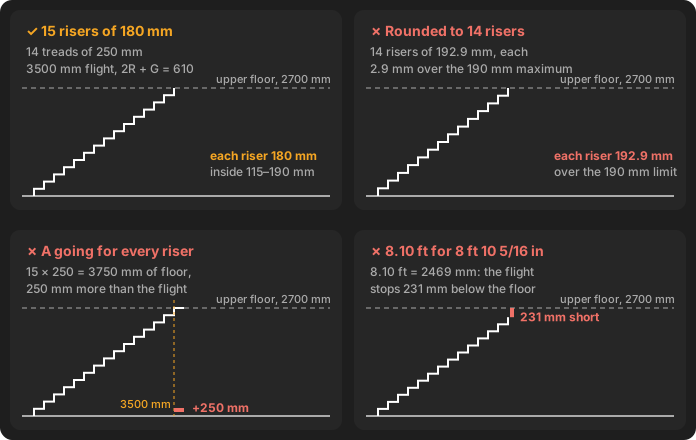
None of these is a slip in the arithmetic. Each is a correct sum on a wrong setup, so running it as code wouldn't catch it. Four checks would: multiply back (15 × 180 = 2700), compare the riser with the maximum, compare the going with the minimum, and check 2R + G. The wrong setups are worked by hand to show the kinds of mistake described above. They are not quotes from a chatbot.
One thing to know about our own tool: in Rise Only, MeisterCalc works its Total Run, and the Base on its diagram, from 15 goings (3750 mm), one more than the 14 treads. The risers, riser height and treads are not affected. The going guide explains it. Whatever tool you use, check what each number measures. The 2R + G guide covers the comfort rule in more depth.
How do I use ChatGPT safely for site maths?
- Give every number its unit. "Floor to floor 2700 mm, going 250 mm", not "2.7 and 250". In imperial, write 8 ft 10 5/16 in, never 8.10.
- Say what you are counting and how to round. "How many risers, rounded up so no riser is over 190 mm?"
- Name the place and the rule. "A house stair in Australia, under the NCC Housing Provisions." Then read the clause yourself at the official source.
- Ask for the formula with your numbers in it, before the answer. A wrong setup is easier to spot in the formula than in the result.
- Ask it to run the sum as code and show the code, if it can.
- Check the answer back. Multiply back, compare with the limits, and put the same inputs through a calculator.
- Round counts and orders up yourself: risers from a maximum, studs, bags, sheets and loads.
- Type the dimensions instead of uploading a photo of the plan.
- Let the rules decide. Stair, balustrade and fall limits come from the NCC, the NZ Building Code or the Approved Documents, and your council or certifier, not from a chatbot or an app. Rules differ by country: the floor-height guide compares the NCC with England's Approved Document K.
When is a calculator the better tool?
Whenever the number goes on a cut list, an order or a set-out. A calculator built for the job asks for each measurement in its own labelled field, uses one fixed formula, and gives the same answer for the same inputs every time. A chatbot is better at the why: what the going is, why 2R + G is used, what a clause says, which you then check at the source.
Where MeisterCalc fits:
- Offline. Every calculation runs on the phone, so it works on site without signal.
- Metric first. Lengths are in millimetres by default (a construction calculator in millimetres). Feet, inches and sixteenths are under Settings ▸ Units ▸ Default units ▸ Imperial (ft/in), where each length has its own ft and in boxes and a fraction picker, so 8 ft 10 5/16 in can't turn into 8.10.
- A live diagram. Each of the 16 calculators has a diagram that redraws as you type. On Stairs it labels the height, rise and going, so you can see what each number refers to before you use it.
- Free and paid. Concrete, Stairs and Check Square are free. The other 13 unlock with a weekly subscription that starts with a 3-day free trial, or with a one-time lifetime unlock (what is free).
- Not a chatbot. It won't explain a clause or guess what you meant, and it doesn't check your work against the NCC or any other rule.
What this page doesn't do
- It doesn't rank one chatbot against another. Models change every few months, and the studies above are snapshots of named models.
- No chatbot was run for this page. The wrong setups in the worked example are worked by hand.
- It doesn't decide what is allowed. The NCC, the NZ Building Code or the Approved Documents, and your council or certifier do.
- MeisterCalc runs on Android 7.0 or later. Its Stairs calculator doesn't design landings, winders or spiral stairs.
Try it
Stairs is one of three MeisterCalc calculators that are free to use, along with Concrete and Check Square. The other 13 unlock with a weekly subscription that starts with a 3-day free trial, or with a one-time lifetime unlock; Google Play shows the prices in your currency.
Sources
- Genç, O. (2025), Is conversational AI ready for engineering licensure? A ChatGPT performance benchmark and prompting strategy evaluation, Journal of Asian Architecture and Building Engineering.
- Oblitas, L., Adeeb, S. and Cruz-Noguez, C. (2025), Performance of AI Chatbots on the fundamentals of engineering civil exam, Discover Artificial Intelligence 5, article 378.
- Kim, S., Kim, D. and Youn, H. (2025), Automating vertical bearing capacity calculations using python: Prompt engineering of ChatGPT on API RP 2A, Developments in the Built Environment 21, 100628.
- Dziri, N. and colleagues (2023), Faith and Fate: Limits of Transformers on Compositionality, NeurIPS 2023.
- OpenAI, Does ChatGPT tell the truth? (help article)
- Anthropic, Claude is providing incorrect or misleading responses. What's going on? (help article)
- NCC 2022 Housing Provisions, Part 11.2 Stairway and ramp construction
Checked on 1 November 2026.