What is the minimum fall for a gutter?
Published · Updated · By Sai Nath
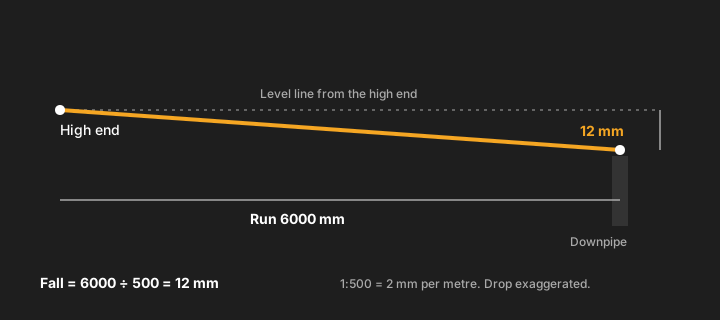
In Australia, an eaves gutter must be installed with a fall of not less than 1:500 (NCC 2022 Housing Provisions, clause 7.4.4(1)(a)). That is 2 mm per metre: 12 mm over 6 m, 24 mm over 12 m. It is a minimum, not a target. This page covers fall only, not gutter or downpipe size.
What does a fall of 1:500 mean?
For every 500 mm along the gutter, the bottom drops 1 mm. Fall in millimetres = run in millimetres ÷ 500. Divide, do not multiply: a 6000 mm run gives 6000 ÷ 500 = 12 mm. As a percentage it is 0.2%, and as an angle it is about 0.115 degrees. Checked on 28 October 2026 against the NCC 2022 Housing Provisions, Part 7.4.
What is the gutter fall per metre?
2 mm per metre at the minimum of 1:500. The NCC clause reads that eaves gutters are to be “installed with a fall of not less than 1:500”. Anything steeper still meets the minimum. People often write the same thing as a slope, a pitch or a drop per metre; the word in the rule is fall. The NCC 2025 edition keeps the 1:500 and adds “unless designed in accordance with AS/NZS 3500.3”, the plumbing standard, so a flatter gutter is possible only when it is designed to that standard.
How much fall is that over 6 m and longer runs?
Run ÷ 500. Over 6 m the fall is 12 mm. The table gives the minimum drop from the high end to the low end for common runs.
| Gutter run | Fall at 1:500 |
|---|---|
| 2 m | 4 mm |
| 3 m | 6 mm |
| 4 m | 8 mm |
| 5 m | 10 mm |
| 6 m | 12 mm |
| 8 m | 16 mm |
| 10 m | 20 mm |
| 12 m | 24 mm |
| 15 m | 30 mm |
The run is the length of gutter that drains to one outlet, not the length of the house. If the downpipe is at one end, the whole run falls one way. If it sits in the middle, the gutter falls both ways and each half is a separate run: two 4.8 m runs need 9.6 mm each, not 19.2 mm over the whole 9.6 m. For other ratios, see how much fall is 1 in 100 in millimetres.
How do I set the fall out on site?
Worked example: a 9.6 m gutter with one downpipe at the low end, at 1:500. The drop is 9600 ÷ 500 = 19.2 mm, call it 19 mm.
- Fix the high bracket at its finished height and note the height below a level reference line, say 2400 mm.
- Mark the low end 19.2 mm lower on the same reference: 2419.2 mm (about 2419 mm).
- Pull a string line between the two marks. The middle should sit 9.6 mm below the high end.
- Mark the bracket positions along the string at the spacing the gutter maker sets, then fix each bracket to the line.
- Check with water. A bucket poured at the high end should run to the outlet with no pooling.
A fall of 2 mm per metre is hard to see. A gutter that looks level is rarely 12 mm out over 6 m, so measure it. If you read levels with a dumpy level, how to use a dumpy level covers the set-up. For a patio, driveway or slab, the rules are different: see how much fall on a patio.
What about box gutters and valley gutters?
They are a different rule. The NCC 2022 note under clause 7.4.1 says that where box gutters are proposed, AS/NZS 3500.3 may be used to calculate minimum sizes, falls and overflow requirements. The note under clause 7.4.4 says roofs with pitches less than 12.5 degrees may have valley gutters designed as box gutters under AS/NZS 3500.3, or as a Performance Solution by a professional engineer or other appropriately qualified person. The 1:500 figure above is for eaves gutters. Part 7.4 gives no fall figure for box gutters, so this page gives none. Checked on 28 October 2026. Source: NCC 2022 Housing Provisions, Part 7.4.
What is the minimum fall for gutters in NZ and the UK?
Neither gives a number. In New Zealand, Acceptable Solution E1/AS1, paragraph 5.3.1, says only “Roof gutters shall fall to an outlet” (E1/AS1, PDF). In England, Approved Document H, H3 paragraph 1.6, says gutters “should be laid with any fall towards the nearest outlet” (Approved Document H, PDF). So the figure comes from the gutter maker's instructions and your plumber. Checked on 28 October 2026. The 1:500 above is Australian; do not take it as theirs.
Is more fall better?
The NCC sets a floor, not a goal. Gutter makers publish their own installation instructions, and this page has not checked any of them. Follow the maker's instructions for the product you are fixing; where they ask for more than 1:500, they win. Your council or certifier has the last word on a particular job.
Doing it in MeisterCalc
The app has no gutter calculator and no “1 in N” field. What it can do is turn a ratio into a fall: 1:500 is a 0.2% grade, and Pitch gives the drop for a run. It also checks a measured fall, turning a drop and a run into a percentage, and Equal Spacings divides the bracket positions evenly.
- Open MeisterCalc and tap Pitch on the home screen.
- Choose the Run + Grade mode. Enter the gutter length as Run (6000 mm) and 0.2 as % Grade. The diagram’s Rise label shows 12.0 mm, the minimum fall. (For 9600 mm the same entry gives 19.2 mm.)
- To check a fall you have measured, choose the Rise + Run mode instead. Enter the measured drop as Rise (say 12 mm) and the gutter length as Run (6000 mm).
- Read the % Grade: 0.20%. The Angle row shows 0.11°. A reading of 0.2% or more is at or above 1:500 (0.2% is 100 ÷ 500).
- For the bracket positions, tap Equal Spacings, enter the Overall Length and a Target Spacing, and read the Number of Spaces and the Actual Spacing. The app rounds to the nearest whole number of spaces, so the actual spacing can come out larger than your target; check it against the gutter maker's limit. For example, a 6000 mm run with a 900 mm target gives 6000 ÷ 900 = 6.67, so 7 Spaces, an Actual Spacing of 857.1 mm and 8 Pieces Needed.
Millimetres are the default; feet and inches are under Settings ▸ Units ▸ Default units ▸ Imperial (ft/in). For ratios and percentages in general, see how to calculate fall.
What the app doesn't do
- It does not know the NCC or any other rule, and it does not flag whether a fall complies.
- It does not size gutters or downpipes, or check overflow.
- It has no “1 in N” input. You enter the ratio as a percentage (1:500 is 0.2%), or enter the drop and the run and read the percentage.
- It doesn't measure anything. The result is only as good as your tape and level.
- Building rules are set by the NCC, the NZ Building Code or Approved Documents, and your local council, not by this page or the app.
Try it
Pitch and Equal Spacings are among the MeisterCalc calculators that unlock with a weekly subscription that starts with a 3-day free trial, or with a one-time lifetime unlock; Google Play shows the prices in your currency. Concrete, Stairs and Check Square are free. It works offline, on Android 7.0 or later. There's no iPhone version yet; you can join the iOS waitlist.
Sources
- NCC 2022 Housing Provisions, Part 7.4 Gutters and downpipes (Australian Building Codes Board), checked on 28 October 2026.
- NCC 2025 Housing Provisions, Part 7.4: the same 1:500, with the AS/NZS 3500.3 exception. Checked on 28 October 2026.
- Acceptable Solution E1/AS1 Surface Water (NZ, MBIE), paragraph 5.3.1. Checked on 28 October 2026.
- Approved Document H (2015 edition) (England), H3 paragraph 1.6. Checked on 28 October 2026.