How much concrete do I need for a slab?
Published · Updated · By Sai Nath
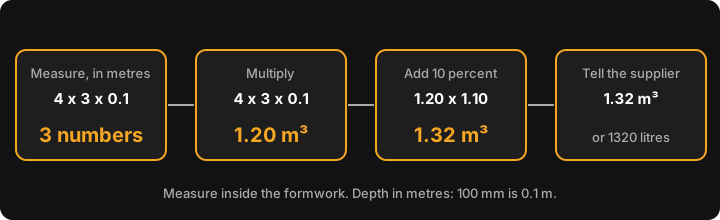
Multiply the slab's length, width and depth, all in metres, to get cubic metres. A 4 m × 3 m slab, 100 mm deep, is 4 × 3 × 0.1 = 1.20 m³. Add 10% for low spots and spillage and order 1.32 m³. MeisterCalc's free Concrete calculator does the same sum.
How to work out the concrete for a slab
- Measure inside the formwork. The concrete fills the space between the inside faces of the form boards, so measure there, not to the outside of the boards.
- Convert millimetres to metres. Divide by 1000: 4000 mm is 4 m, 3000 mm is 3 m and 100 mm is 0.1 m. Typing 0.01 instead of 0.1 is a tenfold mistake, so check this step twice.
- Multiply. 4 × 3 × 0.1 = 1.20 m³. That is 1200 litres.
- Add 10%. 1.20 × 1.10 = 1.32 m³. That is the figure to give the supplier.
If you only want a calculator in the browser, there is one on the concrete calculator in m³ page.
How do I calculate concrete volume in m³?
Volume in cubic metres is length × width × depth, with every measurement in metres. For a round slab, use π × radius² × depth: a 2 m wide round pad, 100 mm deep, is 3.1416 × 1 × 0.1 = 0.314 m³, or 0.346 m³ with 10%. For an L-shape, split it into rectangles and add them: 4 × 3 m plus 2 × 1.5 m, both 100 mm deep, is 1.2 + 0.3 = 1.5 m³, or 1.65 m³ with 10%.
Slabs with thickened edges, beams or steps are the same idea: work out each part as its own box and add them. Strip footings have their own page: how much concrete for a strip footing.
Why add 10%, and when is it not enough?
The extra covers what a perfect box does not: a base that is a little low in places, concrete that spills over the formwork, and what stays in the chute or barrow. Boral, an Australian supplier, says it is common to allow a small margin for ground variation and spillage, and that the right allowance varies with the project and site (Boral concrete calculator, checked on 28 October 2026). The 10% is a sensible starting point, not a rule.
Depth is where jobs go over. If the base is 10 mm low across a 12 m² slab, that is 12 × 0.01 = 0.12 m³ extra, which is nearly all of the 10% on a 1.2 m³ job. Measure the depth to the base at several points, not once, and allow more than 10% on rough or soft ground. Running short in the middle of a pour is worse than having a barrow load left over. The full reasoning is in how much extra concrete to order.
How much concrete for a path, shed base or driveway?
Use the same sum for each. The sizes below are examples to show the arithmetic, not recommendations. The depth is whatever your plans, engineer or council specify.
| Job (example size) | Length × width | Example depth | Volume (m³) | Order, +10% (m³) |
|---|---|---|---|---|
| Path | 5 × 1 m | 100 mm | 0.50 | 0.55 |
| Shed base | 3 × 2.4 m | 100 mm | 0.72 | 0.79 |
| Patio | 4 × 3 m | 100 mm | 1.20 | 1.32 |
| Driveway, one car wide | 6 × 3 m | 125 mm | 2.25 | 2.48 |
| Double garage slab | 6 × 6 m | 125 mm | 4.50 | 4.95 |
Worked by hand from length × width × depth. For the path: 5 × 1 × 0.1 = 0.50 m³, and 0.50 × 1.10 = 0.55 m³. For the shed base: 3 × 2.4 × 0.1 = 0.72 m³, and 0.72 × 1.10 = 0.792, so 0.79 m³. Depth matters as much as area: the same 6 × 3 m driveway is 1.80 m³ at 100 mm and 2.25 m³ at 125 mm, so take the depth from your plans, not from a table.
Ready-mix or bags?
Bags suit small jobs, such as a path or a few post holes. The yield is on the bag and differs by product: Boral's data sheet says 108 bags of its 20 kg Concrete Mix make 1 m³, so 1.32 m³ is 1.32 × 108 = 142.6, which rounds up to 143 bags of that mix. Mixing that by hand is a long day, so for a patio-sized slab get a ready-mix price as well. Other makers' yields are in how many 20 kg bags of concrete make a cubic metre, and the concrete calculator in m³ counts the bags for you.
Ready-mix is ordered in cubic metres. Boral says many agitator trucks carry around 6 to 8 m³ a load and that minimum order quantities vary with the plant, so ring the local plant and ask what the smallest load is and whether a small order costs extra (Boral, checked on 28 October 2026). In the UK, Heidelberg Materials lists small-load deliveries for smaller jobs (Heidelberg Materials, checked on 28 October 2026). Post holes are a different job again: see how much concrete for a post hole.
How thick should the slab be?
That is not a calculator question. Thickness, reinforcement, the sub-base and the concrete strength come from your plans, the engineer and the local council, under the National Construction Code in Australia, the NZ Building Code in New Zealand or the Building Regulations in the UK. This page gives no thickness figures as rules: use the depth on your drawings and put it in the sum above.
Common mistakes
- Measuring to the outside of the formwork instead of the inside.
- Mixing millimetres and metres in one sum.
- Ordering the exact volume with no allowance.
- Using one depth reading on an uneven base.
What the MeisterCalc Concrete calculator does not do
- It works out volume only: slabs and round holes. It does not give bag counts, round slabs, slopes, steps or irregular shapes. Split those into boxes yourself.
- It does not choose slab thickness, mesh, strength or sub-base, and it does not subtract anything set in the concrete.
- It shows a fixed Order (+10%) row. The optional cost block has its own wastage slider (0 to 30%), which is separate from that row.
Concrete is one of three free MeisterCalc calculators, with Stairs and Check Square. It works offline, in metric or feet and inches (Settings ▸ Units), on Android 7.0 or later. There is no iPhone version yet. More: is there a free concrete calculator app.