What is the maximum gap between stair spindles in the UK?
Published · Updated · By Sai Nath
In England, Approved Document K says a 100 mm sphere must not pass through any opening in the guarding to a flight of stairs in a building that children under five can use (paragraphs 1.39 and 3.3). So every gap between spindles must be under 100 mm. The document states a sphere test, not a figure of 99 mm.
Checked on 28 October 2026 against the PDF of Approved Document K, "Protection from falling, collision and impact", the 2013 edition for use in England, linked from GOV.UK (PDF). This page covers England only. Scotland, Wales and Northern Ireland have their own documents, which are not covered here. Approved Documents are guidance, and building control for your job has the final say.
What does the 100 mm sphere rule actually say?
Two paragraphs carry it. Both give the same test.
- Paragraph 1.39, guarding of stairs. In a building that may be used by children under five, construct the guarding to a flight of stairs so that "a 100mm sphere cannot pass through any openings in the guarding". It must also prevent children readily climbing it.
- Paragraph 3.3, protection from falling. The same sphere test applies to guarding in such a building. It adds that horizontal rails should be avoided so children can't climb.
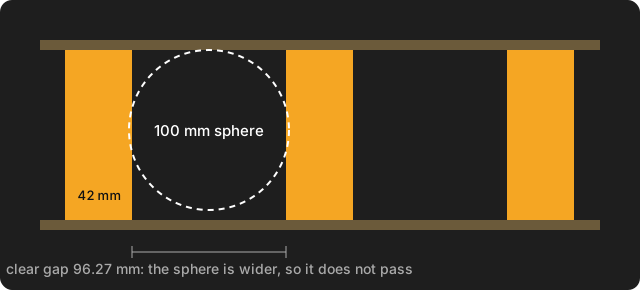
Read it as a test, not a measurement. Imagine a ball 100 mm across. If it can be pushed through any opening, the guarding fails. A gap of exactly 100 mm lets the ball through, so the gap must be smaller than 100 mm.
Is the limit 99 mm or 100 mm?
Approved Document K uses neither as a "maximum gap". It says a 100 mm sphere must not pass. The practical result is that gaps are under 100 mm. You may see 99 mm quoted as a target. That is a way of building in a margin, not a figure in the document. Leaving a little room for fixing tolerance is sensible, because a spindle that sits slightly out turns a 99.5 mm gap into a failure.
Does it apply to my house?
The wording is "a building that may be used by children under five years of age". The document does not say "all houses", but an ordinary home is a building such children may use, so treat the rule as applying to domestic stairs unless building control tells you otherwise.
Whether you need guarding at all is a separate rule. In a dwelling, paragraph 1.41 asks for guarding at the sides of flights and landings when there is a drop of more than 600 mm. Diagram 3.1 gives the guarding height for single family dwellings as 900 mm on stairs, landings, ramps and the edges of internal floors, and 1100 mm on external balconies, Juliette balconies and roof edges. The loads guarding must resist are set by BS EN 1991-1-1 and its UK National Annex, with PD 6688-1-1 (paragraph 3.2). Those loads are not covered here.
What do people mix up with this rule?
- Open risers. Paragraph 1.9 allows open risers in dwellings if treads overlap by at least 16 mm and a 100 mm diameter sphere cannot pass through the open risers. Same sphere, different opening.
- Horizontal rails. Paragraph 3.3 says to avoid them where children under five may be present, because they act as a ladder. That is the climbing rule, not the gap rule.
- Other countries' figures. Australian and New Zealand rules use different numbers and wording. See balustrade gap in Australia and stair regulations in New Zealand rather than borrowing a number across.
- Decking. Paragraph 3.3 covers guarding in a building under-fives may use, so check with building control whether a deck or balcony edge falls under the same sphere test. Use the 1100 mm height from Diagram 3.1 for external balconies.
What does Approved Document K not say?
- A minimum gap. There is none. The only practical minimum is that the gap must be big enough to leave between the spindles at all.
- How to measure a turned or shaped spindle. The text is silent on where on a shaped opening the sphere is tried. If your spindles are turned, ask building control which opening they will test before you order.
- Anything outside England. It is the 2013 edition for use in England.
How do I set out spindles to keep every gap under 100 mm?
Equal spacing is the simplest layout. For n spindles of width w across a clear run, there are n + 1 gaps:
- Gap = (run − n × w) ÷ (n + 1).
- You want the gap under 100 mm, so n must be more than (run − 100) ÷ (w + 100). Round up to a whole number.
- Work out the gap for that n and check it is under 100 mm, with a margin for tolerance.
Example 1: a 3000 mm run, 42 mm spindles. (3000 − 100) ÷ (42 + 100) = 20.42, so at least 21 spindles. Gap = (3000 − 21 × 42) ÷ 22 = 2118 ÷ 22 = 96.27 mm. On centres that is 42 + 96.27 = 138.27 mm.
Example 2: a 1200 mm run, 38 mm spindles. (1200 − 100) ÷ (38 + 100) = 7.97, so 8 spindles. Gap = (1200 − 8 × 38) ÷ 9 = 896 ÷ 9 = 99.56 mm. It passes by less than half a millimetre, so use 9 spindles: (1200 − 342) ÷ 10 = 85.8 mm.
Spindles on a stair sit on a rake, so the clear run along the rail is not the horizontal run. Work the layout out along the rail you will actually fix to, then measure the finished openings, including the one next to each newel post and the triangle above the tread. More on the method is in how to calculate baluster spacing and baluster spacing on stairs.
How do I do it in MeisterCalc?
- Open MeisterCalc and tap Baluster Spacing on the home screen.
- Enter the Run (3000) and the Baluster Width (42).
- Enter a Max Spacing. The count comes from the run divided by this figure, and the app rejects a Max Spacing of 200 mm or more.
- Read Number of Balusters, Between Balusters (the equal gap) and On Centres. The RUNNING TABLE lists the Leading Edge and Centre of each baluster, and the Speak button reads it aloud.
Check the Between Balusters figure, not just the one you typed. With a Max Spacing of 100, a 3000 mm run and 42 mm spindles gives 29 balusters and a gap of 59.4 mm. That is safely under 100 mm but uses more spindles than the hand sum above. The app's count keeps every gap under the figure you enter. It isn't the fewest spindles. With a Max Spacing of 140 it gives 21 balusters and a 96.27 mm gap, matching Example 1.
The calculator treats every baluster as one constant width. It does not do the sphere test, turned spindles, a raking rail, guarding height or handrails. Settings ▸ Units ▸ Default units can show feet and inches, but UK work is usually in Metric (mm).
What this doesn't do
- It doesn't decide what is allowed. Approved Document K, building control and your local authority do.
- It doesn't check the finished work. Measure the real openings after fixing.
- It is Android only, on Android 7.0 or later, and works offline. There is no iPhone version yet.
Try it
Baluster Spacing is one of the 12 calculators that unlock with a weekly subscription that starts with a 3-day free trial, or with a one-time lifetime unlock; Google Play shows the prices in your currency. Concrete, Stairs and Check Square are free to use. You can join the iOS waitlist.