How do you calculate ridge or gable height from span and pitch?
Published · Updated · By Sai Nath
Ridge height above the wall plate is half the span multiplied by the tangent of the pitch angle: rise = (span ÷ 2) × tan(angle). An 8000 mm span at 22.5° gives 4000 × 0.4142 = 1657 mm. Add the wall height to that for the height above the ground.
How to work out ridge height from span and pitch
"Ridge height" means different things to different people, so fix the start point first. In this page it is the vertical distance from the top of the wall plate up to the ridge centre-line. The height of the top of the ridge board or ridge beam is a little higher, and the height above the ground needs the wall height added. Both are covered below.
- Find the run. On a gable or hip roof the run is half the span, measured between the wall plates. 8000 ÷ 2 = 4000 mm.
- Get the pitch as an angle. Here it is 22.5°. If you have X/12, per cent or 1:X, convert it first (see the next section).
- Multiply the run by the tangent of the angle. tan 22.5° = 0.4142, so 4000 × 0.4142 = 1657 mm. That is the rise, the ridge height above the wall plate.
- Check it the other way. arctan(1657 ÷ 4000) = 22.5°. If it does not come back, one of the numbers went in wrong.
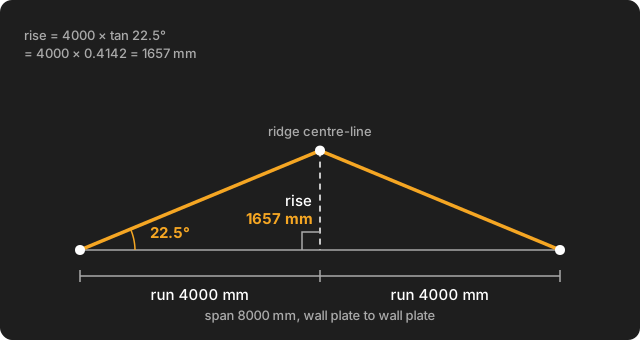
Use the same unit for run and rise. Millimetres in gives millimetres out.
What is the ridge height formula?
The formula is rise = run × tan(angle). It is the same sum whichever way the pitch is written, because every pitch notation is rise ÷ run:
- From degrees: rise = run × tan(angle).
- From X/12: rise = run × X ÷ 12. A 6/12 pitch over a 4000 mm run is 4000 × 0.5 = 2000 mm, and 4/12 is 4000 × 4 ÷ 12 = 1333 mm.
- From per cent grade: rise = run × grade ÷ 100. A 41.4% grade over 4000 mm is 1656 mm. Put 41.4 into the percentage sum, never into tan.
Pick one notation and stay in it. 22.5° is about 4.97/12, so "about 5/12", but a true 5/12 gives 4000 × 5 ÷ 12 = 1667 mm, 10 mm more than the 22.5° answer. The roof pitch to degrees chart converts between all of them, and how to calculate roof pitch covers measuring a pitch you already have.
How do you calculate gable height?
Gable height is the same sum: half the span times the tan of the pitch. A second example: a 9000 mm span at 25° has a run of 4500 mm, and 4500 × tan 25° = 4500 × 0.4663 = 2098 mm from the plate to the ridge centre-line.
As a cross-check against another source, Engineering ToolBox gives the gable height as the run times the vertical rise per unit run, with a 60 ft span at 6 in 12 rising 15 ft: Engineering ToolBox, roof framing. Checked on 28 October 2026. Same sum, imperial units: run 30 ft × 6/12 = 15 ft.
How do you find the roof height from the ground?
Measure from the ground to the top of the wall plate, then add the rise. If the plate is 2400 mm above the ground, the ridge centre-line in the example is 2400 + 1657 = 4057 mm above the ground.
The plate height has to be measured on site, from the ground you care about. On a sloping site the ground is lower on one side, so the ridge is higher above the low side than the high side. People also check a finished roof with a tape up the gable end or a clinometer, but the plate-plus-rise sum is the one to use for planning.
What the number leaves out
The figure is a geometric centre-line height. It does not include the depth of a ridge board or ridge beam, the way the rafters bear on it, the roofing and battens on top, or any raised heel. These add height above the centre-line figure, and by how much depends on the members on your plans. If a planning height limit applies, take the number from the plans and the finished roof, not from this sum. Your council's planning rules set the limit, so check them before you design to a height.
How do you calculate skillion roof height?
On a skillion (single-slope) roof the run is the full width, because there is no ridge in the middle. A 4000 mm width at 15° rises 4000 × tan 15° = 4000 × 0.2679 = 1072 mm. That is the height of the high wall over the low wall, so it is the difference between the two wall heights. The skillion roof pitch page goes into the pitch itself.
Use the full width on a skillion and half on a gable. Mixing them up is the commonest error: use the whole span on a gable and the rise comes out double.
What if the two sides have different pitches?
The two sides must reach the same height at the ridge, so run₁ × tan(angle₁) = run₂ × tan(angle₂). Take a 3000 mm run at 20°: the rise is 3000 × 0.3640 = 1092 mm. If the other side is 30°, its run must be 1092 ÷ tan 30° = 1092 ÷ 0.5774 = 1891 mm. The ridge then sits 3000 mm in from one wall and 1891 mm in from the other, so the building is 4891 mm wide. The ridge is no longer in the middle.
How do you find the pitch from a ridge height?
Work backwards with arctan. If you want a ridge 1500 mm above the plate on an 8000 mm span, the run is 4000 mm and angle = arctan(1500 ÷ 4000) = arctan(0.375) = 20.56°. As X/12 that is 0.375 × 12 = 4.5/12, and as a grade it is 37.5%. This is the quickest way to see what pitch a height limit allows. The rafter length from pitch page picks up from there: the sloped length of the example rafter line is 4000 ÷ cos 22.5° = 4330 mm to the centre-line, before any overhang.
Does a ridge beam or ridge board change the height?
Yes, a little. A ridge board or ridge beam sits at the apex, so the roof's top edge is higher than the centre-line by an amount set by the member's depth and the cut on the rafters. This page does not size ridge beams or give spans. Those come from the span tables and the engineer or truss supplier, so see the standard that applies to your job and the NCC on the ABCB site. Checked on 28 October 2026.
Common mistakes
- Using the whole span on a gable. The run is half. Whole span doubles the rise.
- Putting a percentage into tan. tan takes an angle. A 41.4% grade is 0.414 as a decimal, used directly: rise = run × 0.414.
- Mixing pitch and slope. Metric "pitch" can mean rise ÷ span, and "slope" rise ÷ run. A pitch of 1/6 is a slope of 1/3, which is 18.43°. Wikipedia sets out the difference: Roof pitch on Wikipedia. Checked on 28 October 2026.
- Forgetting the plate. The rise is above the plate. The ground height needs the wall added.
- Mixing units. Run in millimetres and rise read as inches gives nonsense. Convert first.
The right-triangle sum behind all of it is in Pythagoras in construction.
Doing it in MeisterCalc
Two calculators solve the rise. Both need Android and work offline.
- Open MeisterCalc and tap Pitch on the home screen.
- Choose the Run + Angle mode.
- Enter Run = 4000 (half the span) and Angle = 22.5.
- Read the rise on the diagram, on the left-hand side of the triangle: 1656.9 mm (1657 mm to the nearest millimetre). The result card shows Pitch, Angle, % Grade, Slope Ratio and Hypotenuse (the sloped length, 4329.6 mm), not the rise as a separate row. The result card shows Pitch 5", Angle 22.50°, % Grade 41.42% and Slope Ratio 0.4142.
For the reverse, choose Rise + Run, enter Rise 1500 and Run 4000, and read the Angle (20.56°), the Pitch (shown as a fraction, 4-1/2") and the % Grade (37.50%). The Triangles calculator also does it: choose the Base + ∠A mode, enter Base 4000 and Angle A 22.5, and the result card lists the Rise and the Hyp (the sloped length, 4329.6 mm). A live diagram of the triangle updates as you type. The Pitch help text describes the rise as the height from the top of the wall plate to the ridge.
What this doesn't do
- It is triangle geometry. There is no ridge thickness, overhang, wall height or ground-height field, so add those yourself.
- It does not cut rafters, birdsmouths, hips or valleys, and it does not work out roof area. A roofing calculator is planned, but there is no date.
- It does not size ridge beams or check planning height limits. Those come from the NCC, the NZ Building Code or the rules where you are, your council and an engineer. A calculated height does not make a roof compliant.
- Angles must be above 0° and below 90°.
Try it
Pitch and Triangles unlock with a weekly subscription (it starts with a 3-day free trial) or a one-time lifetime unlock; Google Play shows the prices in your currency. Concrete, Stairs and Check Square are free. It works offline, on Android 7.0 or later. There's no iPhone version yet; you can join the iOS waitlist.