How many square metres does a tonne of gravel cover?
Published · Updated · By Sai Nath
One tonne has no single coverage: it depends on depth and density. At 50 mm compacted depth and 1,500 kg/m³, one tonne covers about 13.3 m². At 75 mm it covers 8.9 m², and at 100 mm 6.7 m². The formula is area (m²) = tonnes × 1,000 ÷ (density × depth in metres).
What is the formula for the area a tonne covers?
Area (m²) = tonnes × 1,000 ÷ (density in kg/m³ × depth in metres). One tonne is 1,000 kg (NIST SP 811, Appendix B.8; checked on 28 October 2026). It is the same sum as in how much gravel do I need, turned around.
Worked example: 1 tonne at 75 mm (0.075 m) and 1,500 kg/m³. 1,500 × 0.075 = 112.5 kg per square metre. 1,000 ÷ 112.5 = 8.9 m².
How much does a tonne of gravel cover at each depth?
At 1,500 kg/m³, the figure MeisterCalc's Gravel calculator starts at (it is the app's default, not a quarry or standard figure), one tonne covers this much:
| Compacted depth | Tonnes per m² | m² per tonne | m² per m³ |
|---|---|---|---|
| 25 mm | 0.0375 t | 26.7 m² | 40 m² |
| 50 mm | 0.075 t | 13.3 m² | 20 m² |
| 75 mm | 0.1125 t | 8.9 m² | 13.3 m² |
| 100 mm | 0.15 t | 6.7 m² | 10 m² |
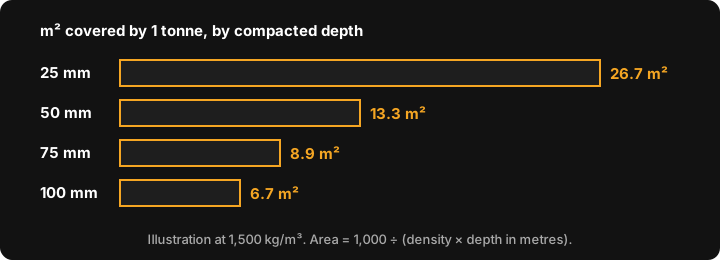
Worked sums for the 50 mm row: 1,500 × 0.05 = 75 kg per m², so 0.075 t per m²; 1,000 ÷ 75 = 13.3 m² per tonne; 1 ÷ 0.05 = 20 m² per m³.
What area does a cubic metre of gravel cover?
A cubic metre covers 1 ÷ depth in metres. That is 1 ÷ 0.05 = 20 m² at 50 mm, 1 ÷ 0.075 = 13.3 m² at 75 mm and 1 ÷ 0.1 = 10 m² at 100 mm. This does not depend on density, because it is pure volume. To go from cubic metres to tonnes, multiply by the density; cubic metres to tonnes covers that step.
Why does the answer change with the supplier?
Because density changes. Here is the same job, one tonne at 50 mm, at four example densities. The densities are made up to show the effect, not supplier figures.
| Example density | m² per tonne at 50 mm |
|---|---|
| 1,400 kg/m³ | 14.3 m² |
| 1,500 kg/m³ | 13.3 m² |
| 1,600 kg/m³ | 12.5 m² |
| 1,800 kg/m³ | 11.1 m² |
For the 1,400 row: 1,400 × 0.05 = 70 kg per m², and 1,000 ÷ 70 = 14.3 m². A denser product covers less area per tonne. Size, rock type and moisture all move the figure. This page gives no density table for named products, because densities differ by quarry and product. Ask the supplier for the tonnes per cubic metre of the exact product, and whether that figure is loose or compacted.
How many square metres does a bulk bag of gravel cover?
Take the bag's stated weight in tonnes and multiply by the m² per tonne for your depth. As a labelled example, a bag that holds 0.5 t covers 0.5 × 13.33 = 6.7 m² at 50 mm and 1,500 kg/m³. A 1 t bag covers 13.3 m². Bag sizes vary by supplier, so read the weight off the bag or product page. The bag-count sum is in how many bulk bags of gravel do I need.
How deep should gravel be for a path?
There is no single depth that suits every path. Depth depends on the ground, the traffic and the product. Ask your supplier or check the product's instructions, then use the table above for that depth. Use the depth after compaction: loose gravel spreads thicker than it ends up.
Should I add an allowance?
Usually, yes. About 10 percent is a common rule of thumb for spillage, uneven ground and settling. It is not a standard. Worked example: 10 m × 3 m (30 m²) at 75 mm is 3.375 t. With 10 percent on top, MeisterCalc shows 3.713 t to order. So one ordered tonne covers 30 ÷ 3.713 = 8.1 m² on that job, not 8.9 m². Say which basis you mean before you compare numbers.
Tonne or ton?
In Australia, New Zealand and the UK, a tonne is 1,000 kg. American pages use tons, a different unit, so check before using a figure from one.
Checking it in MeisterCalc
The Gravel calculator works forward: area and depth in, tonnes out. To check a coverage figure, enter a real job and compare the tonnes.
- Open MeisterCalc and tap Gravel (Home ▸ Gravel).
- Enter Length, Width and Depth. Millimetres are the default.
- Change Density (kg/m³) from 1,500 to your supplier's figure.
- Read Volume, Weight and Order (+10%). For 8.9 m × 1 m × 75 mm that is 0.667 m³, 1.001 t and 1.101 t.
That is the quick test: 1 m × 8.9 m at 75 mm and 1,500 kg/m³ reads about 1 t, which matches the 8.9 m² per tonne above.
What it doesn't do
- No tonnes-to-area mode. Use the formula above.
- No compaction or moisture setting, and no preset depths for paths or driveways.
- It does not know your supplier's densities. Density must be between 100 and 5,000 kg/m³.
Try it
Concrete, Stairs and Check Square are the free calculators. Gravel is among the other twelve, which unlock with a weekly subscription that starts with a 3-day free trial, or with a one-time lifetime unlock; Google Play shows the prices in your currency. Calculations work offline, on Android 7.0 or later. There's no iPhone version yet; you can join the iOS waitlist.
Sources
- NIST Guide to the SI, Appendix B.8: tonne = 1,000 kg. Checked on 28 October 2026.