What is the standard joist spacing in Australia?
Published · By Sai Nath
There is no single Australian joist spacing. The NCC points to AS 1684, whose span tables size each joist for its spacing, and the board on top sets a maximum: 19 mm STRUCTAflor particleboard allows joists at up to 450 mm centres and 22 mm up to 600 mm, while 19 mm hardwood decking allows up to 500 mm.
In the app: Running Measurements in MeisterCalc, with a worked example and real screens.
Checked on 1 November 2026 against NCC 2022 and the makers’ guides named below. A newer edition, NCC 2025, is also published, so check which one your state applies. The span tables in AS 1684 are sold by Standards Australia, so this page quotes none of them. The figures here are limits that WoodSolutions and product makers publish for what sits on the joists, each with its source and date.
What is the standard joist spacing in Australia?
No single figure applies to every floor, deck or ceiling. Two limits apply at once: the joist must span between its supports at that spacing (the span table’s job), and the board or sheet on top must span between the joists (the maker’s job). The second limit is the one makers publish, and it is where 450 and 600 mm come from:
| On the joists | Maximum joist centres | Source |
|---|---|---|
| 19 mm STRUCTAflor particleboard flooring | 450 mm | STRUCTAflor installation guide, 01/2026 |
| 22 mm or 25 mm STRUCTAflor particleboard flooring | 600 mm | STRUCTAflor installation guide, 01/2026 |
| 19 mm hardwood decking, Medium Feature or Standard grade | 500 mm | WoodSolutions TDG 21, Table 2 (source AS 1684) |
| 19 mm cypress decking, Grade 1 | 400 mm (450 mm at 21 mm) | WoodSolutions TDG 21, Table 2 |
| 19 mm treated softwood decking, Standard grade | 400 mm (450 mm at 22 mm) | WoodSolutions TDG 21, Table 2 |
| 10 mm Gyprock Plus ceiling, wind N1 to N4 | 450 mm | Gyprock Red Book 2, Table 13, May 2020 |
| 10 mm Supaceil or 13 mm Gyprock Standard ceiling, wind N1 to N4 | 600 mm | Gyprock Red Book 2, Table 13, May 2020 |
These are the board’s limits, not the joist’s. A joist at 450 mm centres still has to be big enough for its span, and that comes from AS 1684, a joist maker’s span table or an engineer.
Which standard sets joist spacing in Australia?
For timber framing, NCC 2022 Volume Two, clause H1D6(4), says the structural requirement is met if the framing is designed and built to the listed standards. They include AS 1684.2 or AS 1684.4 for non-cyclonic areas, AS 1684.3 for cyclonic areas, and AS 1860.2 for installing particleboard flooring. Source: NCC 2022, Volume Two, Part H1 Structure. WoodSolutions describes AS 1684.4 as a simplified version for wind classes N1 and N2 only (Woodsolutions on AS 1684).
AS 1684’s span tables give the joist size for a span, load and spacing. They are sold, not free, which is why this page quotes the makers instead. Engineered joists, such as I-joists and LVL, come with their maker’s own span tables.
Is joist spacing 450 or 600 centres?
Either, depending on the flooring and the joist. 19 mm STRUCTAflor needs joists no more than 450 mm apart; 22 mm allows 600 mm. The STRUCTAflor guide also says: “Floor joist spacings must not exceed the span capacity of the particular particleboard flooring product.” (STRUCTAflor installation guide, 01/2026).
Wider spacing means each joist carries more floor, so it can span less. One maker’s table shows it: Tilling’s SmartJoist Design Guide (Edition 2, August 2021), Table 1, for general domestic floors, gives its SJ24040 I-joist a maximum single span of 4650 mm at 450 mm centres and 4250 mm at 600 mm (Tilling SmartJoist Design Guide). That is one product’s figure, shown to make the point, not a span for your joists.
The count changes too. Along a 4.8 m floor: 4800 ÷ 450 = 10.67, up to 11, + 1 = 12 joists at 450 mm, and 4800 ÷ 600 = 8, + 1 = 9 joists at 600 mm. More in how many joists do I need.
How far apart should deck joists be in Australia?
Closer than most floors. WoodSolutions’ Technical Design Guide 21, Domestic Timber Deck Design (revised October 2020), Table 2, lists the maximum joist spacing for decking boards with AS 1684 as its source: 500 mm for 19 mm hardwood (Medium Feature or Standard grade), 400 mm for 19 mm Grade 1 cypress and 450 mm at 21 mm, and 400 mm for 19 mm Standard grade treated softwood and 450 mm at 22 mm.
Boards laid at an angle span further between joists, so the joists come closer. The same guide says 19 mm Standard grade hardwood boards laid at 45 degrees to the joists need the joists at 350 mm to keep the 500 mm span. Composite boards follow their maker: ModWood’s fixing instructions (2021) give a maximum of 450 mm joist centres for its 88 × 23 and 137 × 23 mm boards and 600 mm for its 137 × 32 mm boards, and add that it may be reduced depending on the concentrated load.
What spacing do ceiling joists need for plasterboard?
Gyprock’s Red Book 2 residential installation guide (May 2020), Table 13, gives the maximum framing centres for interior ceilings, with up to 5 kg/m² of insulation on top. In wind categories N1 to N4: 450 mm for 10 mm Gyprock Plus and Aquachek, and 600 mm for 10 mm Supaceil and Superchek and 13 mm Gyprock Standard and Soundchek. The limits drop in higher wind categories, for example to 450 mm for 10 mm Supaceil in N5 and C1. If battens are fixed under the joists, the batten spacing is the one the board sees.
Is joist spacing measured centre to centre?
Yes. The guides above give joist “centres”, and Tilling’s guide says joists should be placed at not more than the nominated maximum centre to centre spacing. So the clear gap between two joists is the spacing less one joist thickness: with a 45 mm joist (an example thickness) at 450 mm centres, 450 − 45 = 405 mm.
How do I mark out joists at 450 centres?
Hook the tape on the end of the bearer and read every mark off that one hook, so errors don’t add up. With the first joist sitting from 0 to 45 mm, each mark is 45 + n × 450, the far face of the next joist:
- Mark the first joist from 0 to 45 mm.
- Mark 45 + 450 = 495, 45 + 900 = 945, 45 + 1350 = 1395 mm, and on: 1845, 2295, 2745 and 3195 mm on a 3600 mm bearer.
- Stop before the next mark, 3645 mm, which is past the end. The closing joist sits from 3555 to 3600 mm, 3555 − 3195 = 360 mm clear of the last marked one.
- Count: 1 first joist + 7 marked + 1 closing = 9 joists, the same as ⌈3600 ÷ 450⌉ + 1 = 8 + 1 = 9.
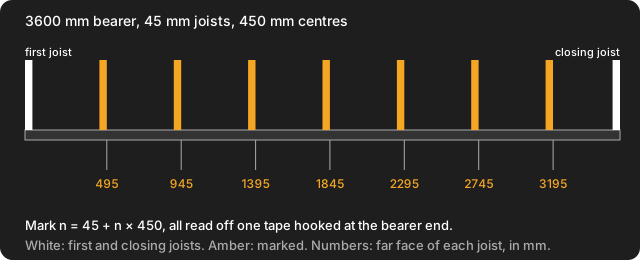
Why Running Measurements and not Equal Spacings? A joist spacing is a maximum. Equal Spacings rounds to the nearest whole number of spaces, so it can land wider than your target: 5500 mm at a 450 mm target is 12 spaces of 458.3 mm. Running Measurements never goes past the interval you enter, and its Speak button reads the marks aloud while you mark. The same method for walls is in how to mark out studs.
How many joists do I need?
Joists = length ÷ spacing, rounded up, plus one. A 3.6 m bearer takes 9 at 450 mm and 7 at 600 mm (3600 ÷ 600 = 6, + 1). Doubled joists, trimmers and rim joists come on top. The full method and a table of lengths are in how many joists do I need for a deck or floor, and the boards on top in how many decking boards.
Can MeisterCalc work out joist spacing?
No. It has no span tables and does not know your flooring, decking or loads. You type the spacing in. Running Measurements gives the marks at that spacing and Stud Counter counts the members (it is labelled for walls, so read studs as joists). It does not size joists, choose a spacing or make a floor compliant.
Before you build
Joist size, spacing and fixing are set by the NCC, AS 1684 or the joist maker’s tables, your plans and your certifier, and the flooring or decking maker’s guide for the board you buy. Where two limits differ, the tighter one applies. Wall framing works the same way: see stud spacing in Australia. In New Zealand the rules differ: see joist spacing in New Zealand.
Try it
Running Measurements and Stud Counter are not among the three free calculators. Concrete, Stairs and Check Square are free; the other 13 unlock with a weekly subscription that starts with a 3-day free trial, or with a one-time lifetime unlock, and Google Play shows the prices in your currency. It works offline on Android 7.0 or later.
Sources
- NCC 2022, Volume Two, Part H1 Structure: clause H1D6(4), the standards for timber framing. Checked on 1 November 2026.
- STRUCTAflor installation guide (01/2026): joist spacing (max) 450 mm for 19 mm, 600 mm for 22 and 25 mm. Checked on 1 November 2026.
- WoodSolutions TDG 21, Domestic Timber Deck Design (revised October 2020): Table 2, maximum joist spacing for decking boards, source AS 1684. Checked on 1 November 2026.
- ModWood fixing instructions (2021): joist centres, maximum, by board size. Checked on 1 November 2026.
- Gyprock, The Red Book 2, Residential Installation Guide (May 2020): Table 13, maximum framing centres for interior ceilings. Checked on 1 November 2026.
- Tilling, SmartJoist Design Guide, Edition 2 (August 2021): Table 1, floor joist spans by joist spacing for its own I-joists. Checked on 1 November 2026.