Roof pitch calculator in MeisterCalc: inputs, results and screens
Published · Updated · By Sai Nath
MeisterCalc's Pitch calculator works out a whole slope from any two of Rise, Run, Pitch (X/12), Angle and % Grade, with 1 in X, Fall per Metre and the Hypotenuse. A 2000 mm rise over a 4000 mm run is 6 in 12, 26.57° and 50.00%; with 450 mm eaves the rafter line is 4975.3 mm.
Try it free on the web: Roof pitch calculator and Fall calculator, in your browser with nothing to install.
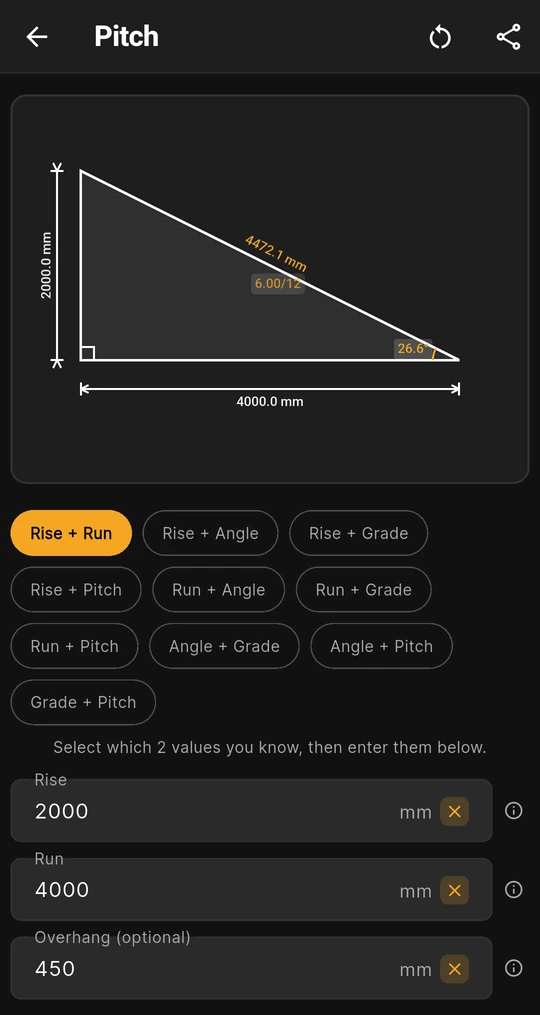
Rise + Run: 2000 and 4000 mm, overhang 450 mm
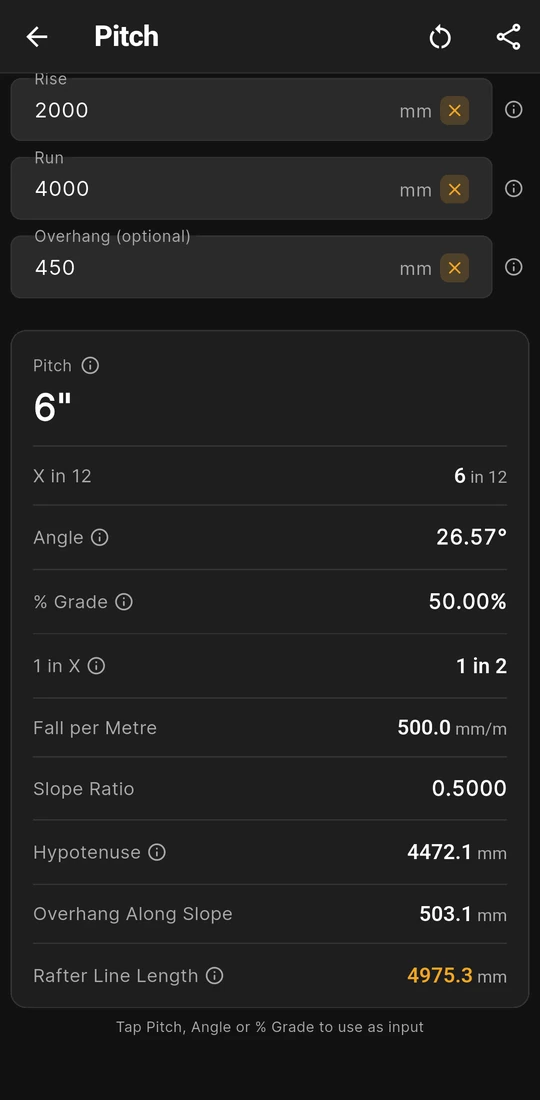
6 in 12, 26.57°, rafter line 4975.3 mm
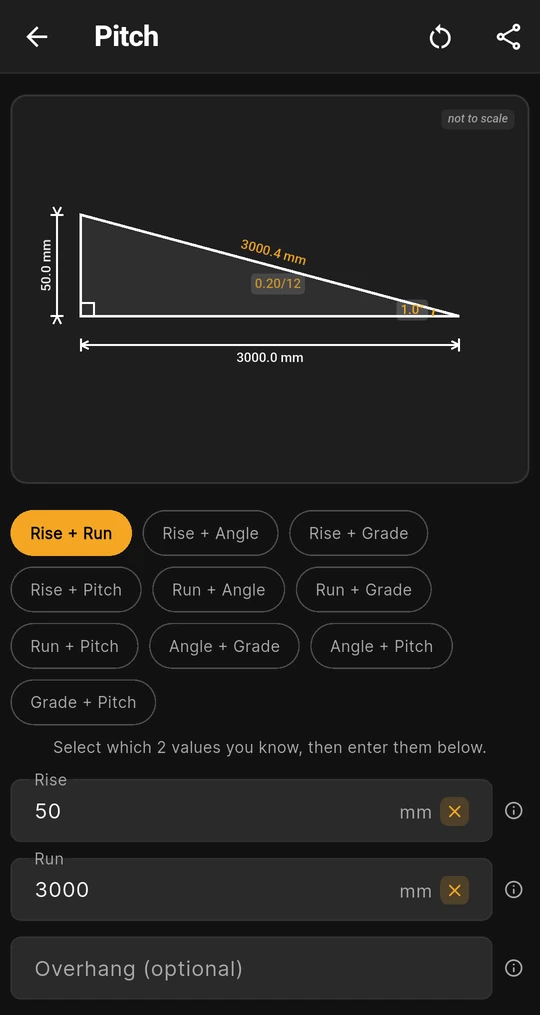
50 mm over 3000 mm, drawn not to scale


What does the Pitch calculator work out?
One slope, written every way at once. Open Home ▸ Pitch, tap the chip for the two values you have and type them: there are ten chips, one for each pair of Rise, Run, Pitch (X/12), Angle and % Grade. When the pair includes a length, an Overhang (optional) box appears for the eaves, measured level.
| Result row | What it tells you |
|---|---|
| Pitch | Rise per 12 of run, rounded to the nearest 1/16 inch, so a 6 in 12 roof reads 6". |
| X in 12 | The same figure to two decimals, such as 0.2 in 12 on a shallow fall. |
| Angle | Degrees from level, to two decimals. |
| % Grade | Rise as a per cent of run. |
| 1 in X | Run for each unit of rise, the way falls are written on drawings. |
| Fall per Metre | Millimetres of drop per metre of run (Fall per Foot in feet and inches). |
| Slope Ratio | Rise ÷ run as a decimal, to four places. |
| Hypotenuse | The length along the slope for the rise and run. |
| Overhang Along Slope and Rafter Line Length | Only with an Overhang above 0: the eave along the rafter, and the line from ridge to tail. |
Tap Pitch, Angle or % Grade on the card and it becomes an input, with the chip switching to a pair that keeps one of your values.
Worked example: a 2000 mm rise over a 4000 mm run, with 450 mm eaves
Take a gable roof on an 8000 mm span, so the run from the wall line to the ridge centre line is 4000 mm. The ridge line sits 2000 mm above the wall plate, and the eaves stick out 450 mm past the wall, measured level. Pick Rise + Run and type Rise 2000, Run 4000 and Overhang 450.
- Slope: 2000 ÷ 4000 = 0.5, so Slope Ratio reads 0.5000.
- X in 12: 0.5 × 12 = 6. X in 12 reads 6 in 12 and Pitch reads 6".
- Angle: arctan 0.5 = 26.57°. % Grade: 0.5 × 100 = 50.00%.
- 1 in X: 1 ÷ 0.5 = 2, so 1 in 2. Fall per Metre: 0.5 × 1000 = 500.0 mm/m.
- Hypotenuse: √(2000² + 4000²) = 4472.1 mm, the rafter line between wall line and ridge line.
- Slope factor: √(1 + 0.5²) = 1.1180, the length along the rafter for each millimetre of level run. The eave along the rafter is 450 × 1.1180 = 503.1 mm, the Overhang Along Slope row.
- Rafter Line Length: (4000 + 450) × 1.1180 = 4975.3 mm.
Add the 450 mm straight onto 4472.1 mm and you get 4922.1 mm, 53.2 mm short, because the eave runs on the slope too. And 4975.3 mm is a line length: the ridge board, plumb cut and tail cut come off it on site (see rafter length from pitch and span).
The same screen handles falls. Type Rise 50 and Run 3000, a path that drops 50 mm over 3 m, and 1 in X reads 1 in 60, % Grade 1.67%, Angle 0.95° and Fall per Metre 16.7 mm/m. At 0.95° the triangle would be a flat line, so it's drawn at 15° and tagged not to scale, as the third screen shows.
What you see on the screen
- A triangle that redraws as you type. Run along the bottom, rise up the left, the sloped length on the diagonal, the angle at the low corner and X/12 inside, each labelled with its value.
- A not to scale tag. Slopes from 15° to 75° are drawn true; flatter or steeper ones are drawn at the nearer limit and tagged, with every label still exact.
- A note behind each ⓘ. Each opens a short note, and Learn more opens a page with the formula and a drawing.
- Share results. Share as Text, or Share as PDF with the diagram.
- Your last slope is kept. The chip and values are still there next time, and Clear asks before it wipes them.
- Millimetres or feet and inches. Settings ▸ Units ▸ Default units; the boxes clear when you switch.
Try the pitch maths free on the web
The same formulas run in a browser on this site, overhang included. For falls, the slope calculator converts between 1 in X, per cent, degrees and millimetres per metre.
Is Pitch free?
No. Pitch is one of the 13 calculators that come with Pro. Without Pro you can open it, pick a chip and type: the diagram draws with your values, the figures it worked out show a lock, and the result card stays blurred until you unlock. Pro is a subscription or a one-time lifetime unlock; Google Play shows the plans and prices in your currency. Concrete, Stairs and Check Square are free.
Falls and pitches by country
Pitch converts; the slope a job needs comes from the code, the product maker and your certifier, council or building control. Figures quoted with their sources on the pages linked:
| Country | Job | Figure | Where it comes from |
|---|---|---|---|
| Australia | Eaves gutter | At least 1:500, 2 mm per metre | NCC 2025 Housing Provisions 7.4.4(1)(a): minimum fall for a gutter |
| Australia | End laps on metal roof sheets | 150 mm above 15°, 200 mm from 5° to 15° | Housing Provisions 7.2.6(2)(b): calculators for roofers |
| New Zealand | Membrane-covered deck | At least 1.5° (1:40) | E2/AS1 8.5.1.2: New Zealand |
| New Zealand | Roof gutters | No figure: they fall to an outlet | E1/AS1 5.3.1: common falls and their sources |
| England | Paving | At least 1 in 60 recommended | Approved Document H, H3 2.3: United Kingdom |
There's no 1 in X box, so type a ratio as its % Grade: 1:500 is 0.2% and 1 in 60 is 1.67%. Pitch gives no minimum pitch for any roof covering; the sheet or tile maker does, and in Australia so does Figure 7.2.3 of the Housing Provisions.
Rules in more detail: NZ minimum roof pitch (E2/AS1), and the rest of building codes by country, from Australia's NCC to New Zealand's Building Code, England's Approved Documents and the US IRC.
Questions about Pitch
Where is the rise when I enter a run and an angle?
On the diagram. The card lists the slope figures and the Hypotenuse; the rise or run you didn't type is labelled on its side of the triangle. In Run + Angle, read the ridge height above the plate off the upright side.
Does Pitch work out rafter cuts?
No. Rafter Line Length runs from the ridge line out to the tail, measured on the rafter's top edge. There are no plumb or seat cuts, birdsmouths, hips, valleys or creepers, and no roof area or sheet counts; for hip roofs, use an app built for roof framing as well.
Why does the Overhang box disappear in some modes?
It only shows when the chip has Rise or Run in it. Angle + Grade, Angle + Pitch and Grade + Pitch have no length, so the triangle is drawn on a stand-in 1000 mm run and its Hypotenuse means nothing on site.
Can I use Pitch in feet and inches?
Yes. With Settings ▸ Units ▸ Default units ▸ Imperial (ft/in), lengths show in feet, inches and fractions, and Fall per Metre becomes Fall per Foot. A quarter inch per foot, typed as Pitch (X/12) 0.25, reads 0.25 in/ft, 1 in 48 and 2.08%.
Does it tell me if a fall is too flat?
No. Pitch has no warnings, because it doesn't know whether the slope is a gutter, a shower floor or a roof. Compare the answer with the figure for your job and with your plans.
Guides that go deeper
- How do I calculate roof pitch in degrees?
- What is a roof pitch in degrees? (X/12 and 1:X chart)
- How do I calculate rafter length from the pitch and span?
- How much fall is 1 in 100 (and 1 in 60, 1 in 80) in millimetres?
- What is the minimum fall for a gutter?
- Is there a roof pitch calculator app that solves from any two values?
Get MeisterCalc
MeisterCalc runs on Android 7.0 or later and works every sum out on the phone, so Pitch works up on a roof with no signal. Concrete, Stairs and Check Square are free; Pitch comes with Pro.