How do I measure the slope of a block of land?
Published · Updated · By Sai Nath
Slope is the fall divided by the horizontal distance. Subtract the levels (RLs) at the low and high points for the fall, divide by the distance between them, then write it as a percentage (× 100), a 1 in X ratio (1 ÷ slope) or degrees (arctan). Example: 0.84 m over 24 m is 3.5%, 1 in 29 or 2.0°.
What are you actually measuring?
You are measuring the average slope between two points. Slope is rise over run: slope = fall ÷ horizontal distance. On a block, the “rise” is the fall, the difference in height between the high point and the low point. The “run” is the level distance between them, not the distance along the ground.
The same slope can be written three ways, and the three formulas are standard (Humboldt State University, Calculating Slope; dCode slope calculator):
- Percentage = fall ÷ run × 100. It can go past 100%.
- 1 in X: X = run ÷ fall. The trades say “1 in 29” or “1:29”.
- Degrees = arctan(fall ÷ run). It tops out at 90°.
Checked on 28 October 2026. Fall and run must be in the same unit before you divide. Mixing millimetres and metres is the commonest slip.
How do you measure the slope of land with a level?
Use a dumpy, laser or rotary level and a staff to get a reduced level (RL) at each end, subtract, then divide by the level distance. The steps:
- Peg the two points. One at the high end, one at the low end of the stretch you care about, along the line the water would run.
- Set up the level where it can see both pegs. See how to use a dumpy level.
- Backsight on the benchmark. Read the staff at a point of known RL. Add it to that RL: this is the height of instrument (HI). If you have no benchmark, call the high peg RL 100.000. The fall comes out the same.
- Foresight on the other peg. RL = HI − staff reading. The sums are in how to calculate a reduced level, and the staff is explained in how to read a dumpy level staff.
- Fall = high RL − low RL.
- Measure the horizontal distance between the pegs with the tape held level, or measure along the ground and correct it (see the warning below).
- Divide: slope = fall ÷ distance. Convert to the form you need.
Worked example: how much fall does this block have?
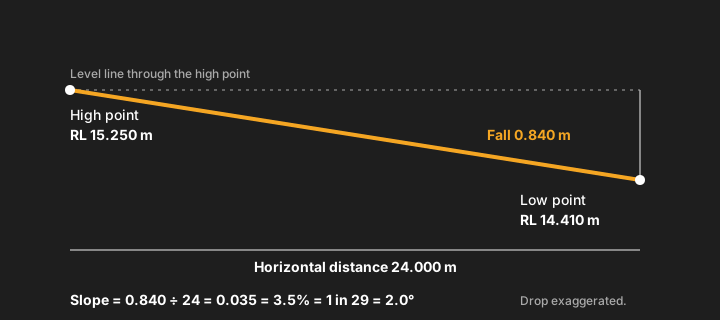
The high corner is a benchmark at RL 15.250 m. The staff reads 1.340 m on it, so HI = 15.250 + 1.340 = 16.590 m. The staff reads 2.180 m at the low peg, so its RL = 16.590 − 2.180 = 14.410 m.
- Fall = 15.250 − 14.410 = 0.840 m (840 mm).
- Horizontal distance = 24.000 m.
- Slope = 0.840 ÷ 24 = 0.035.
How do you give the slope in degrees, as a gradient or in mm per metre?
The same 0.035 slope, written four ways:
| Form | Sum | Result |
|---|---|---|
| Percentage | 0.035 × 100 | 3.5% |
| Gradient, 1 in X | 24 ÷ 0.840 = 28.57 | 1 in 29 (to the nearest whole number) |
| Degrees | arctan(0.035) | 2.00° (2.004) |
| Millimetres per metre | 0.035 × 1000 | 35 mm per metre |
To work backwards, X = 100 ÷ percentage, so 5% is 1 in 20 and 20% is 1 in 5. Common values, from the same sums:
| Gradient | Percentage | Degrees | mm per metre |
|---|---|---|---|
| 1 in 100 | 1% | 0.57° | 10 |
| 1 in 40 | 2.5% | 1.43° | 25 |
| 1 in 20 | 5% | 2.86° | 50 |
| 1 in 10 | 10% | 5.71° | 100 |
| 1 in 5 | 20% | 11.31° | 200 |
| 1 in 4 | 25% | 14.04° | 250 |
| 1 in 1 | 100% | 45° | 1000 |
At 45° the run equals the rise, which is 100% (Wikipedia, Grade (slope), checked on 28 October 2026). For the full conversion, see slope percentage to degrees. For falls in millimetres over a given run, see how to calculate fall.
Why must the distance be horizontal?
Because slope is defined against the level run. In surveying the run is the horizontal distance between two points, and the rise is the difference in height (Maidment and Tarboton, Computation of Slope, checked on 28 October 2026). If you tape along the sloping ground, the length is the hypotenuse, and it is always a bit longer than the run.
- Gentle slope. Example A: the sloped length is √(24² + 0.84²) = 24.015 m. Using it as the run barely moves the answer.
- Steeper slope. Take a 2.4 m fall over a 12 m run: 2.4 ÷ 12 = 0.2 = 20% = 1 in 5 = 11.31° = 200 mm per metre. The sloped length is 12.238 m. Using it as the run gives 2.4 ÷ 12.238 = 19.6%, not 20%.
On gentle ground, taping along the surface is fine for a working figure. On steep ground, hold the tape level and plumb down from the end, or measure in short level steps.
What if the block is not one even slope?
Then one number does not describe it. The end-to-end figure is an average, and the steepest stretch can be well above it. Take an RL at regular intervals along the fall line, say every 10 m, and work out the slope of each stretch. A made-up 40 m line:
| Stretch | RL at start (m) | RL at end (m) | Fall (m) | Slope over 10 m |
|---|---|---|---|---|
| 0 to 10 m | 15.250 | 15.020 | 0.230 | 2.3% |
| 10 to 20 m | 15.020 | 14.680 | 0.340 | 3.4% (1 in 29) |
| 20 to 30 m | 14.680 | 14.540 | 0.140 | 1.4% |
| 30 to 40 m | 14.540 | 14.410 | 0.130 | 1.3% |
End to end, the fall is 0.840 m over 40 m, an average of 2.1% (1 in 48). The steepest stretch is 3.4%. If you are planning a drain, a pad or a retaining wall, the steepest stretch and the actual levels at each point matter more than the average. A drive is a special case: see how to work out the gradient of a driveway.
How do you measure slope without a level?
With less accuracy. These methods are rough, so treat the answer as a guide only:
- String line and line level. Pull a string tight between two pegs, level it with a line level, then measure straight down from the string to the ground at the low peg. That drop is the fall, and the distance between the pegs is the run.
- Straight board and spirit level. The same idea over a shorter distance. Long boards sag, so keep it short and repeat along the line.
- A phone inclinometer. It gives an angle only. Its accuracy depends on the phone and its calibration, and this page has no sourced figure for it.
For a patio or slab, the amount of fall you need is a different question: see how much fall a patio should have.
Can you use Google Maps, Google Earth or a contour map?
For a rough idea of which way the land falls, yes. For anything you will build on, no: this page has no sourced accuracy figure for web-map elevations, so check the levels on the ground with a level and staff.
Do you need a surveyor?
Often, for anything that needs approval or has to be signed off by someone qualified. A level and tape give a working figure for planning a drain, pad or retaining wall. A registered surveyor’s contour or detail survey is a different product. Ask your council, engineer or surveyor what your job needs. Building rules are set by the NCC, the NZ Building Code or Approved Documents, and your local council, not by this page or the app.
Doing it in MeisterCalc
Use two calculators: Dumpy Level for the two RLs, then Pitch for the percentage and angle. The app has no single “slope of land” calculator.
- Tap Dumpy Level on the home screen. In either mode, enter Benchmark RL 15.250, Staff Reading at BM 1.340 and Staff Reading at Measure 2.180. All three are in metres.
- The Height of Instrument (HI) shows 16.590 and the Measured RL shows 14.410.
- Subtract the two RLs yourself: 15.250 − 14.410 = 0.840 m.
- Tap Pitch and choose the Rise + Run mode. Enter Rise 840 and Run 24000. Rise and Run are in millimetres in metric mode.
- % Grade shows 3.50% and Angle shows 2.00°. The Hypotenuse (the sloped length) also appears.
The Pitch calculator has a roof name but works for any slope. The calculations run on the phone and need no signal.
What the app doesn’t do
- Dumpy Level gives one RL per calculation. It does not work out the fall or slope between two points, and it keeps no level book.
- Pitch shows no “1 in X” and no millimetres per metre. Work those out from the sums above.
- Pitch needs a rise above zero, so it will not show a downhill slope as negative.
- It does no contours and no cut-and-fill.
- It doesn’t make work compliant with the NCC or any other rule.
Try it
Dumpy Level and Pitch are among the MeisterCalc calculators that unlock with a weekly subscription that starts with a 3-day free trial, or with a one-time lifetime unlock; Google Play shows the prices in your currency. Concrete, Stairs and Check Square are free. It runs on Android 7.0 or later. There’s no iPhone version yet; you can join the iOS waitlist.