How do you read a dumpy level staff?
Published · Updated · By Sai Nath
Read the whole-tenth number just below the middle crosshair, count the whole 10 mm blocks above it, then estimate the last millimetre. Write the total in metres to three decimals, such as 2.035. Subtract it from the height of instrument for the point's level.
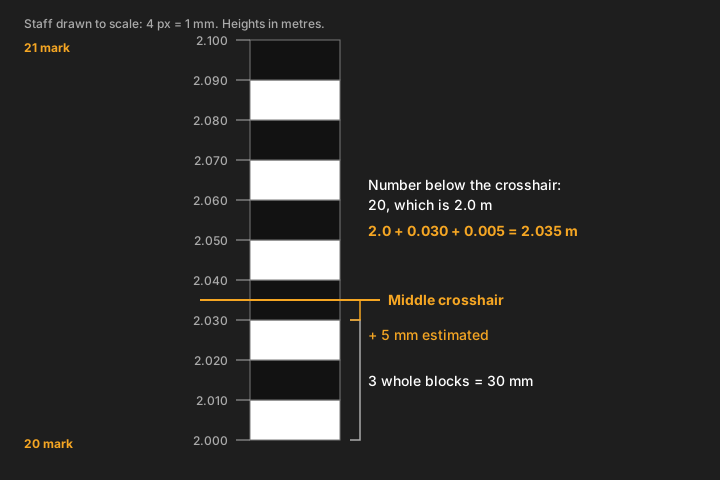
What is printed on the staff?
The staff starts at zero on the ground. Its big numbers are in metres and tenths of a metre, so “18” means 1.8 m and “20” means 2.0 m. Between the numbers, a pattern of blocks and gaps, usually an E shape or its mirror image, divides each tenth into 10 mm steps. Wikipedia's page on levelling rods describes the numbering and the E pattern. A lab sheet from Tomsk Polytechnic University gives the same 10 mm blocks. Both checked on 28 October 2026.
Staffs vary. Some are one piece, some telescope out in sections, and some are marked in feet and tenths of a foot. This page is about a metric staff. Check yours before you rely on it: count the blocks between two numbers and make sure there are ten.
How to read the staff, step by step
- Focus first. Focus the eyepiece until the crosshairs are sharp, then focus the telescope on the staff. If the crosshairs seem to slide on the staff when you move your eye, that is parallax: refocus. The Tomsk sheet says to use the focusing knob to remove it.
- Check the staff is upright. The holder rocks it slowly toward and away from you. Take the lowest reading you see, because a leaning staff reads long. Leaning left or right shows against the vertical crosshair.
- Find the number below the middle crosshair. This is the last whole tenth that is below the hair. In the drawing above it is 20, so 2.0 m.
- Count the whole 10 mm blocks between that number and the middle crosshair. Each block, and each gap, is 10 mm. Three blocks is 0.030 m.
- Estimate the last millimetre. Judge how far the crosshair is into the next block, in tenths of it. Halfway is 5 mm, so 0.005 m. Wikipedia notes that this interpolation gives a reading to about 1 mm.
- Add and write it down in metres to three decimals: 2.0 + 0.030 + 0.005 = 2.035.
Always use the middle crosshair for this. The upper and lower hairs are the stadia hairs, used for estimating distance, not height.
Three worked readings
| Number below hair | Whole blocks | Estimated mm | Reading |
|---|---|---|---|
| 13 (1.3 m) | 4 (40 mm) | 0 | 1.340 m |
| 21 (2.1 m) | 8 (80 mm) | 0 | 2.180 m |
| 20 (2.0 m) | 3 (30 mm) | 5 | 2.035 m |
The sums: 1.3 + 0.040 = 1.340; 2.1 + 0.080 = 2.180; 2.0 + 0.030 + 0.005 = 2.035.
The first two are the readings used in how to use a dumpy level. Notice that 1.340 and 2.180 end in a zero. That zero is a real millimetre digit, so keep it.
How do I write a reading down: metres or millimetres?
Pick one unit and keep to it. Levelling is usually booked in metres to three decimals, so 1.340 m. The same reading is 1340 mm. The mistake to avoid is writing 1.34 when you mean 1.340 or, worse, 1.034. If you say readings aloud, say each digit: “one, three, four, zero.”
| You see | In metres | In millimetres |
|---|---|---|
| 13, 4 blocks, 0 mm | 1.340 | 1340 |
| 20, 3 blocks, 5 mm | 2.035 | 2035 |
| 9, 0 blocks, 7 mm | 0.907 | 907 |
The MeisterCalc Dumpy Level calculator takes metres only, so enter 1.340, not 1340.
What are a backsight and a foresight?
A backsight is the first reading, taken on a point whose level you already know, such as a benchmark. A foresight is a reading taken on a point whose level you want to find. See Wikipedia's article on levelling, checked on 28 October 2026. Set-up, tripod and bubble are in how to use a dumpy level, so they aren't repeated here.
How do I turn two readings into a level?
Add the backsight to the benchmark's level to get the height of instrument (HI), the level of your line of sight. Then subtract the foresight from HI.
- Benchmark level 15.250 m, backsight 1.340 m: HI = 15.250 + 1.340 = 16.590 m.
- Foresight 2.180 m: level = 16.590 − 2.180 = 14.410 m.
A high reading means lower ground, because more of the staff sits below your line of sight. The point above is 0.840 m below the benchmark. Levels can come out negative. With a benchmark at 0.500 m and a backsight of 1.200 m, HI is 1.700 m. A foresight of 2.300 m gives 1.700 − 2.300 = −0.600 m, which is below datum. For more on working with levels, see how to calculate reduced level, and for the fall between two points, slope of land.
Do I read an automatic level the same way?
The reading is taken the same way: the staff graduation at the crosshair. Wikipedia's page on levels describes one reading procedure for the instrument and says an automatic level's compensator removes small remaining tilt. Checked on 28 October 2026. Digital levels are different: they read a bar-coded staff for you, as the Tomsk sheet notes.
Common reading mistakes
- Reading the wrong tenth. Take the number below the hair, not the one above it. Check that the reading falls between the two numbers.
- Using the top or bottom hair instead of the middle one.
- Parallax. Refocus the eyepiece and telescope until nothing shifts.
- A leaning staff. Rock it and take the lowest reading.
- Reading across a joint on a telescopic staff. Check that the sections are fully extended and locked.
- Dropping the zero. Write 1.340, not 1.34.
- Not saying it back. Read the number aloud to the person on the staff and write it down straight away.
Doing the sums in MeisterCalc
Open MeisterCalc, tap Dumpy Level on the home screen and choose Mode A — BM On Ground or Mode B — BM Not On Ground. Enter the Benchmark RL (15.250), the Staff Reading at BM (1.340) and the Staff Reading at Measure (2.180). It shows the Height of Instrument (HI) as 16.590 m and the Measured RL as 14.410 m. Negative numbers are accepted.
What the app doesn't do
- It doesn't read the staff or check your readings. A mistyped reading gives a wrong level with no warning.
- It does one set-up and one point at a time. There is no change-point, rise and fall or multi-set-up run.
- It doesn't replace a surveyor. Levels for a permit, boundary or drainage fall come from the surveyor, the plans and the council.
Try it
Dumpy Level is one of the 12 MeisterCalc calculators that unlock with a weekly subscription that starts with a 3-day free trial, or with a one-time lifetime unlock; Google Play shows the prices in your currency. Concrete, Stairs and Check Square are free. It works offline, on Android 7.0 or later. There's no iPhone version yet; you can join the iOS waitlist.