How do I work out the gradient of a driveway?
Published · Updated · By Sai Nath
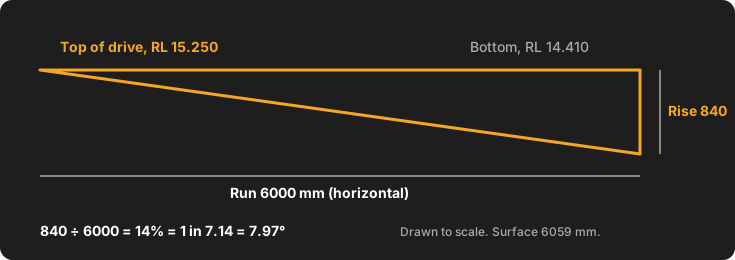
Divide the height difference between the top and bottom of the driveway by the horizontal distance between them, then multiply by 100 for a percentage. A fall of 840 mm over 6 m of run is 840 ÷ 6000 = 14%. That is also 1 in 7.14, or 7.97 degrees. Measure the run level, not along the slope.
How do I measure and calculate it?
- Get the height difference (rise) between the top and bottom of the section you care about. A dumpy level gives it from two staff readings (method A below). On a short drive, a string line works (method B).
- Get the horizontal run between those two points with a tape, in the same unit as the rise.
- Gradient % = rise ÷ run × 100. 1 in X: X = run ÷ rise. Degrees = arctan(rise ÷ run).
Worked example: the top of the drive is at RL 15.250 and the bottom at RL 14.410, so the rise is 0.840 m. The run is 6.000 m. Gradient = 0.840 ÷ 6.000 = 0.14, so 14%. X = 6.000 ÷ 0.840 = 7.14, so 1 in 7.14. Degrees = arctan(0.14) = 7.97. The sloped surface a tape would read is √(6.000² + 0.840²) = 6.059 m.
Method A: with a dumpy level
Set up the level where you can see both ends. Read the staff on the top of the drive, then on the bottom, without moving the level between the two readings. The sums are in how to use a dumpy level and how to calculate a reduced level.
- Backsight on the top (benchmark, RL 15.250): staff reads 1.340. Height of instrument = 15.250 + 1.340 = 16.590.
- Foresight on the bottom: staff reads 2.180. RL = 16.590 − 2.180 = 14.410.
- Rise = 15.250 − 14.410 = 0.840 m. The bigger staff reading is the lower ground. The difference between the two staff readings (2.180 − 1.340) gives the same 0.840 m, so you don’t need the RLs if you only want the gradient. With the 6.000 m run, 0.840 ÷ 6.000 × 100 = 14%.
Method B: string line and line level
Pull a string from the top edge out over the bottom point. Hang a line level on it and adjust until the bubble centres. Measure straight down from the string to the ground at the bottom point: that is the rise. Measure along the string from the top point to that spot: that is the run, and it is horizontal because the string is level. For example, 840 mm down at the bottom point and 6000 mm along the string gives 840 ÷ 6000 × 100 = 14%. A long string sags and gives a false rise, so on a longer drive work in shorter legs and add the rises.
What do the percentage, 1 in X and degrees mean?
They are three ways to say the same thing. Percentage is rise per 100 of run, 1 in X is run per 1 of rise, and degrees is the angle to level. The scales differ: 100% is 45 degrees, not 100 degrees, and 10% is 5.71 degrees, not 10.
| Ratio | Gradient (%) | Angle (°) | Rise per metre of run (mm) |
|---|---|---|---|
| 1 in 20 | 5.00 | 2.86 | 50 |
| 1 in 10 | 10.00 | 5.71 | 100 |
| 1 in 8 | 12.50 | 7.13 | 125 |
| 1 in 7.14 | 14.00 | 7.97 | 140 |
| 1 in 6.67 | 15.00 | 8.53 | 150 |
| 1 in 5 | 20.00 | 11.31 | 200 |
| 1 in 4 | 25.00 | 14.04 | 250 |
Rise per metre of run is the percentage × 10. For other values see slope percentage to degrees. Flatter falls for drains and paving are in how to calculate fall, and the fall ratio calculator page converts between ratios and millimetres.
Why does the steepest part matter more than the average?
A driveway that averages 10% can still have a short 20% pitch in it, and the ends are where cars scrape. The gradient of the whole drive hides that. Measure the steepest section as well as the whole length, and measure the change of grade at the top and bottom. Several Australian councils set separate limits for exactly that, as below. The same method gives a gradient for any leg: measure each leg’s rise and run separately.
What are the Australian limits on a driveway gradient?
The limit is set by your council, usually with reference to AS/NZS 2890.1 (Parking facilities: off-street car parking). MeisterCalc does not check any limit, and the figures below are what councils say, not a compliance test for your drive.
Checked on 28 October 2026.
- Town of Vincent (Western Australia): its planning information sheet says the maximum driveway grade is 25% (1:4), and that where a driveway is steeper than 12.5%, a 2.0 m transition at 12.5% (1:8) is required at the top and bottom. It names AS2890.1 and the Residential Design Codes. Source: Planning Information Sheet: Driveways (May 2024).
- Brisbane City Council (Queensland): inside the property boundary, a driveway must not exceed 1:4. Outside the boundary, between the boundary and the road, it must not exceed 1:6. Source: Brisbane City Council, driveway technical standards.
- Lismore City Council (New South Wales): its standard drawing for residential driveways notes a maximum change of grade of 12.5% for a crest and 15% for a sag, citing AS2890.1 section 2.5.3(d), and calls the drawing a guide only. Source: Lismore, residential driveway longitudinal grading details.
These differ: 1:4 is the whole-drive cap in two of them, but Brisbane’s is 1:6 on the part outside your boundary. The council that issues your driveway approval decides, and it can set tighter limits than the standard. AS/NZS 2890.1 itself is sold by Standards Australia, and this page quotes no figure from it directly.
The 14% drive in the example is under the 25% caps above, but over 12.5%, so a council like Vincent would also ask for the end transitions. Whether yours passes is for your council.
What about New Zealand and the UK?
This page has not verified a driveway gradient for New Zealand or the UK, so it states none. In New Zealand, ask the territorial authority that approves vehicle crossings. In the UK, ask the local highway authority, which approves dropped kerbs, and check the planning conditions on the property. Approved Document M covers access routes to buildings, and its figures are set out for ramps in the 1 in 14 ramp post; it is not a driveway limit.
How do I do it in MeisterCalc?
Use the Pitch calculator. It solves rise, run, angle, % grade and sloped length from any two inputs.
- Open MeisterCalc, tap Pitch on the home screen and choose the Rise + Run mode.
- Enter the Rise: 840 mm. Enter the Run: 6000 mm.
- The % Grade shows 14.00%, the Angle 7.97°, the Slope Ratio 0.1400 and the Hypotenuse 6058.5 mm (the page rounds it to 6059 mm elsewhere).
The rise itself can come from the Dumpy Level calculator: enter the Benchmark RL 15.250, the Staff Reading at BM 1.340 and the Staff Reading at Measure 2.180, and read the Measured RL, 14.410. Subtract the two RLs for the rise. To start from a gradient, use Run + Grade. Pitch has no 1 in X output, so work X as run ÷ rise or 100 ÷ percentage.
What the app doesn’t do
- No driveway calculator, no transition or breakover check, and no clearance check for a particular car.
- No limits for any council or standard. It does not check a drive against AS/NZS 2890.1 or a council rule.
- No rise-and-fall levelling or cut-and-fill sheet: you do the staff-reading subtraction yourself.
- Pitch and Dumpy Level are paid calculators, Android only.
Quick answers
What is the formula for driveway gradient as a percentage?
Rise ÷ run × 100, with both in the same unit and the run measured level.
What is the maximum slope for a driveway?
It depends on the council. The Australian council documents above give 1:4 (25%) as a cap, with 12.5% as the point where end transitions are asked for in one of them. Ask yours.
How do I convert a driveway gradient from degrees to a percentage?
Percentage = tan(angle) × 100. For 7.97 degrees, tan = 0.14, so 14%.
Is a 1 in 10 driveway steeper than 10 degrees?
No. 1 in 10 is 10% or 5.71 degrees. 10 degrees is about 17.6%.
Try it
Pitch and Dumpy Level are among the MeisterCalc calculators that unlock with a weekly subscription that starts with a 3-day free trial, or with a one-time lifetime unlock; Google Play shows the prices in your currency. Concrete, Stairs and Check Square are free. It works offline, on Android 7.0 or later. There’s no iPhone version yet; you can join the iOS waitlist.