How much does a cubic metre of concrete weigh?
Published · Updated · By Sai Nath
A cubic metre of concrete weighs about 2.4 tonnes (2,400 kg), so half a cubic metre is about 1.2 tonnes and two cubic metres about 4.8 tonnes. Ready-mix makers declare about 2,300 to 2,400 kg/m³ for normal-class mixes, so 2,400 is a round working figure, not a promise. Ask your supplier for the density of your mix and use that.
How much do 0.5, 1 and 2 cubic metres of concrete weigh?
Weight is volume times density. At an example density of 2,400 kg/m³, the sums are:
| Volume | Weight (kg) | Weight (tonnes) |
|---|---|---|
| 0.5 m³ | 1,200 | 1.2 |
| 1 m³ | 2,400 | 2.4 |
| 1.5 m³ | 3,600 | 3.6 |
| 2 m³ | 4,800 | 4.8 |
| 3 m³ | 7,200 | 7.2 |
A tonne is 1,000 kg, so divide by 1,000. In pounds, 1 m³ at this density is roughly 2,400 × 2.2046 = 5,291 lb, or about 5,300 lb. The table is arithmetic from one example density. A mix that is denser or lighter moves every row by the same percentage.
Checked on 28 October 2026: where does 2,400 come from? Two manufacturers' environmental product declarations (EPDs), as listed on One Click LCA's materials database, give 2,400 kg/m³ for a Holcim 20 MPa ready-mix (Adelaide, 2024) and 2,300.2 kg/m³ for a Heidelberg 50 MPa ready-mix (Gold Coast). So a spread of (2,400 − 2,300.2) ÷ 2,400 = 4.2 percent between two Australian mixes. These are plant-specific figures, and the Holcim one is marked internally verified, so treat 2,400 as a planning figure and get your supplier's number before you rely on it for anything that carries a load.
Why does the weight vary?
Concrete is cement, water, sand and stone, with a little air, and the share of each changes the density. This page doesn't quote separate figures for reinforced, wet or lightweight concrete. The two declared figures above differ by about 4 percent between mixes and plants. Your supplier's mix sheet or delivery docket is the place to look. If you only need an order, you don't need the weight at all: concrete is ordered by volume, in cubic metres. How much concrete do I need? covers that, and how much extra to order covers the allowance.
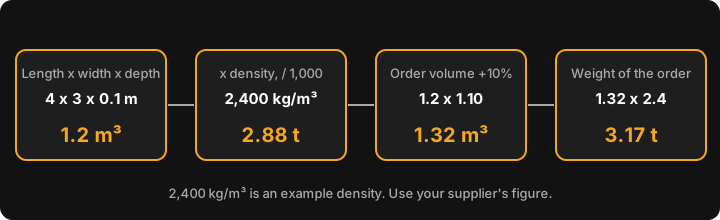
A worked example: a 4 m by 3 m slab, 100 mm thick
- Volume: 4 × 3 × 0.1 = 1.2 m³.
- Weight: 1.2 × 2,400 ÷ 1,000 = 2.88 tonnes at the example density.
- Order: the Concrete calculator adds 10 percent extra, 1.2 × 1.10, and shows Order (+10%) of 1.320 m³. Truck loads are measured by volume, so that is the number you give the supplier. If you want the weight of the full order, 1.32 × 2.4 = 3.17 tonnes.
The Concrete calculator gives volume only. It has no weight or density output, so the weight step is by hand. The same arithmetic as for gravel and soil is in cubic metres to tonnes, and how to calculate cubic metres shows the volume step for other shapes.
Doing the weight in MeisterCalc
Concrete is free. For a weight in tonnes inside the app, the Gravel calculator has an editable Density field in kg/m³. Type your supplier's concrete density there and it shows the weight in tonnes. It is a gravel tool, not a concrete one, and Gravel is one of the calculators that unlock with a subscription or a lifetime purchase. If you only want the one sum, a phone calculator does the same job.
How many wheelbarrows are in a cubic metre?
A cubic metre is 1,000 litres. Wikipedia's Wheelbarrow page gives a typical capacity of about 100 L, so a brimful barrow means about 10 barrows per cubic metre, and about 9 for a 110 L steel barrow (1,000 ÷ 110 = 9.1). Nobody fills one to the brim. At 60 L a load it is 1,000 ÷ 60 = 16.7, so 17. These are sums worked from the cited capacity, not a published figure.
The weight is the real limit. At 2,400 kg/m³, 100 L is about 240 kg, far more than one person can push, so a part-filled barrow is the practical load and a big pour is better pumped or tipped from the truck.
How many bags of concrete are in a cubic metre?
That depends on the product, which is why there is no one number. Boral's data sheet, for example, says 108 bags of its 20 kg Concrete Mix make one cubic metre. Bags of concrete per cubic metre lists other makers' figures, and the concrete calculator in m³ counts the bags.
What does a cubic metre of cement weigh?
Cement is not concrete. Cement is the powder that binds the mix, and concrete is the finished mix of cement, sand, stone and water. People search the two as if they were the same, but the numbers differ, and this page gives no cement density. Crushed concrete (rubble) and ready-mixed "concrete blend" are different products again, so ask the supplier for the weight of the product you are buying.
What to check before the truck arrives
- Ask the supplier for the density of your mix and the size of the truck load in cubic metres.
- A full load is several tonnes, so check the access and the ground the truck will cross.
- Order by volume with an allowance, not by weight.
- What a slab can carry, and what supports it, is a question for the NCC (or your local code), the engineer and the council, not for this page or the app.
What the app doesn't do
- The Concrete calculator doesn't give weight, bag counts or barrow counts. It shows a cost only if you type in a price per m³.
- It doesn't add steel reinforcement weight.
- It runs on Android 7.0 or later; there is no iPhone version yet.
Sources
- One Click LCA: Holcim ready-mix concrete, Adelaide (2024), EPD S-P-04660: 20 MPa, 2,400 kg/m³, internally verified. Checked on 28 October 2026.
- One Click LCA: Heidelberg Materials ready-mix concrete, Gold Coast, EPD-IES-0015032:001: 50 MPa, 2,300.2 kg/m³, third-party verified (ISO 14025). Checked on 28 October 2026.
- Wikipedia, Wheelbarrow: typical capacity about 100 L. Checked on 28 October 2026.
Try it
Concrete is one of three MeisterCalc calculators that are free to use, along with Stairs and Check Square. It works offline, on Android 7.0 or later. The other 12 calculators unlock with a weekly subscription that starts with a 3-day free trial, or with a one-time lifetime unlock; Google Play shows the prices in your currency. You can join the iOS waitlist.