What fall does a drainage pipe need, in mm over its length?
Published · Updated · By Sai Nath
The fall a drain needs depends on its use, its size and the country’s rule. The sum is the same everywhere: fall = run ÷ N, in millimetres. A 1 in 40 fall over 8 m is 200 mm. This page quotes the England rules from the official document and leaves Australian and NZ figures to the code.
How do you calculate fall in a drainage pipe?
Divide the run by the second number in the ratio. Keep fall and run in the same unit, millimetres.
- Fall = run ÷ N for a fall of 1 in N.
- Far-end invert level = start invert level − fall. The invert is the level of the inside bottom of the pipe.
A bigger N means a flatter pipe. “1 in 40” is 1 mm of fall for every 40 mm of run, which is 25 mm per metre, not 40. So 1 in 100 needs less drop than 1 in 40.
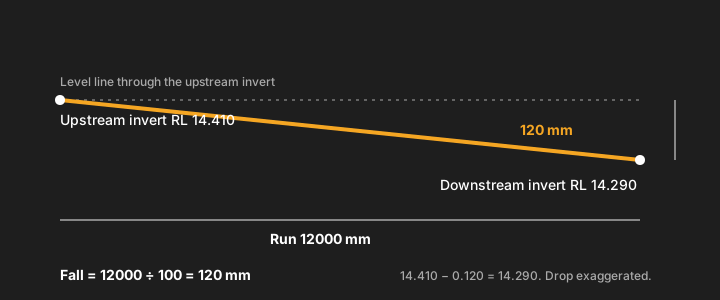
The worked example: 12 m of 100 mm rainwater drain at 1 in 100, the England minimum for that size (see below). Its fall is 12 000 ÷ 100 = 120 mm. If the upstream invert is at RL 14.410 m, the downstream invert is 14.410 − 0.120 = 14.290 m.
What is 1 in 40, 1 in 60, 1 in 80 and 1 in 100 in mm?
1 in 40 is 25 mm per metre, 1 in 60 is 16.7, 1 in 80 is 12.5 and 1 in 100 is 10. Values are run in millimetres ÷ N, rounded to 0.1 mm. Percentage is 100 ÷ N and the angle is arctan(1 ÷ N).
| Fall | Slope (%) | Angle (°) | mm per m | 3 m | 5 m | 8 m | 10 m | 15 m |
|---|---|---|---|---|---|---|---|---|
| 1 in 40 | 2.5 | 1.432 | 25 | 75 | 125 | 200 | 250 | 375 |
| 1 in 60 | 1.7 | 0.955 | 16.7 | 50 | 83.3 | 133.3 | 166.7 | 250 |
| 1 in 80 | 1.25 | 0.716 | 12.5 | 37.5 | 62.5 | 100 | 125 | 187.5 |
| 1 in 100 | 1 | 0.573 | 10 | 30 | 50 | 80 | 100 | 150 |
| 1 in 150 | 0.7 | 0.382 | 6.7 | 20 | 33.3 | 53.3 | 66.7 | 100 |
For a run that is not in the table, divide: 1 in 80 over 11.5 m is 11 500 ÷ 80 = 143.75, so 143.8 mm. More ratios and runs are in how to calculate fall.
What fall do foul drains and sewers need?
In England, Approved Document H recommends a minimum of 1:40 for 75 mm and 100 mm foul drains carrying under 1 litre a second, and flatter minimums for bigger flows. Table 6 gives the flattest gradients:
| Peak flow | Pipe size | Minimum gradient | Over 10 m |
|---|---|---|---|
| Under 1 l/s | 75 mm | 1:40 | 250 mm |
| Under 1 l/s | 100 mm | 1:40 | 250 mm |
| Over 1 l/s | 75 mm | 1:80 | 125 mm |
| Over 1 l/s | 100 mm (at least 1 WC connected) | 1:80 | 125 mm |
| Over 1 l/s | 150 mm (at least 5 WCs connected) | 1:150 | 66.7 mm |
Source: Approved Document H (2015 edition), paragraph 2.34 and Table 6, headed “Recommended minimum gradients for foul drains”. The document is guidance for England, and the pipe size and capacity rules sit alongside these gradients. Checked on 28 October 2026. The last column is worked from the ratio (10 000 ÷ N), not taken from the document.
What fall do rainwater and stormwater drains need?
In England, 75 mm and 100 mm rainwater drains should be laid at not less than 1:100, 150 mm drains at not less than 1:150 and 225 mm drains at not less than 1:225. That is paragraph 3.15 of Approved Document H (2015 edition), which sends larger pipes to BS EN 752-4. Checked on 28 October 2026.
Over 12 m, that is 120 mm for a 100 mm drain, 80 mm for a 150 mm drain and 53.3 mm for a 225 mm drain. The bigger the pipe, the flatter the minimum in that paragraph.
A gutter is not a drain. For the fall on an eaves gutter, see minimum fall for gutters, and for paving, how much fall on a patio.
What fall does a waste pipe need in the UK?
In England, Approved Document H gives branch waste pipes a range, not a single figure: 18 to 90 mm of fall per metre for a WC branch, and 18 to 22, 18 to 44 or 18 to 87 mm per metre for a washbasin or bidet, depending on the pipe’s length and size. That is Table 2, “Common branch discharge pipes (unventilated)”.
- WC branch (100 mm pipe): 18 to 90 mm per metre. On a 3 m branch that is 54 to 270 mm.
- Washbasin or bidet, 1.7 m of 30 mm pipe: 18 to 22 mm per metre, so 30.6 to 37.4 mm over the 1.7 m.
- Washbasin or bidet, 0.7 m of 30 mm pipe: 18 to 87 mm per metre.
The table’s footnote says the WC figure may be reduced to 9 mm per metre on long drain runs where space is restricted, but only if more than one WC is connected. Source: Approved Document H (2015 edition), Table 2. Checked on 28 October 2026.
Can a drainage pipe have too much fall?
Yes. For a branch waste pipe the table above has an upper limit (90 mm per metre for a WC branch), so steeper is not automatically better. For drains, ask the plumber or the pipe maker whether there is a maximum for your pipe. One figure not to mix in: a perforated drainage-field pipe, which the document says should be not steeper than 1:200. That is a different system.
What fall do drains need in Australia and New Zealand?
This page gives no figure, because the figure has to come from the standard. Underground drains in Australia are plumbing work, so the plumbing code and its standards apply, such as AS/NZS 3500. New Zealand drains fall under the NZ Building Code. The fall is set by that standard, the pipe maker and the plumber or certifier, so check the current edition and your council. Eaves gutters are covered separately, in minimum fall for gutters.
How do you work out the level at the far end?
- Work out the total fall: run in millimetres ÷ N. For 12 m at 1 in 100, that is 120 mm.
- Take the upstream invert level, RL 14.410 m.
- Subtract the fall in metres: 14.410 − 0.120 = 14.290 m.
- If the pipe has junctions or pits, do the same for each one, using its distance along the run. A pit 5 m along sits 50 mm lower: 14.360 m.
Keep the levels in metres and the fall in millimetres converted to metres before you subtract. Mixing the two is the usual slip. For the sums behind reduced levels, see how to calculate reduced level.
How do you check the fall on site?
With a dumpy level and staff, read the staff at the invert at each end and at each pit. The higher the invert, the smaller the reading. Using the example above, with a benchmark at RL 15.250 and a staff reading of 1.340 on it, the height of instrument is 16.590 m. The staff should read:
- Upstream invert: 16.590 − 14.410 = 2.180 m.
- Downstream invert: 16.590 − 14.290 = 2.300 m.
If the downstream reading is less than 2.300 m, the pipe is too high there and the fall is short. Check each pit and junction, not only the two ends, because a sag in the middle holds water even when the ends are right. The set-up is in how to use a dumpy level. A string line and a line level work for short runs, but a level and staff is better over 5 m or more.
Doing the sum in MeisterCalc
The app has no “1 in N” field and no drain calculator. The Pitch calculator does the sum: a 1 in 100 fall is a 1% grade.
- Open MeisterCalc and tap Pitch on the home screen.
- Choose the Run + Grade mode.
- Enter the Run: 12000 mm.
- Enter the % Grade: 1.
- The diagram’s Rise label shows 120.0 mm, the fall over that run, and the result card shows % Grade 1.00% and Angle 0.57°.
For another ratio, enter its percentage (100 ÷ N): 2.5 for 1 in 40. Or switch to the Rise + Run mode and read the grade back from Rise 200 with Run 8000: 200 ÷ 8000 = 0.025, so the card shows % Grade 2.50% (1 in 40). The Dumpy Level calculator (Mode A — BM On Ground) works in metres: Benchmark RL 15.250, Staff Reading at BM 1.340 and Staff Reading at Measure 2.180 give a Height of Instrument (HI) of 16.590 and a Measured RL of 14.410 at the point.
What the app doesn’t do
- It doesn’t know what fall a drain needs. It does the sum for the ratio you choose.
- It isn’t a drainage design tool: no pipe sizing, no flow or capacity, and no invert schedule.
- It doesn’t make work compliant with the NCC, AS/NZS 3500, Approved Document H or any other rule. Those, and your local council, decide.
Try it
Pitch and Dumpy Level are among the MeisterCalc calculators that unlock with a weekly subscription that starts with a 3-day free trial, or with a one-time lifetime unlock; Google Play shows the prices in your currency. Concrete, Stairs and Check Square are free. It works offline, on Android 7.0 or later. There’s no iPhone version yet; you can join the iOS waitlist.