What is the stud spacing under NZS 3604?
Published · Updated · By Sai Nath
In New Zealand, stud spacing for a timber-framed building comes from NZS 3604, and the figure depends on your wall: its stud size, height and what it carries. This page doesn't quote a figure. Read the table for your wall in NZS 3604, or ask your designer, then use the count below.
Checked on 28 October 2026. No NZS 3604 figure appears here. A number from memory or from another site would be a guess, and stud spacing is not a place for one.
What is the standard stud spacing in NZ?
There is no single number that applies to every wall. Pages that state one flat figure for every wall skip the questions that decide it. Your plans, or the NZS 3604 table for your wall, give the maximum. Where to look: MBIE Building Performance, B1 Structure and Standards New Zealand. Check on those pages whether the standard is free to read.
What decides stud spacing under NZS 3604?
The standard itself is the authority, so treat this list as the questions to bring to it, not as its content.
- Stud size. A deeper or thicker stud can be spaced differently from a smaller one.
- Wall height. Taller studs buckle more easily.
- What the wall carries. A wall under a roof or a floor above is not the same as a partition.
- The lining. The maker of your plasterboard or cladding publishes its own maximum framing centres.
- Scope. A building that falls outside the standard's scope needs specific design.
What is the spacing for an internal wall?
An internal wall can be loadbearing or not, and that is one of the questions above. This page states no figure for either. Ask your designer which kind each internal wall is, then read the table that applies.
What is dwang spacing, and how far apart are nogs?
Dwang is the New Zealand word for nogs: short horizontal pieces between studs. Their spacing is also set in the standard and by the lining maker, and this page quotes no figure for it. MeisterCalc does not count or space dwangs either. Work them out from the standard, then count the pieces from your own layout.
How do I set out studs once I know the spacing?
Spacing is measured centre to centre, "on centres". Studs = wall length ÷ spacing, rounded up, plus one. The last gap is whatever is left over, so it is usually shorter than the spacing.
| Wall length | Spacing | Working | Studs |
|---|---|---|---|
| 4800 mm | 600 mm | 4800 ÷ 600 = 8, +1 | 9 |
| 4800 mm | 400 mm | 4800 ÷ 400 = 12, +1 | 13 |
| 4900 mm | 600 mm | 4900 ÷ 600 = 8.17, up to 9, +1 (last gap 4900 − 8 × 600 = 100 mm) | 10 |
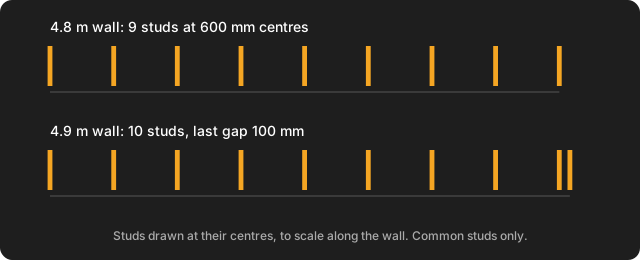
These are common studs along a straight run. Corners, openings and doubled studs come on top. The full method is in how many studs do I need for a wall, the marking in how to mark out studs, and the extras in wall framing calculations.
How does this differ from Australia?
Australia points to AS 1684 instead of NZS 3604, so figures from one country should not be reused in the other. The Australian side is in stud spacing in Australia.
Can MeisterCalc work out stud spacing?
No. It does not know NZS 3604 and enforces no spacing. You type the spacing in, from your plans or the standard.
- Open MeisterCalc and tap Stud Counter.
- Enter Wall Length 4800, On-Centre Spacing 600 and Stud Height 2400. You get Number of Studs 9 and Total Linear 21600.0 mm, as in the box above.
- For the marks, open Running Measurements. Set Start to 0 (marks as centre lines from the end of the plate), Interval to 600 and Number of Marks to 8. Each mark is 0 + n × 600, so the table shows 600.0 mm, 1200.0 mm and on to 4800.0 mm. The Start itself is not in the table, and the Speak button reads the marks aloud.
It counts only a straight run of common studs: no corner or opening studs, dwangs or plates.
Before you build
Spacing, sizes and fixing are set by the NZ Building Code, the standard, your plans and your local council, not by this page or the app. Confirm them with your designer or building consent authority before you order or cut.
Try it
Stud Counter and Running Measurements are not among the three free calculators. Concrete, Stairs and Check Square are free; the other 12 unlock with a weekly subscription that starts with a 3-day free trial, or with a one-time lifetime unlock, and Google Play shows the prices in your currency. It works offline on Android 7.0 or later. There is no iPhone version yet; you can join the iOS waitlist.