The last deck board is too narrow: how do I avoid or fix it?
Published · Updated · By Sai Nath
The last board comes out narrow because the deck width is rarely a whole number of boards plus gaps. Work the sum before you lay: width minus whole boards and gaps is the leftover. Then spread the leftover across all the gaps, if your board maker's gap range allows, or rip the first and last boards to equal widths.
Checked on 28 October 2026. Every figure below was worked by hand in millimetres. No building rule or maker's gap range is stated. Use your board maker's installation guide for the gap.
How do I stop the last deck board being too narrow?
Do the sum on paper before the first board goes down. Let W be the width across the boards, b the board face and g the gap.
- Count whole boards: n = whole number of (W + g) ÷ (b + g), rounded down.
- Find the leftover: L = W − n × b − n × g. That is the space for one more board after n boards and n gaps. Here: 4000 − 42 × 90 − 42 × 5 = 4000 − 3780 − 210 = 10 mm.
- Decide: if L is tiny, spread it across the gaps. If spreading would push the gap past the maker's range, rip the first and last boards instead.
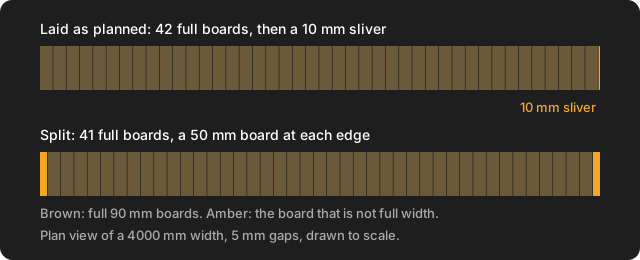
A worked deck: width 4000 mm, boards 90 mm, gap 5 mm. 4000 ÷ 95 = 42.1, so 42 whole boards. Forty-two boards and 41 gaps cover 42 × 90 + 41 × 5 = 3985 mm, leaving 15 mm. After one more 5 mm gap, the 43rd board would be a 10 mm sliver. That is the narrow last board.
Can I change the gap to make it fit?
Yes, if the new gap stays inside your board maker's range. Lay 42 boards with 41 gaps and share the leftover: g = (W − n × b) ÷ (n − 1) = (4000 − 42 × 90) ÷ 41 = 220 ÷ 41 = 5.37 mm. Each gap grows by about 0.37 mm, which nobody can see, and every board stays full width.
The gap is not yours to pick freely. Boards can move with moisture or temperature, so the maker sets a range for each product. This page doesn't give one. Read the installation guide for your boards, and see how big the gap between decking boards should be. If 5.37 mm is outside the range, use the next fix.
Should I rip the first and last boards equally?
Yes, when spreading the gap is not allowed. A matched pair at each edge looks intended, where one thin board looks like a mistake. Lay 43 boards and cut the two edge boards to the same width.
- Face to cover: 4000 − 42 gaps × 5 = 3790 mm.
- 41 full boards: 41 × 90 = 3690 mm.
- What is left: 3790 − 3690 = 100 mm, so each edge board is 50 mm.
Check it adds up: 41 × 90 + 2 × 50 + 42 × 5 = 4000 mm. That is just over half a board each side. No minimum width for a ripped edge board is given here, so treat 50 mm as a practical choice, not a rule. Some makers may have their own limits on cutting boards, so check your installation guide before you rip composite.
How do I rip the last board?
This is site practice, not a rule. Measure the real space at both ends of the board, because a wall or fascia is rarely parallel to the joists. Mark the width, allow for the gap, and cut with the offcut on the waste side. Put the cut edge against the wall or under a fascia or trim, and keep the factory edge facing into the deck. If the two end measurements differ, scribe the board to follow them rather than averaging.
What if the last board is too wide?
The same sum applies. Take a 3950 mm width with the same boards. 3950 ÷ 95 = 41.6, so 41 whole boards. Forty-one boards and 40 gaps cover 41 × 90 + 40 × 5 = 3890 mm, leaving 60 mm. After the gap, a 55 mm board fits.
Spreading the leftover gives g = (3950 − 41 × 90) ÷ 40 = 260 ÷ 40 = 6.5 mm. That is a 1.5 mm increase on every gap, which may be outside the maker's range. If it is, rip both edges: 42 boards and 41 gaps leave 3950 − 205 = 3745 mm of face, 40 full boards take 3600 mm, and the remaining 145 mm gives 72.5 mm on each edge. That is a good outcome, with two edge boards of equal width.
How do I space composite or timber boards evenly?
Pick the gap from the maker's installation guide, then run the sum above. Do not use a gap you remember from a different product. For ordering, how many decking boards you need works the count and lineal metres with the same board and gap.
Why does the last board taper?
If the frame is out of square, the last board is wider at one end than the other, and no gap change fixes that. Check the frame first. The how to square a deck frame guide takes a few minutes with a tape. The joist layout matters too: see how to space deck posts.
What MeisterCalc does here
- The Decking calculator takes Deck Length, Deck Width, Board Width and Board Spacing, and returns boards across rounded up, plus lineal metres. It does not show the last-board width and does not adjust the gap. Use the sum on this page for that.
- Equal Spacings takes an Overall Length and a Target Spacing and returns the Actual Spacing. It treats pieces as points, so it does not give the gap for boards with width. With 4000 mm and a 95 mm target it gives 42 spaces at about 95.2 mm, which is about a 5.2 mm gap, where the formula above gives 5.37 mm. Use the formula.
- Check Square is free and checks your frame before you lay. Decking and Equal Spacings are not among the free calculators.
- Calculations run offline. It is an Android app only, on Android 7.0 or later, with the English interface.
- Rules for decks come from your board maker, the building code that applies to you and the local council, not from the app. The app does not make work compliant.
More on the Decking calculator: decking calculator app.
Questions
What is the narrowest the last board should be?
This page gives no standard minimum. Splitting the leftover between two edge boards keeps both boards wider than one thin sliver and looks deliberate. Ask your board maker if you are unsure.
Do I rip both edges or only the last board?
Rip both when you can. A matched pair looks planned, and each is wider than one thin board.
Does rounding up in the calculator fix this?
No. It counts the sliver as a whole board, which is safe for ordering. The layout on site is still yours to settle.