How do I square a deck frame?
Published · Updated · By Sai Nath
Square the outer frame (the bearers and rim) before you fix any joists. Check that opposite sides are equal, then measure both diagonals from the same point on each corner. Push the two corners at the ends of the longer diagonal together until the diagonals read the same, brace the frame, and measure again.
How to square a deck frame with a tape measure
You need a tape (or laser measure), a string line, clamps or props, a helper and a temporary brace. The method is the same for a ground-level deck and a raised one. For the general method on any frame, see how to check if a frame is square; this page covers what is different on a deck.
- Check opposite sides. Both long sides should be the same length, and both short sides the same. Fix this first, because equal diagonals only prove a right angle when opposite sides match.
- Tack the outer frame together. Use a few nails or screws at the corners, not the final fixings, so the frame can still move.
- Measure the first diagonal from the same point on each corner, for example outside face to outside face, with the tape straight and tight. Write it down.
- Measure the second diagonal from the same points. Write it down.
- Work out the gap. The racking gap is the long diagonal minus the short one. The long diagonal has to come in by half of it.
- Push, then measure again. Push or clamp the two corners at the ends of the longer diagonal towards each other a little at a time, and re-measure both diagonals each time.
- Brace it. When the diagonals match, fix a temporary diagonal brace across the frame, then fix the corners off.
- Fix the joists, then check again before any decking goes down. Joists fixed to a racked frame lock the error in.
Why square the frame before the joists?
The outer frame sets the shape of everything inside it. Joists are cut to a length and fixed at set spacings, so once they are in, moving a corner means undoing fixings. Decking boards run straight across the joists, so a frame that is out of square shows as gaps that taper and board ends that do not line up with the edge. It is much easier to square four sides than a frame full of joists. If you are working out the boards for the finished deck, our guide to how many decking boards you need goes through the sums.
Worked example: a 4800 × 3600 mm frame
The target is the diagonal of a square 4800 × 3600 mm frame: √(4800² + 3600²) = √(23 040 000 + 12 960 000) = √36 000 000 = 6000 mm. In imperial, a 16 × 12 ft frame should measure √(16² + 12²) = √400 = 20 ft.
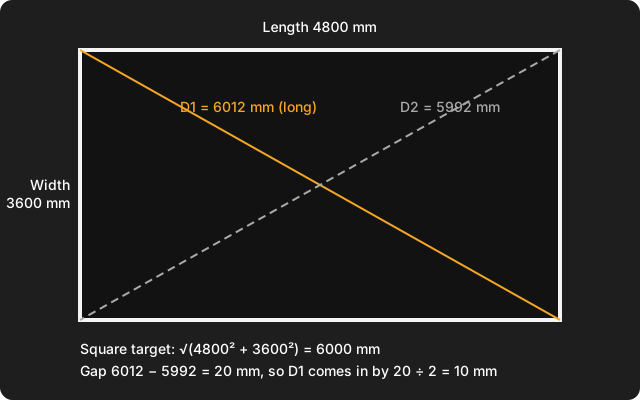
The sides match, and the tape reads 6012 mm on one diagonal and 5992 mm on the other.
| Step | Working | Result |
|---|---|---|
| Racking gap | 6012 − 5992 | 20 mm |
| Long diagonal comes in by | 20 ÷ 2 | 10 mm |
| Both diagonals now read | 6012 − 10 and 5992 + 10 | about 6002 mm |
As a racked frame moves, one diagonal shortens and the other lengthens by about the same amount, so they meet in the middle. If the diagonals now match at 6002 mm, not 6000 mm, the frame is square but a side is slightly long, or the tape was not at exactly the same point on every corner. Measure the sides again. A small gap to the target is a prompt to check the sides, not a reason to keep pushing.
How do I square deck joists?
You square the frame, then set the joists square to it. Mark the joist positions along both bearers from the same end, hold each joist against its marks, and fix it. Check that the joists sit square to the rim, not just evenly spaced. When the last joist is in, measure both diagonals of the whole frame once more. If they have drifted apart, the fixings are pulling the frame, so find which joist moved it before you fix any more.
Deck framing out of square: what do I do?
Work out where the error is before you push anything.
- Diagonals differ, sides match: the frame has racked. Push the long diagonal's corners together as above.
- Diagonals match, sides do not: the frame is a trapezoid. Equal diagonals do not prove it is square, so fix the side lengths first.
- Diagonals match and sides match, but it still looks wrong: check what you measured to. A tape hooked on the outside of one corner and the inside of another reads wrong. Measure again from the same face every time.
- Frame is fixed to something already: posts, a ledger or the house wall may be holding it out. A house wall is not always square or straight, so decide whether the deck must be square to the house or square in itself, and take that from the plans. Square the frame to itself first, then see how it sits against the wall.
How do I square a corner with string and 3-4-5?
When there is no frame yet, set out one corner from a string line. Mark 3 units along one line and 4 along the other, and move the second line until the marks are 5 units apart: 600, 800 and 1000 mm, or 3, 4 and 5 m on a big set-out (600² + 800² = 1,000,000, and √1,000,000 = 1000 mm). It works because 3² + 4² = 5², the smallest whole-number Pythagorean triple (Wikipedia: Pythagorean triple, checked on 28 October 2026). Bigger multiples are more accurate than small ones. Our 3-4-5 rule guide covers it in full. It squares one corner; the diagonal check then proves all four. Setting out the corner posts of a raised deck? How much concrete a post hole needs is the next job.
How do I square a pergola or a shed floor frame?
The maths is identical. A pergola's footprint is a rectangle: set out the post positions, measure both diagonals from the same point on each post, and move them until they match before you fix anything down. A shed floor frame is the same as a deck frame: square the outer frame, brace it, then add the joists, and check again before the sheeting goes on. In both cases, if the footprint is not a plain rectangle, check each rectangle on its own.
How close is close enough?
The tolerance for a particular job comes from the plans, the specification or the builder you are working for. This page doesn't state a figure. MeisterCalc's Check Square calls a frame square when the two diagonals differ by less than 1 mm; that is the app's rule, not a building rule. Building requirements come from the NCC, the NZ Building Code or Approved Documents, and your local council, not from an app.
Doing it in MeisterCalc
Check Square works out the target and the gap from your tape readings, and it is free to use.
- Open Home ▸ Check Square and choose Is It Square?.
- Enter the Length (4800) and Width (3600).
- Enter Diagonal 1 (measured) (6012) and Diagonal 2 (measured) (5992).
- Read the result card: Target Diagonal, both readings, Avg Measured and the Racking gap (20 mm), with the message “Out by … — push long-diagonal corners together”. Push until both diagonals read the same; the long one comes in by half the gap, here 10 mm.
- Enter the new readings until the card shows SQUARE ✓.
Everything is in millimetres by default. For feet and inches, go to Settings ▸ Units ▸ Default units ▸ Imperial (ft/in). Tap the share icon for Share as Text or Share as PDF.
What Check Square doesn't do
- It doesn't measure anything. You take two tape or laser readings, and the answer is only as good as those.
- It checks square, not level or plumb.
- It can't tell you a side is the wrong length. Check the sides first.
- It is for rectangles. Check an L-shaped deck one rectangle at a time.
- The push amount is a guide. Re-measuring both diagonals is the real test.
Try it
Check Square is one of three MeisterCalc calculators that are free to use, with Stairs and Concrete. It works offline, on site with no signal, on Android. There is no iPhone version yet; you can join the iOS waitlist.