How do you measure an angle with a tape measure?
Published · Updated · By Sai Nath
Yes. Mark the same distance, d, along both edges from the corner, then measure the straight line between the two marks. That line is the chord, c. The angle is 2 × asin(c ÷ 2d). With d at 1000 mm, a 90 degree corner gives a chord of 1414 mm and a 45 degree corner gives 765 mm.
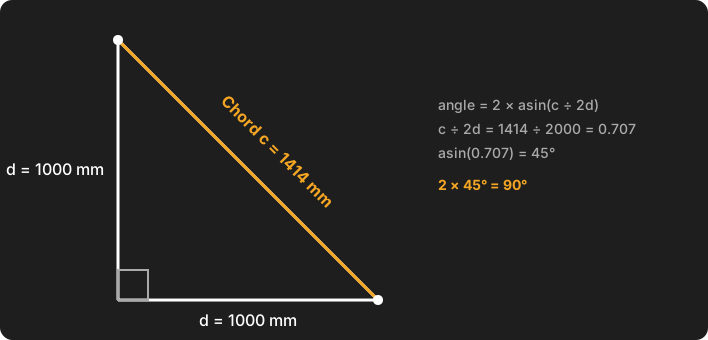
How to measure an angle with a tape
A tape measures lengths, not angles. The trick is to turn the angle into a length. The two marks and the corner make an isosceles triangle with two equal arms (d) and a base (c). The wider the angle, the longer the base. The maths is the standard chord relationship, c = 2d × sin(angle ÷ 2), turned around to give the angle (Chord (geometry), Wikipedia). Checked on 28 October 2026.
- Find the corner. Pick the point where the two edges meet. For a wall corner, use the line where the two wall faces meet.
- Mark d along the first edge. Use 1000 mm if you can. Any length works as long as both marks use the same one. Longer is more accurate.
- Mark the same d along the second edge. Measure from the same corner point, with the tape tight and straight along the edge.
- Measure mark to mark. Hold the tape straight and tight across the gap. This is the chord, c. Write it down.
- Read the angle. With d = 1000 mm, look up c in the table below. For any other d, use angle = 2 × asin(c ÷ 2d) on a scientific calculator.
Chord table: what does the tape read for each angle?
These chords are for d = 1000 mm on each arm. For another d, scale the chord by the same factor: at d = 500 mm every chord is half the figure shown, and at d = 2000 mm it is double. For example, a 90° corner with d = 500 mm reads 2 × 500 × sin 45° = 707.1 mm.
| Angle | Chord c at d = 1000 mm |
|---|---|
| 15° | 261.1 mm |
| 22.5° | 390.2 mm |
| 30° | 517.6 mm |
| 45° | 765.4 mm |
| 60° | 1000.0 mm |
| 75° | 1217.5 mm |
| 90° | 1414.2 mm |
| 120° | 1732.1 mm |
| 135° | 1847.8 mm |
The 60 degree row is the easy one to remember. When the chord equals d, all three sides match and the triangle is equilateral, so every corner is 60°.
How do you measure a 90 degree angle with a tape measure?
Mark 1000 mm on each edge. If the chord reads 1414 mm, the corner is 90°. That figure is 1000 × √2, from Pythagoras: 1000² + 1000² = 2 000 000, and its square root is 1414.2. A longer reading means the corner is open (more than 90°). A shorter one means it is closed.
For a quick pass or fail on a 90 degree corner, the 3-4-5 method is easier to carry in your head: 600 mm along one edge, 800 mm along the other, and the diagonal should read 1000 mm. See the 3-4-5 rule. For a whole frame, comparing both diagonals checks all four corners at once: see how to check if a frame is square.
How do you measure a 45 degree angle with a tape measure?
Mark 1000 mm on each edge. A 45° opening reads 765.4 mm, so about 765 mm. The formula agrees: 2 × 1000 × sin(22.5°) = 765.4. Measure the same way on any opening and compare it with the 45° row. The table also helps with a 22.5° mitre, the angle each piece takes at a corner built from eight pieces.
Worked example: an unknown wall corner
You mark 1000 mm along each wall from the corner and the tape across reads 1250 mm.
- c ÷ 2d = 1250 ÷ 2000 = 0.625.
- asin(0.625) = 38.68°.
- Double it: 2 × 38.68° = 77.4°.
The corner is about 77.4°. In the table, 1250 mm sits between 75° (1217.5) and 90° (1414.2), which agrees.
How do you set out a given angle with a tape?
Read the table backwards. To set out 30°, mark 1000 mm along the first line from the corner point. Then find the second line: from the first mark, swing the tape 517.6 mm, and from the corner swing 1000 mm. Where the two arcs cross is the second mark. A line from the corner through that point is 30° off the first line. Mark the arcs with a pencil at the end of the tape, or use a string and a nail.
Can you get the angle without a formula?
Yes, by halving the chord. Split the isosceles triangle down the middle and you get a right triangle with a hypotenuse of d and a rise of c ÷ 2. The angle in that triangle is half your corner, so double it at the end.
In MeisterCalc, open Home ▸ Triangles and use the Rise + Hyp mode. Enter Rise as half your chord and Hypotenuse as d. For the 90 degree example, that is Rise 707 and Hypotenuse 1000. Angle B comes out at about 45°, and doubling it gives 90°. For the 77.4° wall corner, Rise 625 and Hypotenuse 1000 give Angle B of 38.68°.
Triangles only takes right triangles, so it never sees the original corner. You do the halving and the doubling yourself. For the maths of a right triangle on its own, see the right-angle triangle calculator post and Pythagoras in construction.
If you already have a rise and a run, you don't need a chord at all. The angle of a slope is atan(rise ÷ run), and the Pitch calculator returns it along with the grade: a 1400 mm rise over a 3500 mm run is atan(0.4) = 21.80°, a 40.00% grade. See how to calculate roof pitch.
How accurate is it?
Accuracy comes down to how well you read the tape. With d = 1000 mm, the 90 degree chord is 1414.2 mm. A reading of 1413 mm works out to 89.90°, and 1415 mm to 90.06°. So 1 mm on the chord is worth roughly 0.06 to 0.1 degrees at that length, and the same millimetre is worth less on a longer d. A 2000 mm arm halves the error.
Other things shift the result more than the tape does:
- Arms that aren't the same length. Measure both from the same corner point.
- A tape that sags across the gap. Keep it tight, or measure on a flat surface.
- Edges that aren't straight. A bowed wall or a worn edge gives a different angle depending on where you mark.
For how much error a job can take, see how far out of square is acceptable.
When should you use a bevel or an angle finder instead?
When you need a number you can set a saw to, or a result tighter than a fraction of a degree. A sliding bevel copies an angle directly onto the work with no maths, and a digital angle finder reads it in degrees. The tape method is for when you have only a tape, when the angle is large (a wall corner, a footing) or when you want a check on another tool.
What MeisterCalc doesn't do
- It doesn't measure anything. You take the tape reading, and the answer is only as good as that.
- It has no protractor and no angle finder, and it doesn't take a chord to give an angle. The halving above is done by hand.
- Triangles handles right triangles only, with angles that must be between 0° and 90°.
- It gives no mitre or bevel saw settings.
For squareness, Check Square is one of three free calculators, with Stairs and Concrete. Triangles and Pitch are among the 12 that unlock inside the app. MeisterCalc works offline and is on Android only. There is an iOS waitlist.