How do you calculate the diagonal of a rectangle for a frame or slab?
Published · Updated · By Sai Nath
The diagonal of a rectangle is the square root of length squared plus width squared. For a 4800 × 3600 mm frame, that is √(23,040,000 + 12,960,000) = √36,000,000 = 6000 mm. Square both sides, add them, take the root, and round to the nearest millimetre. On site, both diagonals should read that figure.
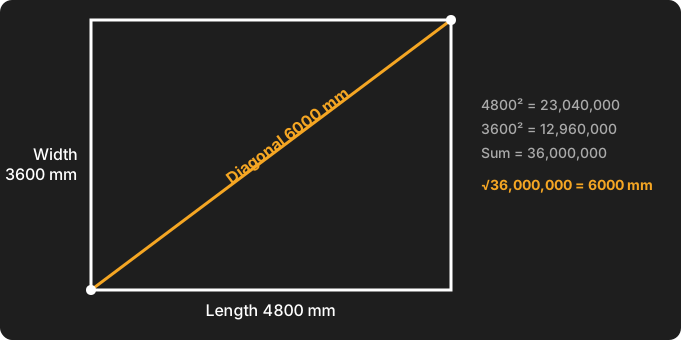
What is the formula for the diagonal of a rectangle?
It is d = √(l² + w²), where l is the length and w is the width (Rectangle, Wikipedia). It works because a diagonal cuts the rectangle into two right-angled triangles, and the diagonal is the longest side of each, the hypotenuse. Pythagoras' theorem says the squares of the two shorter sides add up to the square of the hypotenuse (Pythagorean theorem, Wikipedia). Checked on 28 October 2026.
The same idea sets out a single corner in the 3-4-5 rule: 3² + 4² = 5².
How do I work out the diagonal from the length and width?
- Square the length. 4800 × 4800 = 23,040,000.
- Square the width. 3600 × 3600 = 12,960,000.
- Add them. 23,040,000 + 12,960,000 = 36,000,000.
- Take the square root. √36,000,000 = 6000 mm.
- Round to the nearest millimetre, which is as close as a tape reads.
Use the same unit for both sides. If one is in metres and the other in millimetres, convert first. Here are some common sizes worked the same way:
| Rectangle (length × width) | Diagonal |
|---|---|
| 2400 × 1200 mm (a full sheet) | 2683 mm |
| 3000 × 2400 mm | 3842 mm |
| 3600 × 2700 mm | 4500 mm |
| 4800 × 3600 mm | 6000 mm |
| 6000 × 4000 mm (a slab) | 7211 mm |
In feet and inches the maths is the same: a 16 × 12 ft frame has a √(16² + 12²) = √400 = 20 ft diagonal. Rectangles in the 3:4 ratio, like 4800 × 3600, come out as whole numbers.
How do I find the diagonal from the area?
Area alone isn't enough: many rectangles share one area. You need one side as well. Divide the area by the side you know to get the other, then use the formula. A 17,280,000 mm² slab (17.28 m²) that is 4800 mm long is 17,280,000 ÷ 4800 = 3600 mm wide, so its diagonal is 6000 mm.
How do I measure the diagonal on site?
Hook the tape on the same point at opposite corners and pull it straight and tight. Outside corner to outside corner is easiest. If you can't reach the outside corners, measure between pencil marks set the same distance in from each corner. This is practice, not a rule from a standard: what matters is using the same points on both diagonals, so the two readings are comparable.
What should the two diagonals read?
If the corners are square, both diagonals equal the calculated figure, and equal each other. A quadrilateral whose diagonals are equal and bisect each other is a rectangle (Rectangle, Wikipedia). Checked on 28 October 2026.
A worked example: a 4800 × 3600 mm frame reads 6012 mm on one diagonal and 5988 mm on the other. The target is 6000 mm. The two readings differ by 24 mm, so the frame has racked, and the long diagonal needs to come in by 12 mm to reach 6000 mm. That is half the difference, and the short diagonal grows by about the same.
The calculated diagonal doesn't prove a frame square on its own. Opposite sides must match first, because a frame with sides of different lengths can still have two equal diagonals. The full method, and how far to push, is in how to check if a frame is square. For a table of targets to carry on site, see the square-up diagonal calculator.
Are the diagonals of a rectangle equal?
Yes. Both diagonals of a rectangle have the same length, and they cross at their midpoints (Rectangle, Wikipedia). On a set-out, that midpoint is where the two tapes cross: it sits halfway along each. Checked on 28 October 2026.
Do the diagonals of a rectangle cross at 90 degrees?
Only in a square. A parallelogram whose diagonals are perpendicular is a rhombus, and a rhombus with right angles is a square (Rhombus, Wikipedia). In a 4800 × 3600 mm rectangle the diagonals cross at the midpoint but at an angle other than 90 degrees: 2 × atan(3600 ÷ 4800) = 2 × 36.87° = 73.74° (and 106.26° on the other side). Checked on 28 October 2026.
Doing it in MeisterCalc
- Open MeisterCalc and tap Check Square on the home screen.
- Choose Target Diagonal at the top.
- Enter the Length and Width, for example 4800 and 3600.
- Read the Diagonal in the result card: 6000 mm. A diagram of the rectangle updates as you type.
- To send the numbers on, tap the share icon and choose Share as Text or Share as PDF.
The other mode, Is It Square?, takes your two tape readings and shows how far the frame is out. The Triangles calculator solves any right triangle from two values: enter a base of 3500 and a rise of 1400 and it gives a hypotenuse of 3769.6 mm and angles of 21.8° and 68.2°. Use it when you also want the angle. For the triangle behind a pitch, see how to calculate roof pitch.
Everything is in millimetres by default. For feet, inches and sixteenths, go to Settings ▸ Units ▸ Default units ▸ Imperial (ft/in).
What it doesn't do
- It doesn't measure anything. You still take the tape readings.
- It works out a rectangle's diagonal from length and width only. It has no area input and no 3D (box) diagonal.
- It does no feet-and-inches arithmetic beyond switching the display units.
- Building rules, including how square work must be, come from the National Construction Code (ncc.abcb.gov.au) in Australia, the New Zealand Building Code in New Zealand, and your local council. This page gives no tolerance and MeisterCalc doesn't make work compliant. Checked on 28 October 2026.
Try it
Check Square is one of three MeisterCalc calculators that are free to use, along with Stairs and Concrete. It works offline, on site with no signal, on Android 7.0 or later. Triangles is one of the other 12, which unlock with a weekly subscription that starts with a 3-day free trial, or with a one-time lifetime unlock; Google Play shows the prices in your currency. There's no iPhone version yet; you can join the iOS waitlist.