How many lineal metres of decking are in a square metre?
Published · Updated · By Sai Nath
There is no single answer, because it depends on the board and the gap. Lineal metres per square metre = 1000 ÷ (board face + gap, both in mm). A 90 mm board with a 5 mm gap gives 10.53 m per m². A real deck needs slightly more, because the last board across rounds up to a whole board.
A lineal metre (also written linear metre, and called a running metre) is one metre of board length. The width does not count. That is why a square metre of decking is not a fixed number of lineal metres: wider boards need fewer metres to cover the same area. Checked on 28 October 2026: every figure below was worked by hand, and the deck examples match the formula in MeisterCalc's Decking calculator.
How do I convert m² to lineal metres?
Divide 1000 by the board face plus the gap, both in millimetres. That gives the lineal metres in one square metre of deck.
The reason is simple. Across a 1 m width (1000 mm), each board takes up its face plus one gap. So a metre of width holds 1000 ÷ (board + gap) boards, and each of those boards is 1 m long for a 1 m² patch. For 90 mm boards at a 5 mm gap, that is 1000 ÷ 95 = 10.53. Multiply by the deck area for a first estimate: 18 m² × 10.53 = 189.5 m.
Lineal metres per m² by board face and gap
These are the ideal rates, before any extra for waste. The sizes are examples to show the pattern, not a list of what is sold: check the board width and gap with your supplier or the board maker.
| Board face | 3 mm gap | 4 mm gap | 5 mm gap | 6 mm gap |
|---|---|---|---|---|
| 70 mm | 13.70 | 13.51 | 13.33 | 13.16 |
| 90 mm | 10.75 | 10.64 | 10.53 | 10.42 |
| 140 mm | 6.99 | 6.94 | 6.90 | 6.85 |
| 190 mm | 5.18 | 5.15 | 5.13 | 5.10 |
Each cell is 1000 ÷ (face + gap), rounded to two decimals. For example, 70 mm with a 3 mm gap: 1000 ÷ 73 = 13.70. For a size that is not in the table, do the sum yourself.
Does the gap change the answer?
Yes, but less than the board width does. On a 90 mm board, going from a 3 mm gap to a 6 mm gap drops the figure from 10.75 to 10.42 m per m², a change of about 3%. Going from 90 mm to 140 mm boards cuts it by about a third. The gap you may leave depends on the timber or the board maker's instructions, so take it from them; our guide to the gap between decking boards covers it.
Why does my real deck need more than the table says?
Because boards come whole. The table assumes the boards fit the width exactly. A real deck needs a whole number of boards across, and the last one rounds up. The smaller the deck, the bigger the effect.
Take 90 mm boards at a 5 mm gap, where the ideal rate is 10.53:
- 3 m wide × 6 m long (18 m²): 3000 ÷ 95 = 31.6, so 32 boards across. 32 × 6 = 192 m. That is 10.67 m per m², about 1.3% above the ideal. The estimate was 189.5 m.
- 0.9 m wide × 3 m long (2.7 m²): 900 ÷ 95 = 9.47, so 10 boards across. 10 × 3 = 30 m. That is 11.11 m per m², about 5.6% above the ideal.
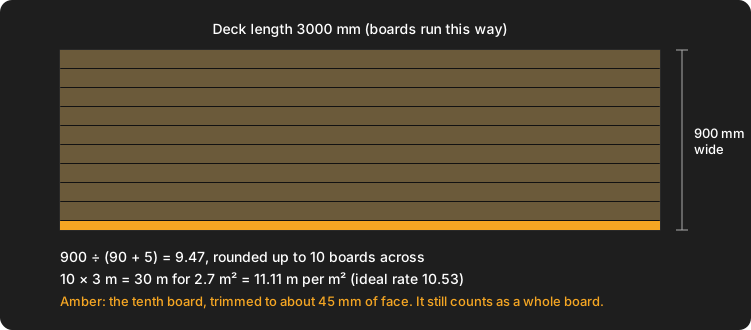
The length cancels out: the real rate depends only on the width, because it is boards across ÷ width in metres. The same 3 m wide deck gives 10.67 whether it is 2 m long or 20 m long. For a quick estimate use the table. For an order, use the next section.
How do I work it out for a real deck?
- Boards across = deck width ÷ (board face + gap), rounded up.
- Lineal metres = boards across × deck length.
- To order = lineal metres plus your allowance for waste.
Example: 6 m long × 4 m wide, 90 mm boards, 5 mm gap. 4000 ÷ 95 = 42.1, so 43 boards across. 43 × 6 = 258 m, which is 24 m² at 10.75 m per m². Add 10% and you order 258 × 1.10 = 283.8 m. The full walk-through is in how many decking boards you need.
One honest note on that example: 42 boards and 41 gaps cover 3985 mm of the 4000 mm, so the 43rd board is a sliver of about 10 mm. In practice a builder would spread the gap slightly or rip the last board rather than fit a 10 mm strip. The calculation still rounds up, which keeps the order on the safe side.
How much extra should I order?
MeisterCalc's Decking calculator shows an Order (+10%) line for end cuts, defects and offcuts, and its help text suggests considering 15% when the deck has many angles. These are the app's own working allowances, not a rule from a standard. Your supplier may advise differently for your boards and layout, so ask them. Waste is a separate step: work out the lineal metres first, then add it.
How do I turn lineal metres into boards?
Divide by the length of the boards you will buy, and round up. Stock lengths vary by supplier, so check what is on offer. For example, 192 m in 5.4 m boards is 192 ÷ 5.4 = 35.6, so 36 boards, if offcuts can be reused. If your deck is longer than one board, the boards join in a row, and you work out boards per row, round up, and multiply by the rows. Where joins may go is set by the frame and the board maker's instructions. The guide to how many decking boards you need covers lengths and offcuts.
How do I go from lineal metres back to m², or price per metre to price per m²?
- Area from lineal metres: lineal metres ÷ lm per m². 100 m of 90 mm board at a 5 mm gap covers 100 ÷ 10.53 = 9.5 m².
- Price per m²: price per lineal metre × lm per m². If boards cost P per metre, 90 mm boards at a 5 mm gap cost P × 10.53 per m² of deck, before waste and before fixings or framing. At 10.00 per metre that is 10.00 × 10.53 = 105.30 per m².
Using the Decking calculator in MeisterCalc
- Open MeisterCalc and tap Decking on the home screen.
- Enter Deck Length, Deck Width, Board Width and Board Spacing.
- Read Total Area, Boards Across, Lineal Metres and Order (+10%).
The calculator works from the deck's real width, so it gives the rounded-up answer, not the per-m² factor. It does not do stock lengths or joins, hidden fixings, joist layout, picture-frame borders or diagonal layouts, and the building rules for a deck come from the board maker, the National Construction Code and the local council, not the app. To check the frame is square before you lay boards, see how to square a deck frame.
Try it
Decking is not one of the three free calculators. Concrete, Stairs and Check Square are free; the other 12, Decking included, unlock with a weekly subscription that starts with a 3-day free trial, or with a one-time lifetime unlock, and Google Play shows the prices in your currency. It works offline on Android 7.0 or later. There is no iPhone version yet; you can join the iOS waitlist. To compare apps, see the decking calculator app guide.