How far should a ladder be from the wall (the 1-in-4 rule)?
Published · Updated · By Sai Nath
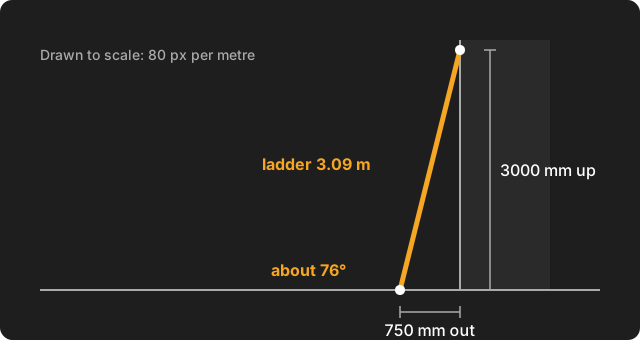
Set the foot of a straight ladder 1 m out from the wall for every 4 m of height to where the ladder touches it. A ladder resting 3 m up has its foot 0.75 m out. That is about 76° from the ground. WorkSafe NZ and SafeWork NSW both give this 1-in-4 ratio.
What does the 1-in-4 rule say?
WorkSafe New Zealand's fact sheet says to “place straight ladders 1m out at the base for every 4m of height for stability” (Safe working with ladders and stepladders, WorkSafe NZ, May 2022). SafeWork NSW says extension ladders “should be angled at a ratio of 1:4”, with the base 1 metre away from the structure for every 4 metres of height (Ladders, SafeWork NSW). Checked on 28 October 2026.
The rule is the regulators' guidance for a stable set-up. Your own regulator, your employer's safe work method and the label on the ladder decide what applies to you.
Is the height the ladder length or the height it reaches?
It is the height to the point where the ladder rests on the wall, not the length of the ladder. Both sources above say “height”. Measure straight up from the ground to the contact point, then divide by 4.
A 5 m ladder set at 1-in-4 reaches about 4.85 m up and stands about 1.21 m out. The working: the ladder is the hypotenuse of a triangle 4 up for every 1 out, so √(4² + 1²) = √17 = 4.123 units long. Height = 5 × 4 ÷ 4.123 = 4.85 m and foot = 5 × 1 ÷ 4.123 = 1.21 m. Dividing the ladder length by 4 would give 1.25 m, which is close but is not the rule as written. The same goes for a 16 ft or 20 ft ladder: work from the height it will reach, not its length. A 16 ft ladder at 1-in-4 reaches 16 × 4 ÷ 4.123 = 15.5 ft with its foot 3.9 ft out, and a 20 ft ladder reaches 19.4 ft with its foot 4.9 ft out.
How far out for a given height?
Divide the height by 4. The last column is the ladder length that fits the set-up: the hypotenuse of the triangle, √(height² + foot²).
| Height to rest point | Foot out from wall | Ladder length at that angle |
|---|---|---|
| 2.4 m (7 ft 10 in) | 0.60 m (2 ft) | 2.47 m |
| 3.0 m (9 ft 10 in) | 0.75 m (2 ft 6 in) | 3.09 m |
| 3.6 m (11 ft 10 in) | 0.90 m (2 ft 11 in) | 3.71 m |
| 4.8 m (15 ft 9 in) | 1.20 m (3 ft 11 in) | 4.95 m |
| 6.0 m (19 ft 8 in) | 1.50 m (4 ft 11 in) | 6.18 m |
The last column is the length that reaches exactly the rest point at that angle, so a real ladder needs to be at least that long. The table is arithmetic, not advice on which ladder to buy.
Worked for the 3.0 m row:
- Foot out: 3000 ÷ 4 = 750 mm.
- Ladder length: √(3000² + 750²) = √(9,000,000 + 562,500) = √9,562,500 = 3092.3 mm.
- Angle from the ground: atan(3000 ÷ 750) = atan(4) = 75.96°.
What angle is 1 in 4?
The angle from the ground is atan(4), which is 75.96°, so about 76°. Many guides round it to 75°. The two agree closely: at 3 m up, 75° puts the foot 3 ÷ tan 75° = 0.80 m out, against 0.75 m for 1-in-4. Both are the same ratio written two ways: height ÷ foot = 4.
To check a set-up you have already made, measure both distances and divide. A ladder resting 3.0 m up with its foot 0.80 m out gives 3.0 ÷ 0.80 = 3.75, which is atan(3.75) = 75.07°. That is a little shallower than 1-in-4, because the foot is 50 mm too far out. A foot 0.60 m out gives a ratio of 5, which is steeper than 1-in-4.
The maths is the same right triangle used for roofs and stairs. Pythagoras in construction covers the length, and how to calculate roof pitch covers rise, run and angle on a roof.
Does the rule work for any ladder?
The WorkSafe NZ line is about straight ladders, and the SafeWork NSW line is about extension ladders. A stepladder is a different case: WorkSafe NZ gives separate tips for stepladders, such as standing no higher than the third step from the top of a straight ladder and avoiding the top two steps of a stepladder. Fixed ladders are also a different topic and this page does not cover them.
What does the rule not cover?
- Where the ladder sits. WorkSafe NZ says to secure the ladder at the top and bottom to stop it slipping sideways or outwards, or, if it cannot be secured, to have a second person foot it after a risk assessment.
- How you climb. WorkSafe NZ asks for three points of contact, no overreaching, and not exceeding the ladder's rated working load. It also says ladders do not protect you from a fall and suit light, short tasks.
- The ladder itself. WorkSafe NZ says ladders should be industrial rated (minimum 120 kg) and meet the relevant AS/NZS 1892 portable ladders standard, and be in good condition before use.
- Everything else a regulator says. Read your own state or national guidance, such as the SafeWork NSW page linked above, WorkSafe NZ in New Zealand, or the HSE in the UK.
A correct angle does not make a set-up safe. It is one of the things to get right.
Working it out in MeisterCalc
MeisterCalc has no ladder calculator. It does the triangle maths, which is all the rule needs. Both calculators below are paid ones.
- For the angle, open Pitch and choose Rise + Run. Enter the height as Rise (3000) and the foot distance as Run (750). It returns the Angle (75.96°), and the Hypotenuse (3092.3 mm), which is the ladder length at that set-up.
- For the foot distance from a height and an angle, open Triangles, choose Rise + ∠A, and enter Rise 3000 with Angle A 75.96 (the angle at the foot of the ladder). It returns Base, the distance out (750.2 mm, a little over 750 because 75.96° is rounded), and Hyp, the ladder length (3092.4 mm).
For a plain check you only need the table above and a tape. The app helps when the height is not a round number. Setting out a right angle on the ground is a different job: see the right-angle triangle calculator page.
Try it
Concrete, Stairs and Check Square are the free calculators. The other 12, including Pitch and Triangles, unlock with a weekly subscription that starts with a 3-day free trial, or with a one-time lifetime unlock. Google Play shows the prices in your currency. It works offline, on Android 7.0 or later. There's no iPhone version yet; you can join the iOS waitlist.