How long should a knee brace be on a pergola?
Published · Updated · By Sai Nath
A knee brace is the diagonal of a right triangle. Square the drop down the post, square the run along the beam, add them and take the square root. At 45° that is the leg × 1.414, so 600 mm legs give 848.5 mm between centre points. The maths does not set the brace's size or fixings.
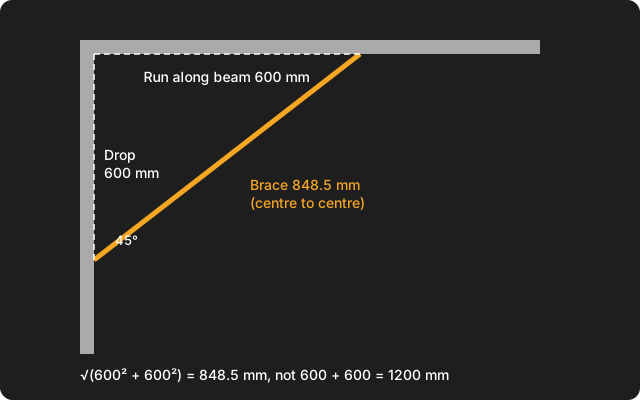
This page is about timber knee braces on a pergola, deck or verandah: the short diagonals between a post and a beam. It is not about the medical product of the same name.
How do I calculate knee brace length from the drop and run?
Work it from two measurements taken on the structure, not from the plan. The formula is Pythagoras: brace = √(drop² + run²). If the idea is new, Pythagoras in construction covers the same maths on four other site jobs.
- Mark the drop. Measure down the post face from the underside of the beam to where the brace will meet it.
- Mark the run. Measure along the underside of the beam, from the post face to where the brace will meet the beam.
- Square both numbers and add them. 600 × 600 = 360,000, twice, is 720,000.
- Take the square root. √720,000 = 848.5 mm. That is the centre-line length, from mark to mark.
- Adjust for the end cuts (next section) to get the length you mark on the timber.
The usual mistake is to add the legs. 600 + 600 = 1200 mm, which is 351 mm too long. The brace is shorter than both legs together, because it cuts the corner.
What is the 45 degree brace length for each leg size?
When the drop and run are equal, the brace is 1.4142 × the leg, so 750 mm legs give 750 × 1.4142 = 1060.7 mm. Centre-line lengths:
| Drop and run | Brace centre-line |
|---|---|
| 450 mm (17.7 in) | 636.4 mm (25.1 in) |
| 600 mm (23.6 in) | 848.5 mm (33.4 in) |
| 750 mm (29.5 in) | 1060.7 mm (41.8 in) |
| 900 mm (35.4 in) | 1272.8 mm (50.1 in) |
If the drop and run differ, the same formula still works. A 600 mm run and a 450 mm drop gives √(360,000 + 202,500) = 750 mm, a 3-4-5 triangle scaled up. The brace then sits at atan(450 ÷ 600) = atan(0.75) = 36.87° from the beam, not 45°.
How do I find the cut length: long point, short point and centre-line?
The 848.5 mm above is the centre-line. Timber has width, so the ends are cut at an angle and the two edges of the brace have different lengths. For a brace cut at 45° to its length, with its centre-line meeting the post face and the beam underside at your two marks, the long edge is centre-line + brace width and the short edge is centre-line − brace width.
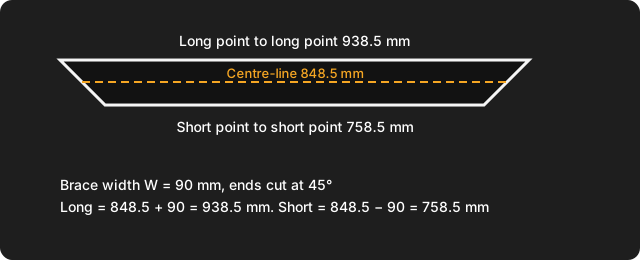
- Long point to long point: 848.5 + 90 = 938.5 mm. Mark this on the timber first.
- Short point to short point: 848.5 − 90 = 758.5 mm. Use it to check the cut.
Each end moves the edge by half the width, and there are two ends. If you notch the brace into the post or beam, or cut a different angle, the allowances change, so cut one brace first and hold it up (see below).
What if the brace is not at 45 degrees?
Use the angle instead. With the run and the angle from the beam: brace = run ÷ cos(angle), and drop = run × tan(angle). For a 900 mm run at 30°, the brace is 900 ÷ 0.866 = 1039.2 mm and the drop is 519.6 mm. For a bigger structure, 3500 mm along and 1400 mm down gives √(3500² + 1400²) = √14,210,000 = 3769.6 mm at atan(1400 ÷ 3500) = 21.8° from the beam. The same triangle maths gives rafter length from pitch.
How do I check it on site?
- Measure the drop and run from the same two marks you will fix to, not from the drawing.
- Check the post and beam are square first, as in how to square a deck frame. A brace cut for a corner that is not 90° will not sit right.
- Cut one brace, hold it in place and check both ends against the marks.
- Use it as the template for the rest. This is practice, not a rule: it saves cutting timber twice.
Doing it in MeisterCalc
The Triangles calculator does the square root for you. It takes any two values, one of them a length, and gives the rest.
- Open MeisterCalc and tap Triangles on the home screen.
- Enter Base (the run along the beam) and Rise (the drop down the post). Choose the Base + Rise mode in the mode picker, then enter 600 and 600.
- Read Hyp: 848.5 mm. That is the brace's centre-line. Angle A and Angle B show 45.000°.
- If you know the angle instead, enter the Base and Angle A, or the Rise and an angle, and read Hyp.
Triangles is not one of the free calculators. Check Square is free and, in its Target Diagonal mode, gives a rectangle's diagonal from the Length and Width, which is the same sum for equal legs: enter 600 and 600 and read the Diagonal, 848.5 mm. Both work offline, on Android. Switch to feet and inches in Settings ▸ Units ▸ Default units ▸ Imperial (ft/in).
What the maths cannot tell you
- It does not give the brace's section (width and thickness), its maximum length, the spacing of braces or the fixings. Those come from the engineer's detail, the span tables for your structure or your local council.
- It does not say whether you need braces. Ask the engineer or the council.
- The app gives the centre-line only. It does not work out the long point and short point, and it has no template.
- Building rules in Australia are in the National Construction Code, produced by the Australian Building Codes Board for the Australian, state and territory governments (Checked on 28 October 2026). New Zealand and the UK have their own codes. Nothing in the app or this page makes work compliant.
Questions people ask
What angle should a knee brace be?
Many are set at 45°, with equal drop and run, because it is easy to mark. This page gives no required angle, so take it from the detail for your structure.
Can I use a metal bracket instead?
Brackets exist, and their sizes come from the maker's published sheet. The brace-length sum above only applies to a timber diagonal.
Try it
MeisterCalc is a construction calculator for Android with 15 calculators, built metric-first. Concrete, Stairs and Check Square are free; the rest unlock through Google Play. There is no iPhone version yet.